Is There A Simple Solution To The Fermi Paradox?
TL;DR
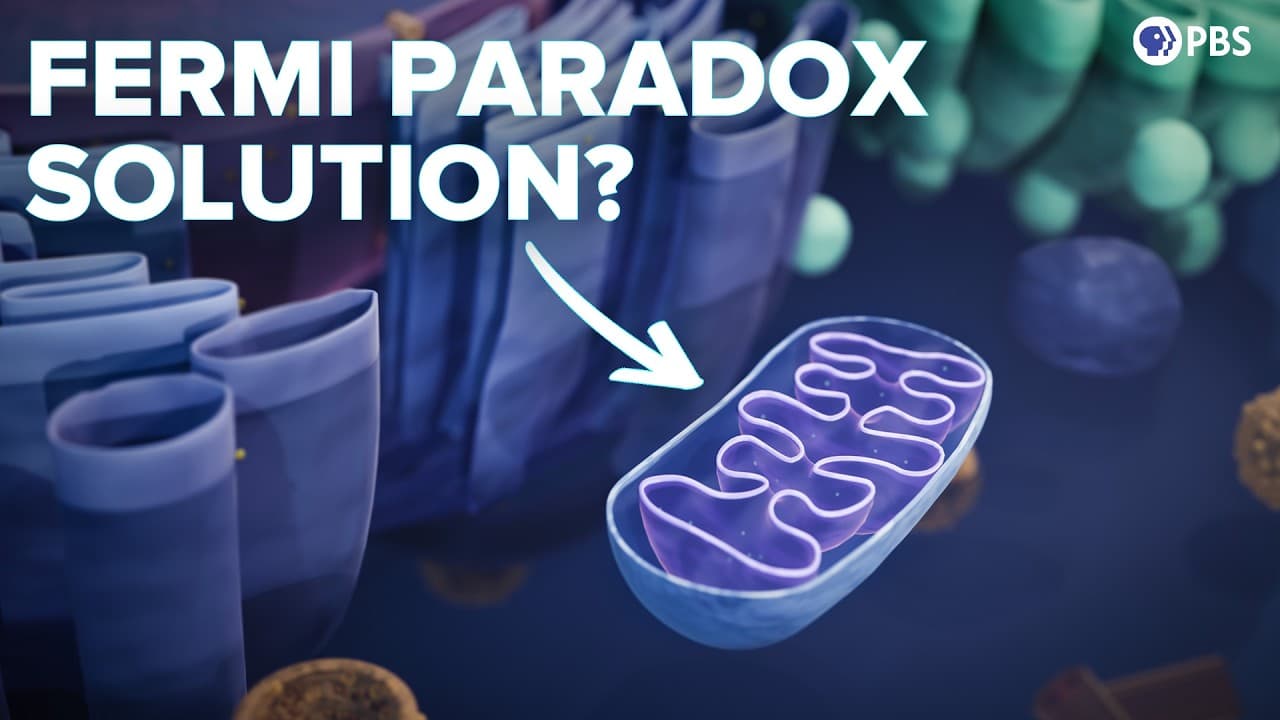
Eukaryote evolution may explain the Fermi Paradox's 'Great Filter'.
Transcript
thank you to Novium the team behind the Hover Pen for supporting PBS around two billion years ago life had plateaued in complexity ruined the atmosphere and was on the verge of self annihilation but then something strange and potentially extremely lucky happened that enabled endless new evolutionary paths the first Ukariote cell was born this may a... Read More
Key Insights
- The Fermi Paradox questions why we haven't detected alien life despite the vast number of potentially habitable planets.
- The 'Great Filter' theory suggests a rare event prevents civilizations from reaching a galaxy-spanning stage.
- Eukaryote cells, which allowed complex life, may have been a rare fluke, acting as a Great Filter.
- The first eukaryote cell emerged around two billion years ago, enabling new evolutionary paths.
- A symbiotic relationship between an archaea and a bacterium led to the formation of mitochondria.
- This symbiosis overcame energetic and computational limits, allowing complex life to thrive.
- Gene and protein length studies suggest an algorithmic shift in DNA regulation coincided with eukaryote emergence.
- If eukaryogenesis is a rare event, many planets may host only simple life forms, explaining the Great Silence.
Install to Summarize YouTube Videos and Get Transcripts
Explore YouTube Video Summarizer or Get YouTube Transcript Extractor
Questions & Answers
Q: What is the Fermi Paradox?
The Fermi Paradox is the apparent contradiction between the high probability of extraterrestrial life existing in the universe and the lack of evidence for or contact with such civilizations. Despite the vast number of potentially habitable planets, we have not detected any signs of advanced alien life, leading scientists to question why this is the case.
Q: What is the 'Great Filter' theory?
The 'Great Filter' theory proposes that there is a stage in the evolution of life that is extremely difficult to surpass, preventing civilizations from reaching an advanced, galaxy-spanning stage. This filter could be a rare event or series of events that most civilizations fail to overcome, explaining why we have not encountered any advanced alien life despite the vast number of potentially habitable planets.
Q: Why is the emergence of eukaryote cells significant?
The emergence of eukaryote cells was a significant evolutionary milestone because it allowed for the development of complex life forms. Eukaryotes overcame energetic and computational limitations that had previously capped the complexity of life. This event enabled the evolution of larger genomes and more complex cellular machinery, leading to the diversity of life we see today. It is considered a potential Great Filter due to its rarity and impact on life's complexity.
Q: How did mitochondria form in eukaryote cells?
Mitochondria formed in eukaryote cells through a process called endosymbiosis, where an archaea cell absorbed a bacterium. Instead of being digested, the bacterium survived and thrived inside the host cell, providing it with a new source of energy through aerobic respiration. Over time, the two organisms became symbiotic, with the bacterium evolving into mitochondria, which are now essential for energy production in eukaryotic cells.
Q: What role did gene and protein length play in eukaryote evolution?
Gene and protein length studies reveal that during eukaryote evolution, gene lengths continued to grow while protein lengths capped at around 500 amino acids. This decoupling indicates an algorithmic phase transition in DNA regulation, where non-coding DNA began to play a significant role in regulating gene expression. This shift allowed for more efficient protein transcription and greater complexity, supporting the idea that eukaryogenesis was a critical evolutionary event.
Q: What is the significance of the algorithmic phase transition in DNA regulation?
The algorithmic phase transition in DNA regulation marked a shift from protein-dependent gene regulation to a more efficient operating system involving non-coding DNA. This transition allowed for improved regulation of gene expression and protein transcription, enabling life to explore a broader space of protein functions and adapt to environmental changes more effectively. This shift coincided with the emergence of eukaryote cells, suggesting it was a crucial factor in the evolution of complex life.
Q: How does eukaryogenesis relate to the Fermi Paradox?
Eukaryogenesis, the emergence of eukaryote cells, may relate to the Fermi Paradox as a potential Great Filter. If the formation of eukaryotes was a rare and improbable event, many planets may host only simple life forms, unable to evolve into complex, intelligent civilizations. This could explain the Great Silence observed in the universe, where we have not detected signs of advanced alien life despite the high probability of its existence.
Q: What might the universe look like if eukaryogenesis is a Great Filter?
If eukaryogenesis is a Great Filter, the universe may be filled with planets hosting only simple life forms, such as prokaryotes, that never evolve into complex, intelligent civilizations. These planets might have atmospheres modified by simple life but lack the diversity and complexity seen on Earth. This scenario would mean that the cataclysmic or developmental bottleneck preventing advanced civilizations is already behind us, giving humanity a unique opportunity to expand and thrive in the universe.
Summary & Key Takeaways
-
The emergence of the first eukaryote cell was a pivotal moment in Earth's history, potentially explaining the Fermi Paradox. This event allowed for complex life to evolve by overcoming energetic and computational limitations, possibly acting as a Great Filter that many planets fail to pass.
-
The integration of mitochondria into archaea cells marked a significant evolutionary leap, enabling larger genomes and complex life forms. This endosymbiotic event may have been a rare occurrence, suggesting that many planets may only host simple life forms, contributing to the Great Silence observed in the universe.
-
Studies on gene and protein lengths indicate an algorithmic phase transition in DNA regulation around the time eukaryotes emerged. This shift allowed for more efficient protein transcription and complexity, supporting the hypothesis that eukaryogenesis was a critical and rare event in evolutionary history.
Read in Other Languages (beta)
Share This Summary 📚
Summarize YouTube Videos and Get Video Transcripts with 1-Click
Try YouTube Summary with ChatGPT & Claude or YouTube Transcript Generator
Explore More Summaries from PBS Space Time 📚

Summarize YouTube Videos and Get Video Transcripts with 1-Click
Try YouTube Summary with ChatGPT & Claude or YouTube Transcript Generator