How to Graph Polynomial Functions Using End Behavior
TL;DR
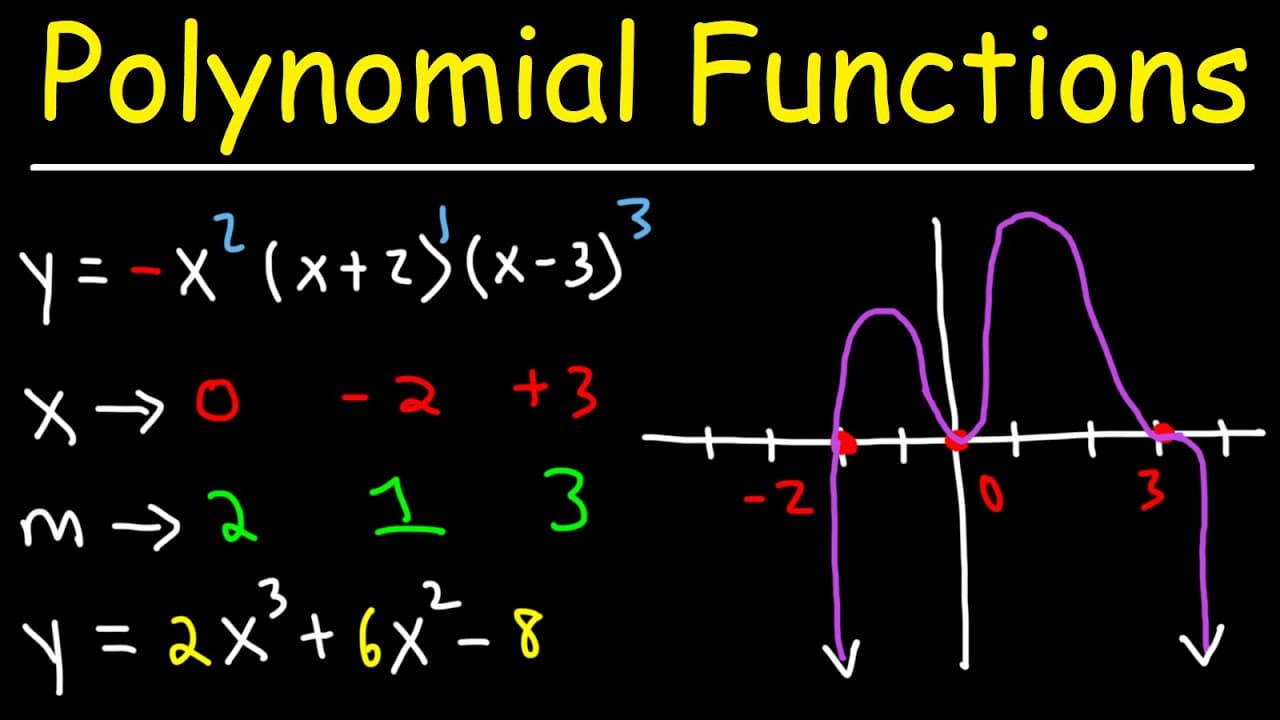
To graph polynomial functions, analyze the end behavior determined by the degree and leading coefficient. Even functions with a positive leading coefficient rise on both sides, while odd functions with a positive coefficient fall on the left and rise on the right. Additionally, the multiplicity of zeros affects how the graph interacts with the x-axis, with a multiplicity of 1 crossing, 2 bouncing, and 3 crossing with a horizontal tangent.
Transcript
in this video we're going to talk about how to graph polynomial functions using things such as end behavior multiplicity and even finding the zeros so let's begin by taking down some notes first let's begin our discussion with the graph of y equals positive x squared so this is an even function with a degree of two even functions are symmetrical ab... Read More
Key Insights
- 🙃 The end behavior of a polynomial function with an even degree and a positive leading coefficient is up on both sides.
- 🙃 The end behavior of a polynomial function with an even degree and a negative leading coefficient is down on both sides.
- ↔️ The end behavior of a polynomial function with an odd degree and a positive leading coefficient is down on the left and up on the right.
- ↔️ The end behavior of a polynomial function with an odd degree and a negative leading coefficient is up on the left and down on the right.
- ☺️ The behavior of the graph near an x-intercept depends on the multiplicity of the zero.
- 🫰 A multiplicity of 1 for an x-intercept results in a straight line crossing the x-axis.
- ☺️ A multiplicity of 2 for an x-intercept results in the graph touching or bouncing on the x-axis.
- 🫰 A multiplicity of 3 for an x-intercept results in the graph crossing the x-axis with a horizontal tangent.
Install to Summarize YouTube Videos and Get Transcripts
Explore YouTube Video Summarizer or Get YouTube Transcript Extractor
Questions & Answers
Q: How can you describe the end behavior of an even function with a positive leading coefficient?
Even functions with positive leading coefficients have a symmetrical graph and end behavior going up on both sides. As x approaches positive or negative infinity, the y-values increase towards positive infinity.
Q: What happens to the end behavior of a graph if the leading coefficient is negative?
If the leading coefficient of an even function is negative, the end behavior will be down on both sides. The y-values decrease as x approaches positive or negative infinity.
Q: How can you describe the end behavior of an odd function with a positive leading coefficient?
Odd functions with positive leading coefficients have end behavior going down on the left and up on the right. As x approaches negative infinity, the y-values become more negative, and as x approaches positive infinity, the y-values increase towards positive infinity.
Q: What is the difference between the end behavior of a polynomial with an odd degree and a negative leading coefficient compared to a positive leading coefficient?
For polynomials with odd degrees, the end behavior alternates based on the leading coefficient. If the leading coefficient is positive, the end behavior starts with down and goes up. If the leading coefficient is negative, the end behavior starts with up and goes down.
Summary & Key Takeaways
-
Polynomial functions can be graphed using concepts like end behavior, multiplicity of zeros, and the leading coefficient.
-
Even functions with positive leading coefficients have a symmetrical graph, with end behavior going up on both sides.
-
Odd functions with positive leading coefficients have end behavior going down on the left and up on the right.
Read in Other Languages (beta)
Share This Summary 📚
Summarize YouTube Videos and Get Video Transcripts with 1-Click
Try YouTube Summary with ChatGPT & Claude or YouTube Transcript Generator
Explore More Summaries from The Organic Chemistry Tutor 📚



Summarize YouTube Videos and Get Video Transcripts with 1-Click
Try YouTube Summary with ChatGPT & Claude or YouTube Transcript Generator