The Useless Number - Numberphile
TL;DR
Exploring the historical challenges and solutions of cubic polynomials, including the introduction of imaginary numbers.
Transcript
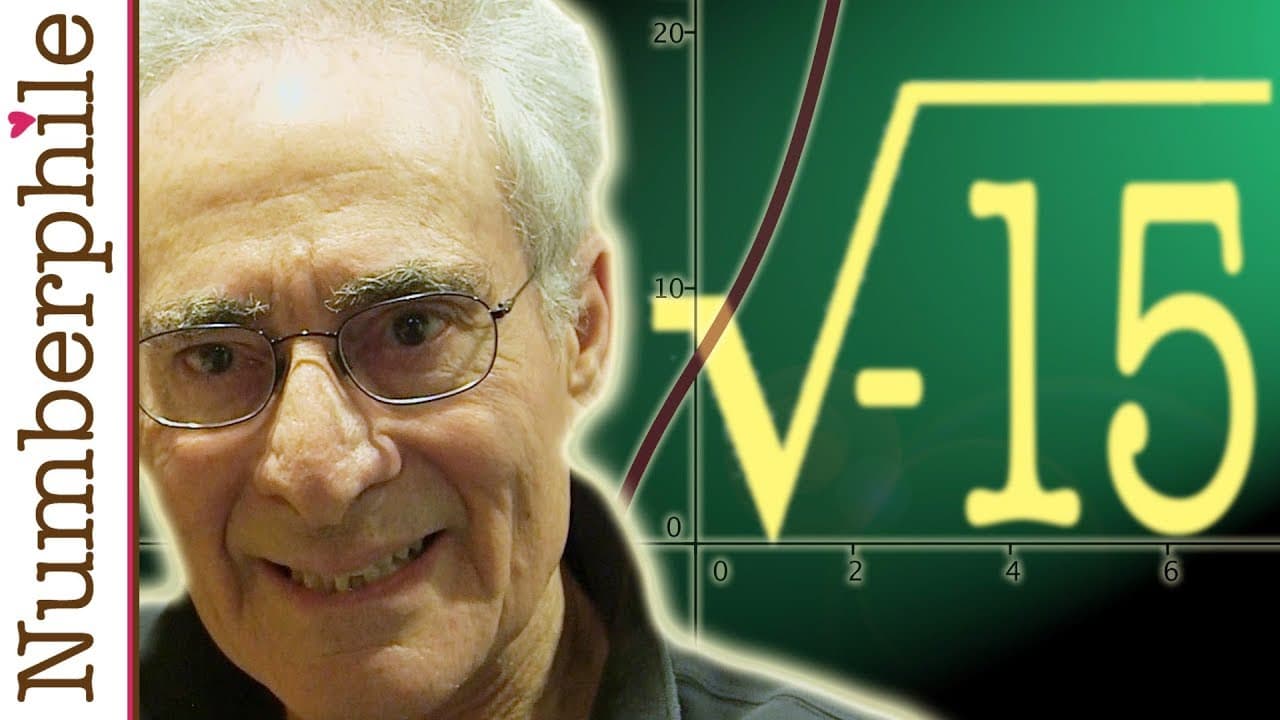
Well, I'm going to bring you back to the sixteenth century first. The Italians, especially, were interested in cubic polynomials x cubed plus, oh, five x plus seven, something of that sort Now I'll draw you the graph of any of these cubic polynomials That is to say I'll draw it qualitatively. Unless you're particularly perverse in your choice of c... Read More
Key Insights
- 🥺 Cubic polynomials in the 16th century led to the development of formulas for their solutions.
- 🎁 The number of solutions to cubic polynomials can be one or three, presenting different levels of complexity.
- #️⃣ The introduction of imaginary numbers for solving cubic equations perturbed mathematicians, shifting their understanding of numbers.
- 😒 Cardano's use of imaginary numbers, like the square root of minus 15, showcased the complexity and novelty of dealing with these mathematical concepts.
- 🦻 Understanding the behavior of cubic polynomials graphically aided in comprehending their solutions and characteristics.
- ❓ The historical context of the 16th century highlights the challenges and advancements in mathematics, specifically regarding cubic polynomials.
- #️⃣ The transition to using imaginary numbers in mathematics required mathematicians to venture into unfamiliar, complex territories of number theory.
Install to Summarize YouTube Videos and Get Transcripts
Explore YouTube Video Summarizer or Get YouTube Transcript Extractor
Questions & Answers
Q: How did Italians in the 16th century study cubic polynomials?
Italians in the 16th century studied cubic polynomials qualitatively, graphing them to observe patterns like maxima, minima, and variations in solutions.
Q: What is the significance of understanding the number of solutions to cubic polynomials?
Understanding the number of solutions to cubic polynomials aids in determining the complexity of the mathematical problem and the techniques required for its solution.
Q: Why were mathematicians perturbed by the introduction of imaginary numbers for solving cubic equations?
Mathematicians in the 16th century were perturbed by the use of imaginary numbers as it delved into a mathematical realm unfamiliar to them, challenging their conventional understanding of numbers.
Q: How did Cardano handle the challenge of using imaginary numbers in solving equations?
Cardano utilized imaginary numbers, such as the square root of minus 15, to solve equations, acknowledging the subtlety and uniqueness of these numbers despite their perturbing nature to mathematicians of the time.
Summary & Key Takeaways
-
In the 16th century, Italians delved into cubic polynomials, graphing them qualitatively to understand their characteristics like maxima and minima.
-
The solutions to cubic polynomials vary, with some having one solution while others may have three solutions.
-
The introduction of imaginary numbers for solving cubic polynomials perturbed mathematicians in the 16th century.
Read in Other Languages (beta)
Share This Summary 📚
Summarize YouTube Videos and Get Video Transcripts with 1-Click
Try YouTube Summary with ChatGPT & Claude or YouTube Transcript Generator
Explore More Summaries from Numberphile 📚





Summarize YouTube Videos and Get Video Transcripts with 1-Click
Try YouTube Summary with ChatGPT & Claude or YouTube Transcript Generator