How Do CPUs Execute Instructions Efficiently?
TL;DR
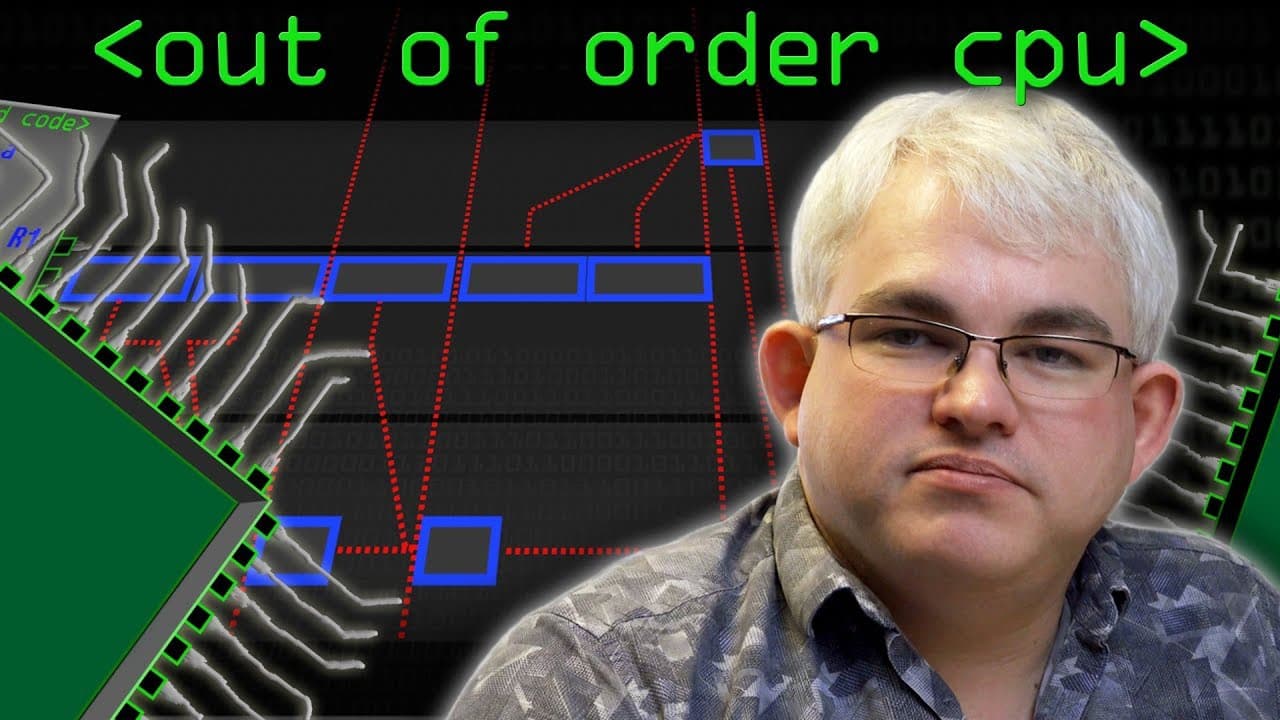
CPUs convert high-level code into machine code before execution, revealing intricate processes of instruction handling. By reordering these instructions, modern superscalar CPUs can exploit parallelism, allowing multiple instructions to be executed simultaneously. However, approaches like speculative execution, while enhancing performance, also introduce potential security concerns.
Transcript
Things we talked about a spectrum meltdown and they rely on some of the more advanced ways that the CPU operates It's probably worth diving down and actually looking at how a CPU actually executes the code be right I mean, we've touched on this before we did a video on pipelining we did a video on caching, but also delve down and see What happens b... Read More
Key Insights
- 👨💻 CPUs convert high-level code into machine code before executing it.
- 🪈 In the execution process, CPUs follow a sequential order of instructions, but superscalar CPUs can exploit parallelism and execute multiple instructions simultaneously.
- 🇦🇪 Load/store units and ALUs are separate units in a CPU that handle memory operations and mathematical/logical operations.
- 🍉 Speculative execution, while improving performance, poses risks and challenges in terms of security vulnerabilities.
Install to Summarize YouTube Videos and Get Transcripts
Explore YouTube Video Summarizer or Get YouTube Transcript Extractor
Questions & Answers
Q: How does a CPU execute code?
When a CPU receives code written in a high-level language, it first converts it into machine code through a compiler. The CPU then executes the machine code instructions one by one, performing calculations, memory operations, and logic operations.
Q: What is the difference between load/store units and ALUs in a CPU?
Load/store units are responsible for fetching data from memory and storing data back into memory. ALUs, on the other hand, perform mathematical operations like addition and subtraction. They are separate units within a CPU and can work independently of each other.
Q: How can a superscalar CPU improve instruction execution?
Superscalar CPUs have multiple execution units, allowing them to execute multiple instructions simultaneously. By analyzing the dependencies between instructions, the CPU can reorder them to maximize parallel execution and improve overall performance.
Q: What are some challenges or risks associated with speculative execution in CPUs?
Speculative execution, where the CPU predicts and executes instructions before it is certain they are needed, can introduce security vulnerabilities. Techniques like Spectre and Meltdown have exploited the side effects of speculative execution, leading to security breaches.
Summary & Key Takeaways
-
This content delves into the complex process of how a CPU executes code by using a simple line of code as an example.
-
It explains how the code is converted into machine code, and then the CPU executes the machine code instructions.
-
The content highlights the sequential execution of instructions and explores the potential for parallel execution in superscalar CPUs.
Read in Other Languages (beta)
Share This Summary 📚
Summarize YouTube Videos and Get Video Transcripts with 1-Click
Try YouTube Summary with ChatGPT & Claude or YouTube Transcript Generator
Explore More Summaries from Computerphile 📚



Summarize YouTube Videos and Get Video Transcripts with 1-Click
Try YouTube Summary with ChatGPT & Claude or YouTube Transcript Generator