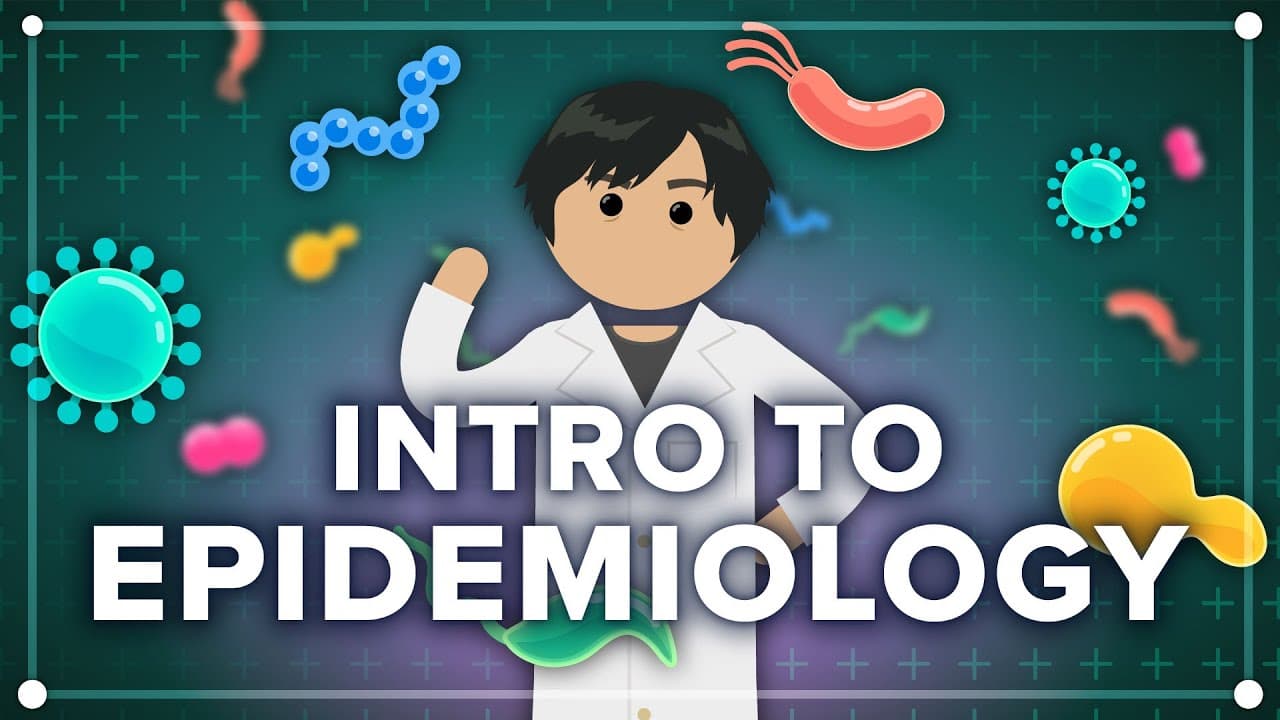
Intro to Epidemiology: Crash Course Public Health #6
TL;DR
Epidemiology is the study of patterns, causes, and control of diseases within populations, providing insights into both infectious and non-infectious diseases.
Transcript
in 2014 an outbreak of the deadly virus ebola was spreading across guinea a country in west africa the outbreak had started in a small village but spread rapidly by the time health officials were able to end the outbreak over two years later there had been more than 11 000 deaths associated with the virus the ebola outbreak is a classic example of ... Read More
Key Insights
- 🧑⚕️ Epidemics can manifest as viral outbreaks or widespread health conditions, such as nearsightedness.
- 🥰 Epidemiology encompasses the study of infectious and non-infectious diseases, including cancer, heart disease, and environmental factors.
- 🧑🏭 Epidemiologists act as detectives, investigating disease patterns, causes, and societal factors that contribute to health inequalities.
- ❓ Data interpretation is crucial in epidemiology, as correlation does not imply causation.
- 👨🔬 Collaborative efforts and interdisciplinary research contribute to our understanding of disease causation.
- ❓ Experimental and observational studies are essential methods used by epidemiologists to gather evidence.
- 🖐️ Epidemiologists play a vital role in responding to health emergencies and developing interventions to prevent disease spread.
Install to Summarize YouTube Videos and Get Transcripts
Explore YouTube Video Summarizer or Get YouTube Transcript Extractor
Questions & Answers
Q: What is epidemiology and why is it important in public health?
Epidemiology is the study of disease patterns, causes, and control in populations. It is crucial in public health as it helps identify risk factors, track diseases, and develop interventions to prevent and control the spread of diseases.
Q: How do epidemiologists investigate and solve health mysteries?
Epidemiologists follow a scientific process, formulating hypotheses and conducting studies to evaluate their hypotheses. They may use experimental studies (exposing participants to interventions) or observational studies (observing populations already exposed to a specific factor) to gather evidence and draw conclusions.
Q: How did the British Doctors Study contribute to our understanding of the link between smoking and lung cancer?
The British Doctors Study, conducted by Richard Doll and Austin Bradford Hill, observed a strong association between heavy smoking and lung cancer. It provided significant evidence connecting smoking to various cancer types, which led to important public health interventions and policies.
Q: How do epidemiologists interpret data and determine causal relationships?
Epidemiologists rely on various pieces of evidence, including historical studies, animal research, and chemical analyses, to interpret data. They also use tools like the Bradford Hill criteria, which establishes evidence of a causal relationship. Mathematical models, such as the Rothman causal pie, help understand how different risk factors contribute to disease development.
Key Insights:
- Epidemics can manifest as viral outbreaks or widespread health conditions, such as nearsightedness.
- Epidemiology encompasses the study of infectious and non-infectious diseases, including cancer, heart disease, and environmental factors.
- Epidemiologists act as detectives, investigating disease patterns, causes, and societal factors that contribute to health inequalities.
- Data interpretation is crucial in epidemiology, as correlation does not imply causation.
- Collaborative efforts and interdisciplinary research contribute to our understanding of disease causation.
- Experimental and observational studies are essential methods used by epidemiologists to gather evidence.
- Epidemiologists play a vital role in responding to health emergencies and developing interventions to prevent disease spread.
- Mathematical models, like the Rothman causal pie, aid in understanding how multiple risk factors combine to produce specific health outcomes.
Summary & Key Takeaways
-
In 2014, an Ebola outbreak in Guinea served as a classic example of an epidemic, resulting in over 11,000 deaths in two years.
-
Epidemiology is the science of studying disease patterns, causes, and control in populations.
-
Epidemiologists use data, math, and research methods to understand the spread and impact of diseases.
Read in Other Languages (beta)
Share This Summary 📚
Summarize YouTube Videos and Get Video Transcripts with 1-Click
Try YouTube Summary with ChatGPT & Claude or YouTube Transcript Generator
Explore More Summaries from CrashCourse 📚




Summarize YouTube Videos and Get Video Transcripts with 1-Click
Try YouTube Summary with ChatGPT & Claude or YouTube Transcript Generator