What's the Difference between Mass Number and Atomic Weight?
TL;DR
Mass number refers to the total number of protons and neutrons in an atom, while atomic weight is the average mass of all the different isotopes of an element.
Transcript
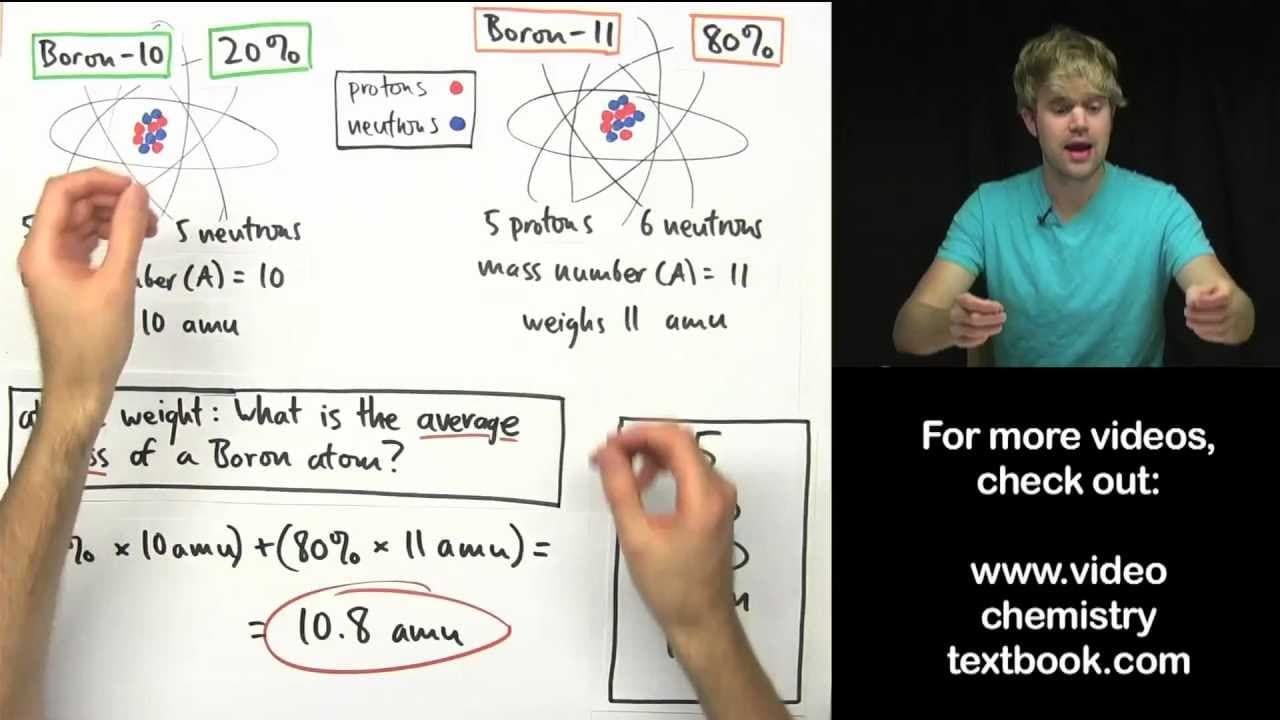
let's talk about mass number and atomic weight these things can seem very similar but they're actually quite different so up here I got two atoms and I'm particularly interested in the number of protons and neutrons that are in the nucleus of both these atoms so the protons are in red the neutrons are in blue we could count them up the atom over he... Read More
Key Insights
- 🫀 Mass number is the sum of protons and neutrons and determines the weight of an individual atom.
- 🫀 Atomic weight takes into account the different isotopes of an element and their proportions.
- #️⃣ Isotopes are different versions of an element with the same number of protons but differing numbers of neutrons.
- 💆 The average mass of an element can be calculated using the proportions of its isotopes.
- 🫀 Atomic weight is indicated by the number displayed on the periodic table.
- 💆 The formula for the average mass of an element considers the different isotopes and their percentages.
- 💆 The average mass of an element might be closer to the mass of the isotope with the higher percentage.
Install to Summarize YouTube Videos and Get Transcripts
Explore YouTube Video Summarizer or Get YouTube Transcript Extractor
Questions & Answers
Q: What does the mass number of an atom represent?
The mass number is the sum of the protons and neutrons in an atom, which determines its weight in atomic mass units (AMU).
Q: What is the difference between mass number and atomic weight?
Mass number refers to an individual atom or isotope, while atomic weight takes into account the different isotopes of an element and their proportions.
Q: How do isotopes differ from each other?
Isotopes have the same number of protons but vary in the number of neutrons, resulting in different mass numbers.
Q: How is atomic weight calculated?
Atomic weight is calculated by multiplying the percentage of each isotope by its respective mass number and summing the results.
Summary & Key Takeaways
-
Mass number is the sum of protons and neutrons in an atom, determining its weight in atomic mass units (AMU).
-
Atomic weight takes into account the different isotopes of an element and their proportions to calculate the average mass of the atoms.
-
Isotopes are different versions of an element that have the same number of protons but differ in the number of neutrons.
Read in Other Languages (beta)
Share This Summary 📚
Summarize YouTube Videos and Get Video Transcripts with 1-Click
Try YouTube Summary with ChatGPT & Claude or YouTube Transcript Generator
Explore More Summaries from Tyler DeWitt 📚

Summarize YouTube Videos and Get Video Transcripts with 1-Click
Try YouTube Summary with ChatGPT & Claude or YouTube Transcript Generator