Worked example: Finding the percent ionization of a weak acid | AP Chemistry | Khan Academy
TL;DR
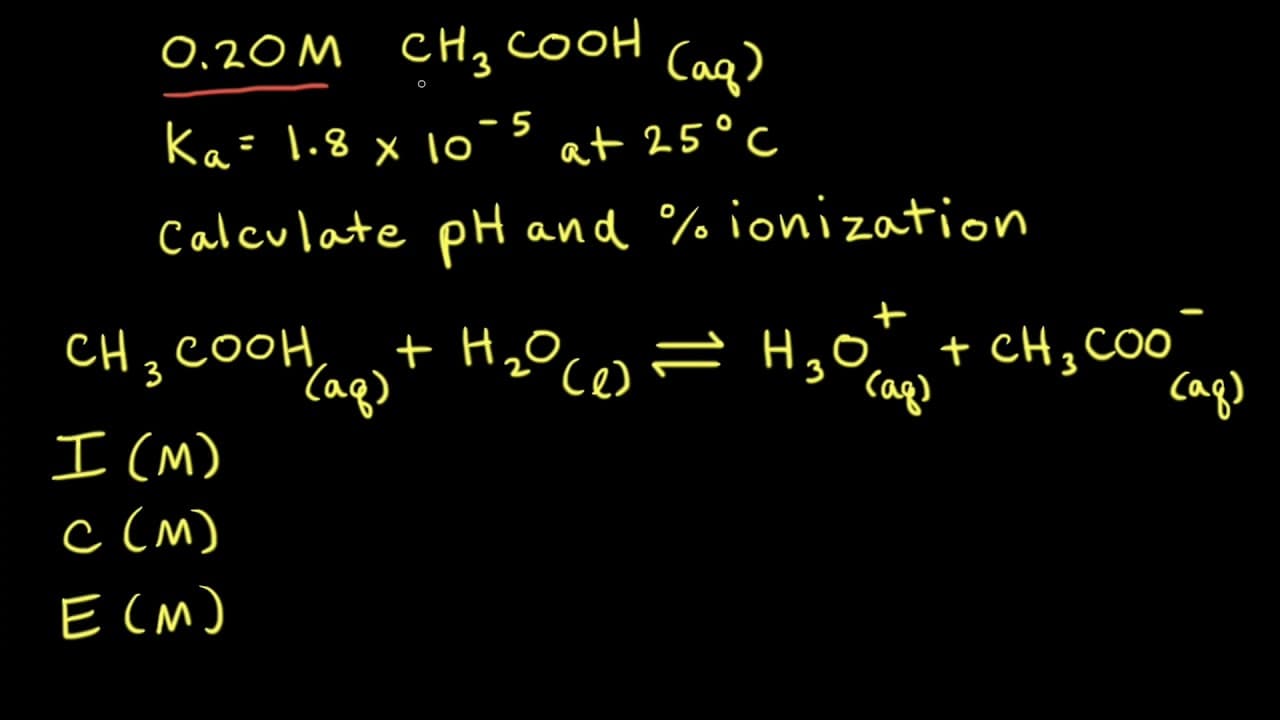
This video explains how to calculate the pH and percent ionization of a 0.20 Molar solution of acetic acid using an ICE table and the 5% rule.
Transcript
- [Instructor] Let's say we have a 0.20 Molar aqueous solution of acidic acid. And our goal is to calculate the pH and the percent ionization. The Ka value for acidic acid is equal to 1.8 times 10 to the negative fifth at 25 degrees Celsius. First, we need to write out the balanced equation showing the ionization of acidic acid. So acidic acid reac... Read More
Key Insights
- 🥶 An ICE table is a useful tool for determining equilibrium concentrations and calculating pH and percent ionization of weak acid solutions.
- 😑 The equilibrium constant expression for the ionization of an acid is derived from the balanced equation, considering the stoichiometry of reactants and products.
- 🤝 Approximations can be used to simplify calculations when dealing with weak acids and small equilibrium concentrations.
Install to Summarize YouTube Videos and Get Transcripts
Explore YouTube Video Summarizer or Get YouTube Transcript Extractor
Questions & Answers
Q: Why do we need to set up an ICE table to calculate the pH and percent ionization of a weak acid solution?
The ICE table helps us track the initial, change, and equilibrium concentrations of the reactants and products in the acid's ionization reaction. By determining the equilibrium concentration of hydronium ions, we can calculate the pH. Percent ionization is obtained by comparing the equilibrium concentration to the initial concentration of the acid.
Q: How is the equilibrium constant expression determined for the ionization of acetic acid?
The equilibrium constant expression is derived from the balanced equation. The concentration of hydronium ions, raised to the power of one, is multiplied by the concentration of acetate anions (the conjugate base of acetic acid), also raised to the power of one. This product is divided by the concentration of acetic acid, raised to the power of one. Water, as a solvent, is not included in the expression.
Q: Why is an approximation used to solve for the equilibrium concentration of hydronium ions?
The approximation is made because acetic acid is a weak acid, meaning it only partially ionizes. With a Ka value less than one, the ionization is minimal and x, the equilibrium concentration of hydronium ions, is a very small number compared to the initial concentration of the acid. This allows us to approximate 0.20 minus x as 0.20, simplifying the calculations.
Q: How is the 5% rule used in this problem?
The 5% rule, also known as the approximation rule, states that if the percent ionization of a weak acid is less than 5%, the approximation used to calculate the equilibrium concentration of hydronium ions is valid. In this problem, the percent ionization was 0.95%, well below 5%, confirming the validity of the approximation.
Summary & Key Takeaways
-
The video demonstrates the process of setting up an ICE table to determine the equilibrium concentration of hydronium ion, pH, and percent ionization for a weak acid (acetic acid) solution.
-
The ICE table is used to track the initial concentration, change in concentration, and equilibrium concentration of the reactants and products in the acid's ionization reaction.
-
The video explains how to set up the equilibrium constant expression using the balanced equation and how to use an approximation to solve for the equilibrium concentration of hydronium ions, avoiding the use of a quadratic equation.
Read in Other Languages (beta)
Share This Summary 📚
Summarize YouTube Videos and Get Video Transcripts with 1-Click
Try YouTube Summary with ChatGPT & Claude or YouTube Transcript Generator
Explore More Summaries from Khan Academy 📚





Summarize YouTube Videos and Get Video Transcripts with 1-Click
Try YouTube Summary with ChatGPT & Claude or YouTube Transcript Generator