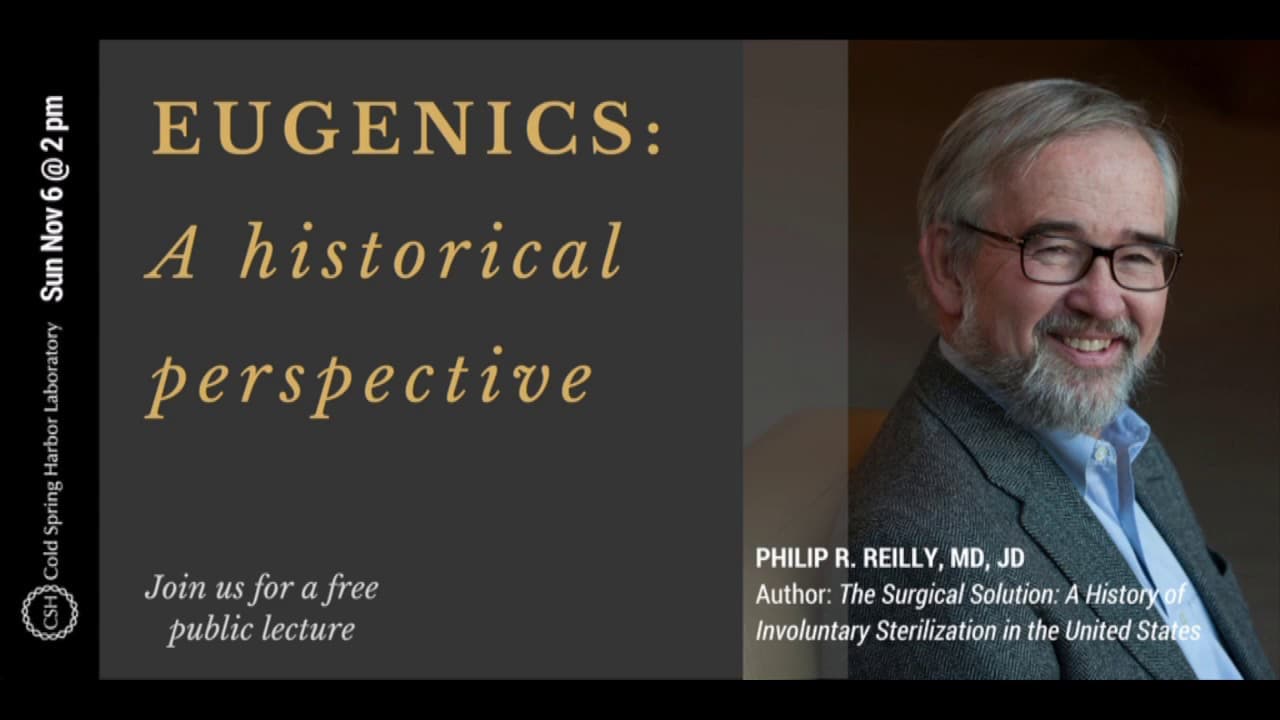
What Is Eugenics: Historical and Modern Perspectives
TL;DR
Eugenics, originating from the Greek term for 'good birth,' was historically a movement aimed at improving human genetics through selective breeding. While initially well-intentioned, it led to coercive practices like involuntary sterilization. Modern genetics has debunked the simplistic single-gene theories of complex traits, urging caution as new reproductive technologies emerge.
Transcript
Thank you thank you very much good afternoon we're gonna have a good time together no slides dialog with the audience and I'm gonna begin by asking you to reflect on a question or two should your you get bored with me and your minds wander a little so the question is what role should society have in trying to improve the human species we'll leave t... Read More
Key Insights
- Eugenics is a concept that originated from the Greek term meaning 'good birth.'
- Francis Galton coined the term 'eugenics' in 1883, aiming to improve human genetics.
- The Progressive Movement in the early 20th century supported eugenics with positive intentions.
- Negative eugenics involved limiting reproduction of individuals deemed 'unfit,' leading to sterilization laws.
- Indiana enacted the first eugenic sterilization law in 1907, influencing other states and countries.
- By the late 1930s, scientific understanding began to challenge the single-gene theory of complex traits.
- Involuntary sterilization was justified as protecting vulnerable women, leading to 60,000 sterilizations in the U.S.
- Modern genetics emphasizes the complexity of traits, urging careful consideration of new reproductive technologies.
Install to Summarize YouTube Videos and Get Transcripts
Explore YouTube Video Summarizer or Get YouTube Transcript Extractor
Questions & Answers
Q: What is the origin of the term 'eugenics'?
The term 'eugenics' originates from the Greek word meaning 'good birth.' It was coined by Francis Galton in 1883, who aimed to improve the genetic quality of the human population through selective breeding. The concept was initially part of the Progressive Movement, which sought to apply scientific principles to improve society.
Q: How did eugenics influence U.S. legislation in the early 20th century?
Eugenics significantly influenced U.S. legislation, leading to the enactment of sterilization laws. Indiana was the first state to pass such a law in 1907, allowing for the sterilization of individuals deemed 'unfit.' By 1927, the Supreme Court upheld these laws, resulting in approximately 60,000 involuntary sterilizations across the country by World War II.
Q: What were the main goals of the Progressive Movement regarding eugenics?
The Progressive Movement aimed to improve society through scientific and social reforms, including eugenics. Initially, the movement focused on positive eugenics, encouraging the reproduction of individuals with desirable traits. However, it later shifted towards negative eugenics, which involved limiting the reproduction of those considered 'unfit,' leading to coercive practices like sterilization.
Q: What role did Cold Spring Harbor play in the eugenics movement?
Cold Spring Harbor was home to the Eugenics Record Office, which played a significant role in the eugenics movement. It was an epicenter for research on heredity and human disease, compiling vast pedigrees to study genetic influences on traits. The office supported the notion of genetic determinism, influencing eugenics policies and legislation in the early 20th century.
Q: How did scientific understanding challenge eugenics in the 1930s?
By the 1930s, scientific understanding began to challenge the simplistic single-gene theory of complex traits, which was a foundation of eugenics. As genetics advanced, it became clear that traits like mental illness and criminality could not be attributed to single genes. This shift in understanding undermined the scientific basis for eugenics policies, leading to a decline in support for sterilization laws.
Q: What were the ethical implications of eugenics practices?
Eugenics practices, particularly involuntary sterilization, raised significant ethical concerns. These practices were based on flawed scientific assumptions and often targeted marginalized groups, violating individual rights and bodily autonomy. The history of eugenics highlights the dangers of using science to justify social policies without ethical considerations, emphasizing the need for caution in applying genetic technologies.
Q: How has modern genetics evolved from the eugenics era?
Modern genetics has evolved significantly from the eugenics era, moving away from deterministic views of heredity. Advances in genetic research have revealed the complexity of traits and the interplay of multiple genes and environmental factors. This understanding has shifted the focus from controlling reproduction to exploring genetic diversity and developing ethical frameworks for applying genetic technologies in medicine and society.
Q: What lessons can be learned from the history of eugenics?
The history of eugenics offers important lessons about the misuse of science and the ethical implications of genetic policies. It underscores the need for rigorous scientific validation, ethical considerations, and public engagement in developing genetic technologies. As society advances in genetic capabilities, it is crucial to learn from past mistakes to ensure that new technologies are used to benefit humanity without infringing on individual rights.
Summary & Key Takeaways
-
Eugenics, a term coined by Francis Galton, aimed to improve human genetics through selective breeding. The Progressive Movement initially supported this with positive intentions, but it led to coercive practices like involuntary sterilization. By the late 1930s, scientific understanding began to challenge the simplistic single-gene theories of complex traits.
-
Indiana enacted the first eugenic sterilization law in 1907, influencing similar laws in other states and countries. The Supreme Court upheld these laws in 1927, leading to 60,000 sterilizations in the U.S. Modern genetics has debunked the idea that complex traits are driven by single-gene disorders.
-
Today, the focus is on understanding the complexity of genetics and the ethical implications of new reproductive technologies. The history of eugenics serves as a cautionary tale, urging society to consider the impact of genetic information and the role of technology in shaping human reproduction.
Read in Other Languages (beta)
Share This Summary 📚
Summarize YouTube Videos and Get Video Transcripts with 1-Click
Try YouTube Summary with ChatGPT & Claude or YouTube Transcript Generator
Explore More Summaries from Cold Spring Harbor Laboratory 📚






Summarize YouTube Videos and Get Video Transcripts with 1-Click
Try YouTube Summary with ChatGPT & Claude or YouTube Transcript Generator