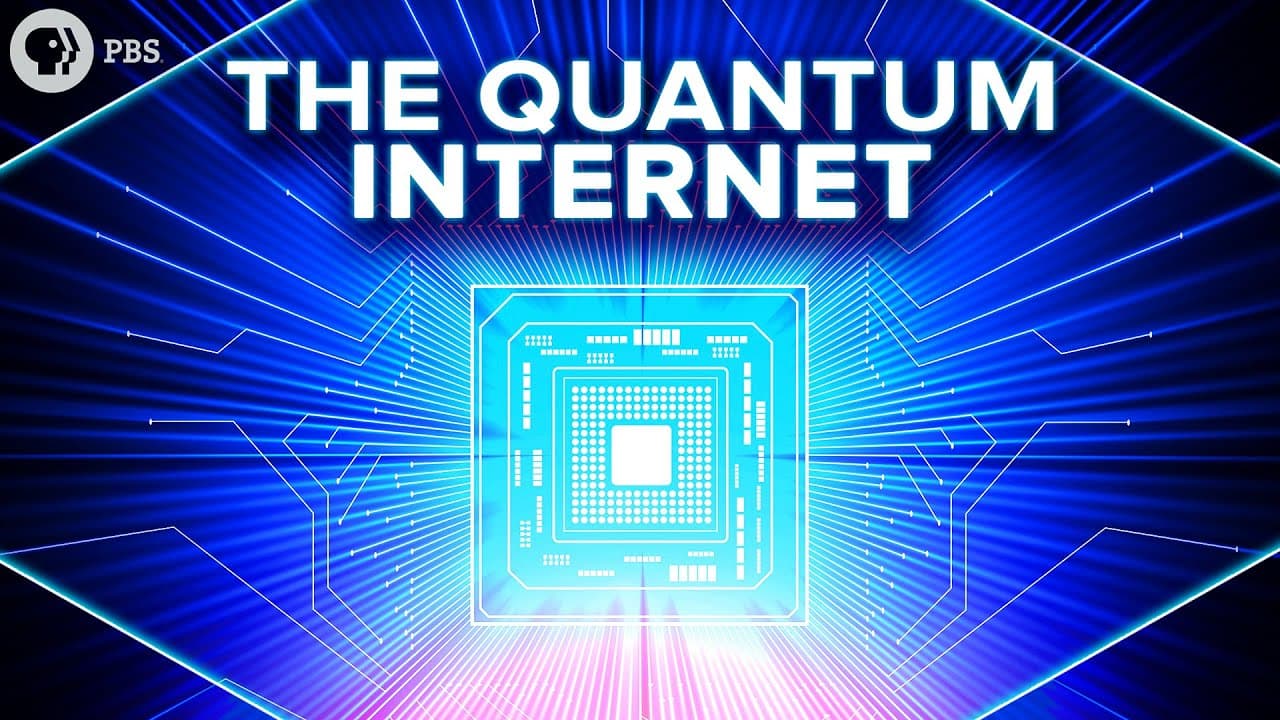
How Does the Quantum Internet Work?
TL;DR
The quantum internet leverages qubits, which are capable of being in multiple states simultaneously, to achieve secure communication and faster computation. Unlike classical bits, qubits cannot be copied due to the no-cloning theorem, but they can be teleported, enabling the transmission of quantum information over long distances. This technology promises advancements in cryptography and distributed computing.
Transcript
When we finally have a quantum internet you’ll be able to simultaneously like and dislike this video. But we don’t yet. So I hope you like it. The world is widely regarded as being well and truly into the digital age, also called the information age. No longer are economies and industries are solely characterized by the physical goods they produce,... Read More
Key Insights
- Quantum internet relies on qubits that can exist in multiple states simultaneously, unlike classical bits.
- The no-cloning theorem prevents perfect copying of quantum states, ensuring secure communication.
- Quantum teleportation allows qubits to be transferred intact over long distances without copying.
- Entangled qubits can be used for secure quantum key distribution, enhancing cryptographic protocols.
- Quantum repeaters extend the transmission range by teleporting qubits across a network of nodes.
- Quantum information can be stored in matter particles, such as electrons, for secure transmission.
- Photonic repeaters offer a potential solution for faster quantum communication networks.
- The quantum internet could revolutionize cryptography, distributed computing, and precision measurements.
Install to Summarize YouTube Videos and Get Transcripts
Explore YouTube Video Summarizer or Get YouTube Transcript Extractor
Questions & Answers
Q: How does quantum teleportation work?
Quantum teleportation involves transferring the state of a qubit from one location to another without physically moving the qubit itself. This is achieved by entangling two qubits and performing a measurement on one of them, which instantaneously affects the state of the other. Classical communication is then used to complete the transfer, ensuring the qubit's state is replicated at the destination.
Q: What is the no-cloning theorem?
The no-cloning theorem is a principle in quantum mechanics stating that it is impossible to create an identical copy of an arbitrary unknown quantum state. This is due to the nature of quantum measurements, which disturb the state being measured. The theorem ensures the security of quantum communication by preventing perfect duplication of quantum information.
Q: Why is the quantum internet important for cryptography?
The quantum internet is crucial for cryptography because it enables secure communication through quantum key distribution, which is theoretically unbreakable. Quantum entanglement and the no-cloning theorem ensure that any attempt to intercept or duplicate the quantum keys would be detectable, providing a level of security that classical cryptographic methods cannot achieve.
Q: What challenges exist in building a quantum internet?
Building a quantum internet faces challenges such as maintaining qubit coherence over long distances, developing efficient quantum repeaters, and storing quantum information in matter particles. Synchronizing quantum entanglement and performing accurate measurements without decoherence are also significant hurdles. Technological advancements in these areas are necessary for the quantum internet's realization.
Q: How can quantum repeaters extend communication range?
Quantum repeaters extend communication range by using a series of entangled qubits to teleport quantum information across multiple nodes. Each repeater node performs entanglement swapping, effectively relaying the quantum state without direct transmission. This process allows quantum information to be transmitted over longer distances than would be possible with direct entanglement alone.
Q: What role do photonic repeaters play in quantum communication?
Photonic repeaters play a vital role in quantum communication by enabling faster transmission of quantum information. Unlike traditional repeaters that rely on matter-based storage, photonic repeaters use only photons, eliminating the need for state transfer between photons and matter. This approach increases speed and reduces complexity in building scalable quantum networks.
Q: How can quantum information be stored in matter particles?
Quantum information can be stored in matter particles by entangling qubits with the spin states of particles like electrons. These spin states serve as a storage medium, preserving the quantum information until it is needed for transmission or computation. This method is crucial for maintaining coherence and enabling long-distance quantum communication through repeaters.
Q: What advancements could the quantum internet bring?
The quantum internet could bring advancements in secure cryptographic protocols, distributed quantum computing, and precision measurements. By leveraging quantum entanglement and teleportation, it could enable new levels of data security, facilitate powerful quantum computations, and improve technologies such as atomic clocks and interferometric telescopes, driving innovation in various scientific and technological fields.
Summary & Key Takeaways
-
The quantum internet utilizes qubits, which can exist in superposition, to enable secure communication and computational speed-ups. Qubits cannot be copied due to the no-cloning theorem, but they can be teleported, allowing intact transmission over long distances. This technology is poised to enhance cryptographic protocols and distributed quantum computing.
-
Quantum information theory parallels classical information theory but operates with qubits instead of classical bits. Qubits can be entangled, allowing for secure quantum key distribution. Quantum repeaters and storage in matter particles are essential for extending transmission ranges and maintaining quantum states.
-
The development of a quantum internet promises new cryptographic protocols, distributed quantum computing, and advancements in precision measurements. Photonic repeaters and entangled state storage are key components in building the infrastructure for this emerging technology, which could usher in the quantum age.
Read in Other Languages (beta)
Share This Summary 📚
Summarize YouTube Videos and Get Video Transcripts with 1-Click
Try YouTube Summary with ChatGPT & Claude or YouTube Transcript Generator
Explore More Summaries from PBS Space Time 📚

Summarize YouTube Videos and Get Video Transcripts with 1-Click
Try YouTube Summary with ChatGPT & Claude or YouTube Transcript Generator