Aromatic Compounds & Heterocycles - Nucleophilic & Electrophilic Aromatic Substitution Reactions
TL;DR
This video discusses the reactions and reactivities of different aromatic heterocyclic compounds, such as pyrrole, furan, and thiophene, in electrophilic and nucleophilic aromatic substitution reactions.
Transcript
in this video we're going to go over electrophilic and nucleophilic aromatic substitution reactions of heterocyclic compounds so let's begin our discussion with this molecule pyrrole pyrrole is an aromatic compound it's more nucleophilic than benzene and so if we perform bromination with pyrrole we don't need a lewis acid catalyst like iron three b... Read More
Key Insights
- 🧘 Pyrrole is more nucleophilic than benzene and undergoes bromination at the two position.
- ❓ Furan and thiophene are more nucleophilic than benzene and react in electrophilic aromatic substitution reactions.
- 🫀 Aromatic heterocyclic compounds can stabilize positive charges better than benzene due to the ability to place them on nitrogen or oxygen atoms, which obey the octet rule.
- 🈂️ The reactivity of aromatic heterocyclic compounds in electrophilic aromatic substitution reactions depends on their ability to stabilize positive charges.
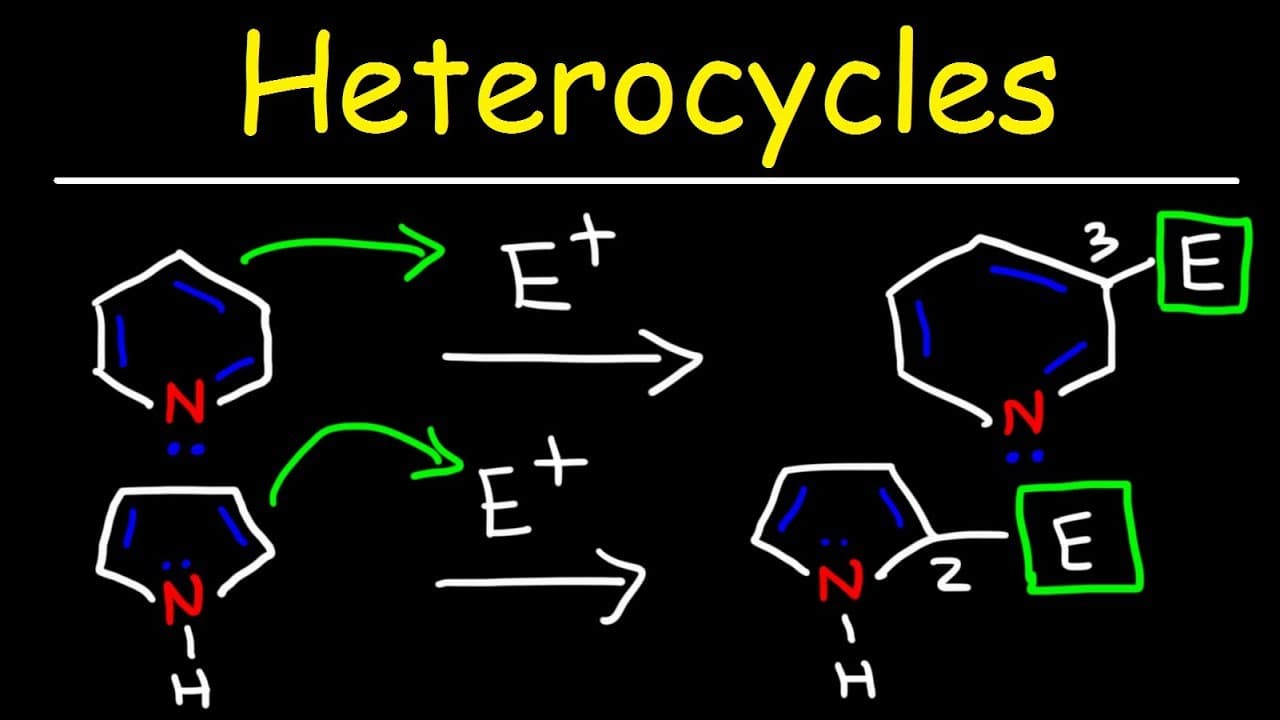
- 🧘 Position two is favored in nucleophilic aromatic substitution reactions, while position three is favored in electrophilic aromatic substitution reactions for certain heterocyclic compounds.
- 💪 Leaving groups on positions two or four in pyridine can be replaced by strong nucleophiles in nucleophilic aromatic substitution reactions.
- 💁 Methyl groups in heterocyclic compounds can undergo deprotonation and form nucleophilic carbanions, which can participate in various reactions.
Install to Summarize YouTube Videos and Get Transcripts
Explore YouTube Video Summarizer or Get YouTube Transcript Extractor
Questions & Answers
Q: Why is pyrrole more nucleophilic than furan and thiophene?
Pyrrole is more nucleophilic due to the presence of a nitrogen atom, which is less electronegative than oxygen in furan and sulfur in thiophene. The nitrogen atom can stabilize positive charges better, making pyrrole more nucleophilic.
Q: Why does bromination in pyrrole occur at the two position?
Bromination in pyrrole occurs at the two position because it is more energetically favorable to replace the hydrogen atom at the two position rather than the three position. This results in the formation of a bromine-substituted carbon atom at the two position.
Q: What is the major product of the electrophilic aromatic substitution reaction between pyrrole and bromine?
The major product of the reaction between pyrrole and bromine is a pyrrole molecule with a bromine atom substituted at the two position, replacing the hydrogen atom originally present.
Q: Why is position three favored over positions two and four in pyridine?
Position three is favored over positions two and four in pyridine due to resonance stabilization. Placing the electrophile at position three allows for the formation of more stable resonance structures, where the positive charge can be delocalized between carbon atoms and nitrogen atoms.
Summary & Key Takeaways
-
Pyrrole is more nucleophilic than benzene and undergoes bromination at the two position, resulting in the replacement of a hydrogen atom with a bromine atom.
-
Aromatic heterocyclic compounds, such as furan and thiophene, are more nucleophilic than benzene and react in electrophilic aromatic substitution reactions.
-
Pyrrole and furan can stabilize positive charges better than benzene due to the ability to place the positive charge on nitrogen or oxygen atoms, respectively, which allows them to obey the octet rule.
Read in Other Languages (beta)
Share This Summary 📚
Summarize YouTube Videos and Get Video Transcripts with 1-Click
Try YouTube Summary with ChatGPT & Claude or YouTube Transcript Generator
Explore More Summaries from The Organic Chemistry Tutor 📚






Summarize YouTube Videos and Get Video Transcripts with 1-Click
Try YouTube Summary with ChatGPT & Claude or YouTube Transcript Generator