What Was Thomas Jefferson's Vision for America?
TL;DR
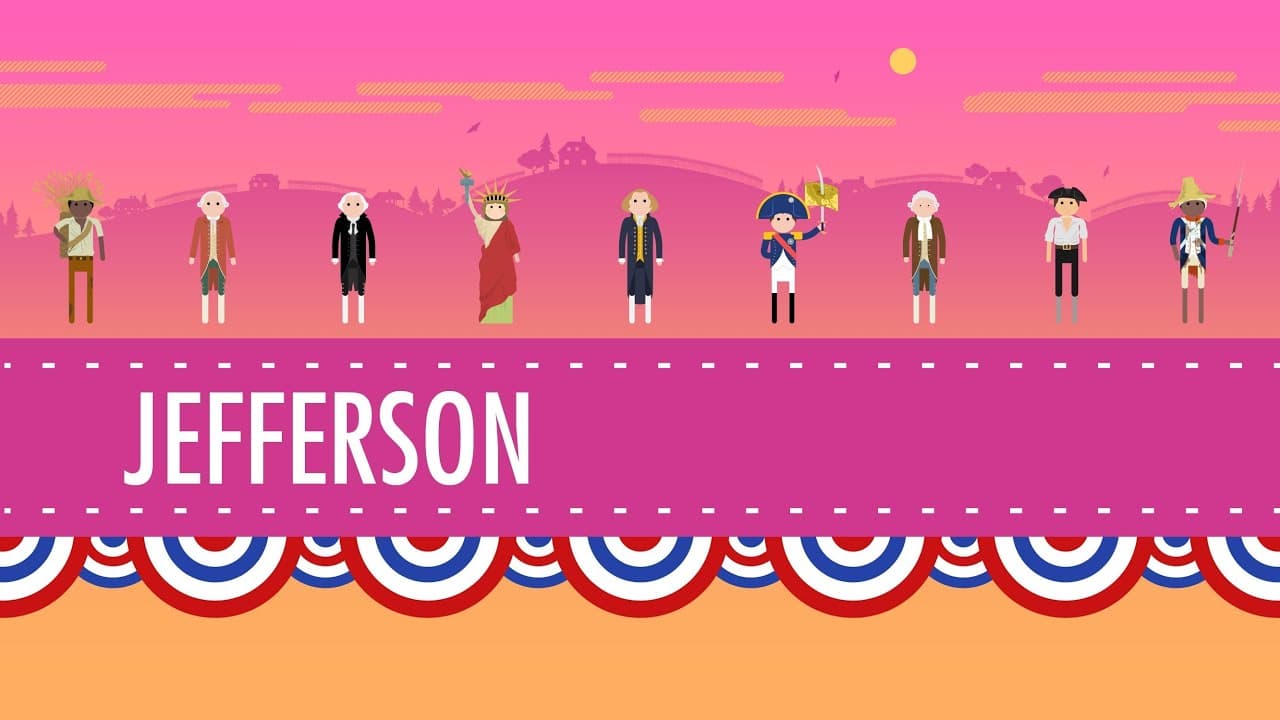
Thomas Jefferson envisioned America as a nation of independent farmers, favoring small government and limited manufacturing. Despite advocating for liberty, he owned slaves and expanded federal power through actions like the Louisiana Purchase. His presidency encapsulates both the ideals and contradictions of American history, highlighting the complexities of his character and policies.
Transcript
Hi I'm John Green, this is Crash Course US History, and today we're going to discuss Thomas Jefferson. We're going to learn about how America became a thriving nation of small, independent farmers, eschewing manufacturing and world trade, and becoming the richest and most powerful nation in the world in the 19th century, all thanks to the vision of... Read More
Key Insights
- Thomas Jefferson envisioned the U.S. as a nation of independent farmers, eschewing manufacturing.
- The election of 1800 marked the first campaign where both political parties actively participated.
- Jefferson's presidency saw the significant expansion of federal power, contrary to his small government ideals.
- The Louisiana Purchase doubled the size of the U.S., despite lacking constitutional provision for such an act.
- Jefferson's embargo aimed to punish Britain but resulted in economic downturn and increased American manufacturing.
- Marbury v. Madison established judicial review, enhancing the Supreme Court's role in American governance.
- Jefferson's views on slavery were contradictory; he owned slaves yet drafted the Declaration of Independence.
- Gabriel's Rebellion highlighted slaves' desire for liberty, prompting harsher laws in Virginia.
Install to Summarize YouTube Videos and Get Transcripts
Explore YouTube Video Summarizer or Get YouTube Transcript Extractor
Questions & Answers
Q: How did Thomas Jefferson envision America's future?
Thomas Jefferson envisioned America as a nation of small, independent farmers, emphasizing agrarian ideals over industrialization. He believed that a society of self-sufficient farmers would promote individual virtue and public morality. This vision was in stark contrast to the mercantile and industrial model of Europe, which he viewed as corrupt and tyrannical. Jefferson's policies, however, sometimes contradicted this vision, as seen in the unintended promotion of manufacturing through his embargo.
Q: What was the significance of the election of 1800?
The election of 1800 was significant as it marked the first time both political parties, the Republicans and the Federalists, actively campaigned for the presidency. It resulted in a peaceful transfer of power from John Adams, a Federalist, to Thomas Jefferson, a Republican, setting a precedent for future transitions. The election also highlighted the flaws in the Electoral College, leading to the 12th Amendment, which aimed to simplify the electoral process.
Q: What was the impact of the Louisiana Purchase?
The Louisiana Purchase in 1803 had a profound impact, doubling the size of the United States and providing vast new territories for settlement and agriculture. It strengthened Jefferson's vision of an agrarian America but also challenged his strict constructionist view of the Constitution, as there was no explicit provision for land acquisition. The purchase facilitated westward expansion, significantly altering the nation's demographic and economic landscape.
Q: How did Marbury v. Madison shape the Supreme Court's role?
Marbury v. Madison, decided in 1803, was a landmark case that established the principle of judicial review, allowing the Supreme Court to invalidate federal laws deemed unconstitutional. This decision, authored by Chief Justice John Marshall, significantly enhanced the power and authority of the judiciary, making it a co-equal branch of government. Judicial review has since been a cornerstone of American constitutional law, shaping the legal landscape of the nation.
Q: What were the effects of Jefferson's embargo?
Jefferson's embargo, enacted in 1807, aimed to pressure Britain and France to respect American neutrality by halting all trade with foreign nations. However, it backfired, devastating the American economy as exports plummeted. Instead of coercing European powers, it inadvertently spurred domestic manufacturing, contrary to Jefferson's agrarian ideals. The embargo highlighted the challenges of balancing foreign policy goals with domestic economic stability.
Q: How did Jefferson's policies contradict his ideals?
Jefferson's policies often contradicted his ideals of limited government and agrarianism. Despite advocating for small government, his presidency saw significant expansions of federal power, such as the Louisiana Purchase. His embargo on trade, intended to assert American independence, resulted in increased federal intervention and domestic manufacturing, contrary to his vision of a nation of independent farmers. These contradictions reflect the complexities of his leadership and legacy.
Q: What was Jefferson's stance on slavery?
Thomas Jefferson's stance on slavery was deeply contradictory. He publicly expressed opposition to the institution and included ideals of liberty in the Declaration of Independence, yet he owned hundreds of slaves throughout his lifetime. Jefferson's writings reveal racist beliefs, and he did not free his slaves upon his death, unlike some of his contemporaries. His relationship with slavery remains a contentious aspect of his legacy, reflecting broader societal contradictions of the era.
Q: What was the outcome of Gabriel's Rebellion?
Gabriel's Rebellion in 1800 was a planned slave uprising in Virginia, led by an enslaved blacksmith named Gabriel. The plot aimed to seize the state capital and demand the abolition of slavery. However, it was discovered before it could be executed, resulting in the execution of Gabriel and 25 other slaves. The rebellion heightened fears of slave revolts, prompting Virginia to enact stricter laws governing slaves and limiting their freedoms even further.
Summary & Key Takeaways
-
Thomas Jefferson's vision for America was centered on a nation of independent farmers, which he believed would ensure individual freedom and virtue. Despite his advocacy for small government, his presidency saw significant expansions in federal power, notably through the Louisiana Purchase. Jefferson's policies often contradicted his ideals, such as his imposition of the embargo that inadvertently spurred American manufacturing.
-
The election of 1800 was pivotal, showcasing the first active political campaigns by both parties. Jefferson's presidency marked the decline of the Federalists and the rise of more democratic politics. His complex legacy includes the establishment of judicial review through Marbury v. Madison, which cemented the Supreme Court's authority in American law.
-
Jefferson's relationship with slavery was fraught with contradictions; he owned slaves while advocating for liberty. Events like Gabriel's Rebellion underscored the enslaved population's yearning for freedom, leading to stricter slave laws in Virginia. Jefferson's presidency reflects the complexities and contradictions of American history, making it a subject of continued study and debate.
Read in Other Languages (beta)
Share This Summary 📚
Summarize YouTube Videos and Get Video Transcripts with 1-Click
Try YouTube Summary with ChatGPT & Claude or YouTube Transcript Generator
Explore More Summaries from CrashCourse 📚



Summarize YouTube Videos and Get Video Transcripts with 1-Click
Try YouTube Summary with ChatGPT & Claude or YouTube Transcript Generator