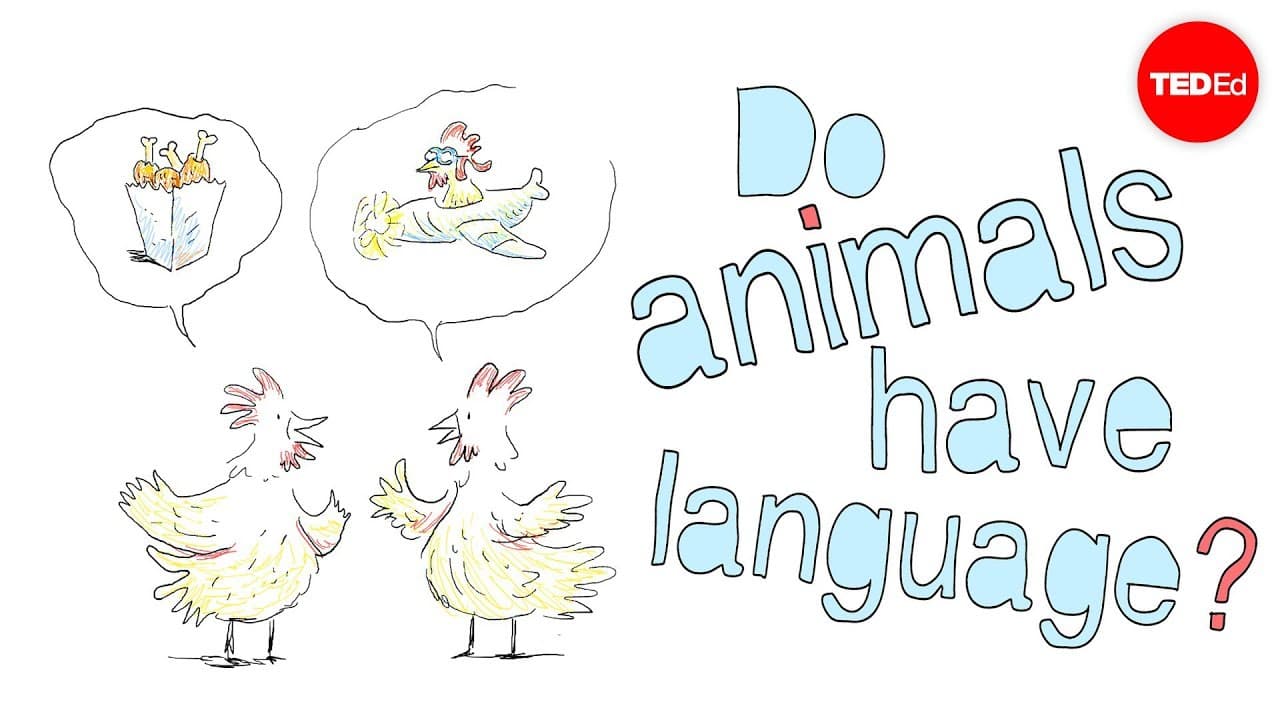
Do animals have language? - Michele Bishop
TL;DR
Animals have various communication systems, but true language requires qualities like discreteness, grammar, productivity, and displacement which are not found in most animal communication.
Transcript
All animals communicate. Crabs wave their claws at each other to signal that they're healthy and ready to mate. Cuttlefish use pigmented skin cells called chromatophores to create patterns on their skin that act as camouflage or warnings to rivals. Honeybees perform complex dances to let other bees know the location and quality of a food source. Al... Read More
Key Insights
- 🖤 Animals like crabs and cuttlefish have communication systems but lack the qualities associated with language.
- 🤙 Bees and prairie dogs exhibit some language-like qualities, using specific movements or calls to convey information.
- 😒 Great apes can learn and use modified sign languages, showing properties of language.
- 🐬 Dolphins can communicate using whistles and understand some grammar in human-made gestural languages.
- 🧍 Human language stands out due to the combination of grammar, productivity, discreteness, and displacement.
- 🧡 Animals' topics of conversation are usually limited compared to the vast range of subjects humans can communicate about.
- 👨🔬 Research suggests that human language and animal communication may exist on a continuum rather than being entirely different.
Install to Summarize YouTube Videos and Get Transcripts
Explore YouTube Video Summarizer or Get YouTube Transcript Extractor
Questions & Answers
Q: What are the four qualities associated with language?
The four qualities associated with language are discreteness, grammar, productivity, and displacement. Discreteness refers to the ability to combine individual units (sounds or words) to create new ideas. Grammar provides rules for combining these units. Productivity is the ability to create an infinite number of messages, and displacement is the ability to talk about things not present.
Q: Do crabs and cuttlefish exhibit any language qualities?
No, crabs and cuttlefish do not exhibit language qualities. They do not creatively combine signals, their signals do not have to be in a grammatical order, and they can only communicate current conditions rather than past or future events.
Q: Are there any animals that display displacement, one of the qualities of language?
Bees and prairie dogs display displacement. Bees use their waggle dance to describe the location and richness of a food source outside the hive. Prairie dogs use alarm calls to indicate a predator's size, shape, speed, and even distinguish specific human predators.
Q: Can great apes use language?
Some great apes, like chimpanzees and gorillas, can use a modified sign language and display qualities of language. They can combine multiple signs to form original phrases and refer to past events, demonstrating discreteness and displacement. However, they often use human communication systems taught to them rather than naturally occurring systems.
Key Insights:
- Animals like crabs and cuttlefish have communication systems but lack the qualities associated with language.
- Bees and prairie dogs exhibit some language-like qualities, using specific movements or calls to convey information.
- Great apes can learn and use modified sign languages, showing properties of language.
- Dolphins can communicate using whistles and understand some grammar in human-made gestural languages.
- Human language stands out due to the combination of grammar, productivity, discreteness, and displacement.
- Animals' topics of conversation are usually limited compared to the vast range of subjects humans can communicate about.
- Research suggests that human language and animal communication may exist on a continuum rather than being entirely different.
- The human brain's ability to create infinite messages sets human language apart from animal communication.
Summary & Key Takeaways
-
Animals like crabs and cuttlefish have communication systems but lack the qualities associated with language such as combining signals in creative ways or talking about past, future, or fictional events.
-
Bees and prairie dogs exhibit some language-like qualities, using specific movements or alarm calls to convey information about food sources or predators.
-
Great apes like chimpanzees and gorillas can learn and use modified sign languages, displaying properties of language, although they were taught human communication systems rather than using their own.
Read in Other Languages (beta)
Share This Summary 📚
Summarize YouTube Videos and Get Video Transcripts with 1-Click
Try YouTube Summary with ChatGPT & Claude or YouTube Transcript Generator
Explore More Summaries from TED-Ed 📚




Summarize YouTube Videos and Get Video Transcripts with 1-Click
Try YouTube Summary with ChatGPT & Claude or YouTube Transcript Generator