Practice Problems: Net Charge, Mass Number, Atomic Number
TL;DR
This content explains how to determine the atomic number, mass number, and net charge of an atom using protons, neutrons, and electrons.
Transcript
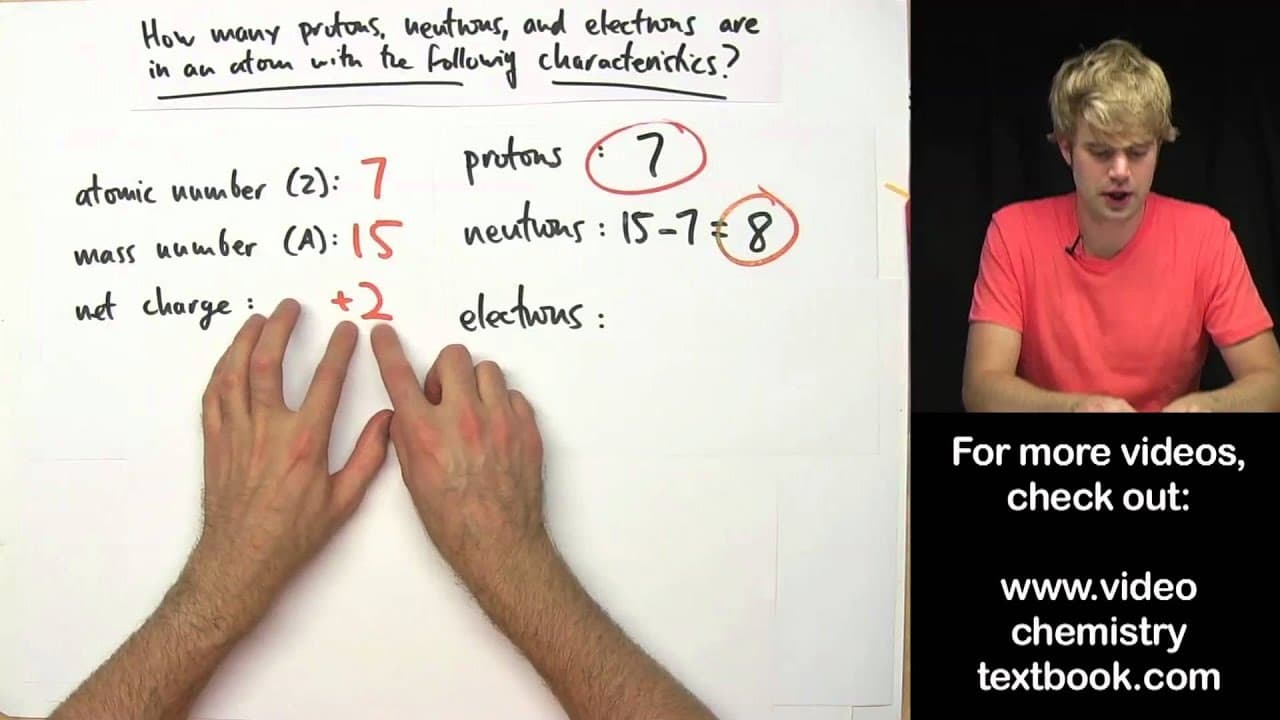
Here's an atom. What is the atomic number, the mass number and the net charge to this atom? So the atomic number is the number of protons. In this diagram, these little red circles are representing protons here in the nucleus so we’ve got 1, 2, 3, 4, 5 which means my atomic number is 5. That was easy enough. Mass number is the number of protons plu... Read More
Key Insights
- 🫀 The atomic number represents the number of protons in an atom's nucleus.
- 🫀 The mass number is the sum of protons and neutrons in an atom.
- 🫀 The net charge of an atom is determined by comparing the number of protons and electrons.
- #️⃣ The number of neutrons in an atom can be calculated by subtracting the number of protons from the mass number.
- #️⃣ Problems involving atomic number, mass number, and net charge can be solved using simple calculations.
- 🫀 Isotopes, a topic for future videos, are atoms with the same atomic number but different mass numbers.
Install to Summarize YouTube Videos and Get Transcripts
Explore YouTube Video Summarizer or Get YouTube Transcript Extractor
Questions & Answers
Q: How do you determine the atomic number of an atom?
The atomic number is equal to the number of protons in an atom's nucleus.
Q: What is the mass number of an atom?
The mass number is the sum of protons and neutrons present in an atom's nucleus.
Q: Can the number of protons and neutrons be different in an atom?
Yes, the number of protons and neutrons can differ in an atom's nucleus. It is not necessary for them to be the same.
Q: How is the net charge of an atom calculated?
The net charge is determined by comparing the number of protons and electrons. If there are more protons, the net charge will be positive, and if there are more electrons, the net charge will be negative.
Q: If an atom has a net charge of 2+, what does that tell us?
A net charge of 2+ means that there are two more protons than electrons in the atom.
Q: How can you determine the number of neutrons in an atom?
By subtracting the number of protons from the mass number, the number of neutrons in an atom can be determined.
Q: What is the relationship between the atomic number and the number of protons?
The atomic number is equal to the number of protons in an atom's nucleus.
Q: How can you determine the number of electrons in an atom?
By subtracting the net charge from the number of protons, the number of electrons in an atom can be calculated.
Summary & Key Takeaways
-
The atomic number is the number of protons in an atom, while the mass number is the sum of protons and neutrons.
-
The net charge of an atom is determined by the balance between protons and electrons.
-
By knowing the atomic number, mass number, and net charge, the number of protons, neutrons, and electrons in an atom can be calculated.
Read in Other Languages (beta)
Share This Summary 📚
Summarize YouTube Videos and Get Video Transcripts with 1-Click
Try YouTube Summary with ChatGPT & Claude or YouTube Transcript Generator
Explore More Summaries from Tyler DeWitt 📚

Summarize YouTube Videos and Get Video Transcripts with 1-Click
Try YouTube Summary with ChatGPT & Claude or YouTube Transcript Generator