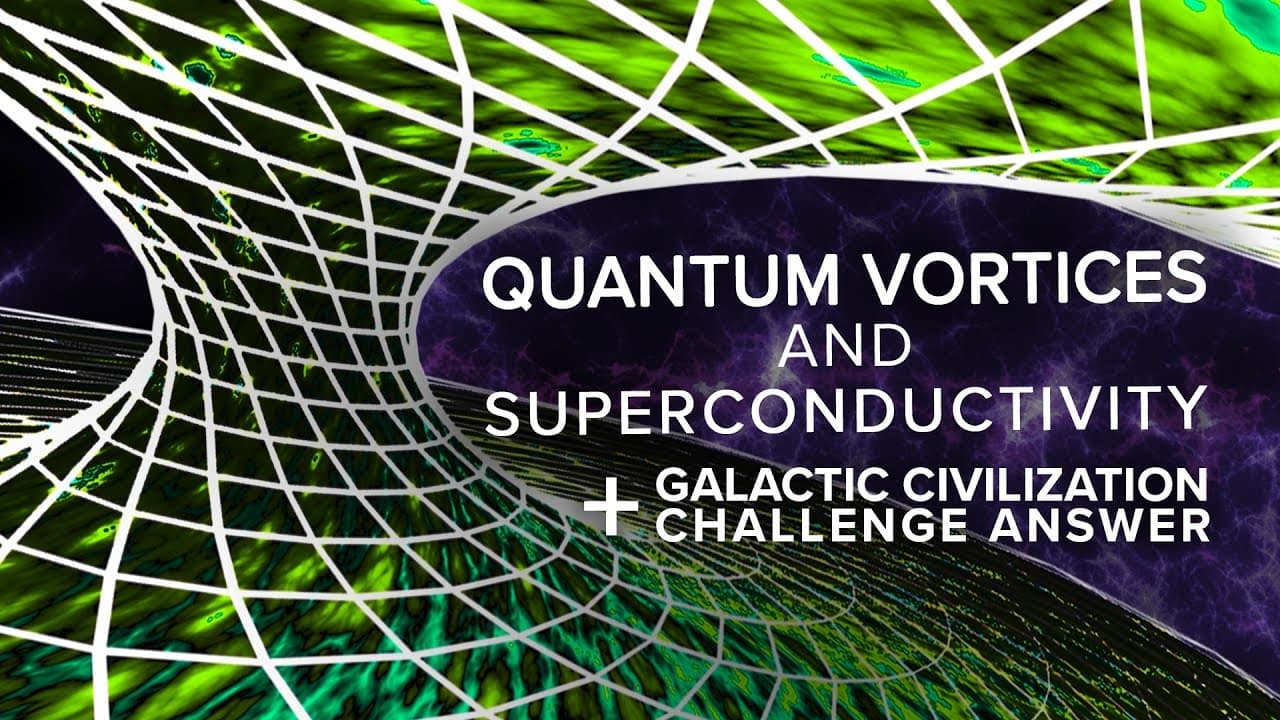
Quantum Vortices and Superconductivity + Drake Equation Challenge Answers
TL;DR
Nobel Prize awarded for quantum material research and Drake Equation analysis.
Transcript
This year's Nobel Prize in Physics went to three researchers for major breakthroughs in understanding the strange quantum behavior of very, very cold materials. Half of the near one million dollar prize was awarded to David Thouless, and the other half split between collaborators Michael Kosterlitz and Duncan Haldane. These theoretical physicists p... Read More
Key Insights
- David Thouless, Michael Kosterlitz, and Duncan Haldane won the Nobel Prize for their work on quantum phases in cold materials, revealing the role of topology in these phenomena.
- Topology, focusing on shapes and holes, explains the behavior of quantum vortices in superconductors, which are essential for understanding phase transitions at near absolute zero temperatures.
- Quantum vortices, resembling elementary particles, lead to superconductivity in thin materials, and their pair splitting disrupts this property at higher temperatures.
- Thouless's work on the quantum hole effect links topology to quantized magnetic fields, advancing potential applications in superconductors and superfluids.
- The Drake Equation, modified by Frank and Sullivan, estimates the probability of technological civilizations, suggesting a 1 in 100 chance of such development on Earth-like planets within 100 light years.
- The analysis of habitable planets and technological civilizations indicates that Earth may be one of the few advanced civilizations in our local region, but not necessarily in the entire galaxy.
- Tabby's Star's dimming, initially thought to be a Dyson Swarm, is unlikely to be caused by aliens, as no Dyson Swarms have been detected in nearby stars.
- The Galactic Civilization Challenge highlights the complexity of estimating the prevalence of advanced civilizations, emphasizing the rarity of technological life forms in the universe.
Install to Summarize YouTube Videos and Get Transcripts
Explore YouTube Video Summarizer or Get YouTube Transcript Extractor
Questions & Answers
Q: What did the Nobel Prize winners contribute to physics?
David Thouless, Michael Kosterlitz, and Duncan Haldane were awarded the Nobel Prize for their pioneering research on the quantum behavior of materials at extremely low temperatures. They advanced the understanding of phase transitions by showing how topology influences these processes, particularly in thin films or strands, which has significant implications for superconductivity and other quantum phenomena.
Q: How does topology relate to quantum vortices and superconductivity?
Topology, the study of shapes and their properties through continuous deformation, plays a crucial role in understanding quantum vortices in superconductors. Quantum vortices, which resemble elementary particles, are topological defects that occur in pairs and affect the spin distribution in materials. This understanding helps explain how superconductivity arises and is disrupted at higher temperatures.
Q: What is the significance of the modified Drake Equation?
The modified Drake Equation, used by Frank and Sullivan, estimates the probability of technological civilizations forming on habitable planets. It suggests a 1 in 100 chance of such development on Earth-like planets within 100 light years, indicating that Earth may be one of the few advanced civilizations locally. This highlights the rarity of technological life forms and the complexity of estimating their prevalence.
Q: Why is Tabby's Star unlikely to host a Dyson Swarm?
Tabby's Star, initially thought to exhibit dimming due to a Dyson Swarm, is unlikely to be caused by aliens. Thorough studies of nearby stars have shown no signs of Dyson Swarms. The analysis suggests that if such structures existed, they would be noticeable, and the absence of evidence implies that Tabby's Star's dimming is not due to an advanced civilization.
Q: What are the potential applications of the Nobel Prize-winning research?
The research by Thouless, Kosterlitz, and Haldane on quantum phases and topology has potential applications in developing advanced electronic components and quantum computing. Understanding how topology affects superconductivity and quantum vortices can lead to new ways of moving charge, spin, and information in materials, possibly enabling the creation of topological quantum computers.
Q: How does the research impact our understanding of superconductors?
The research enhances our understanding of superconductors by explaining how quantum vortices and topology influence their properties. It shows how superconductivity can arise in thin materials and how the splitting of vortex pairs disrupts it at higher temperatures. This knowledge could lead to improvements in superconductor technology and new applications in electronics.
Q: What challenges exist in estimating the prevalence of advanced civilizations?
Estimating the prevalence of advanced civilizations is challenging due to the rarity of technological life forms and the vastness of the universe. Factors such as abiogenesis, evolutionary steps, and the development of spacefaring capabilities contribute to the complexity. The Galactic Civilization Challenge illustrates these difficulties, emphasizing the low probability of such civilizations forming and being detectable.
Q: How does the research on quantum phases relate to future technological advancements?
The research on quantum phases and topology's role in materials at low temperatures is crucial for future technological advancements. By understanding how quantum vortices and topology affect superconductivity, scientists can develop new electronic components and quantum computing technologies. This research lays the foundation for innovative ways to manipulate charge, spin, and information in materials.
Summary & Key Takeaways
-
David Thouless, Michael Kosterlitz, and Duncan Haldane received the Nobel Prize for their groundbreaking research on quantum phases and topology's role in very cold materials. Their work explains how topology influences superconductivity and phase transitions, leading to potential advancements in electronic components and quantum computing.
-
The modified Drake Equation, used to assess the likelihood of technological civilizations, suggests a low probability of such civilizations forming on Earth-like planets. This analysis implies that Earth may be one of the few advanced civilizations in the local region, though not necessarily in the entire galaxy.
-
Tabby's Star, once hypothesized to host a Dyson Swarm, likely isn't an alien civilization, as thorough studies of nearby stars show no signs of Dyson Swarms. The Galactic Civilization Challenge underscores the challenges in estimating the prevalence of advanced life forms, emphasizing their rarity.
Read in Other Languages (beta)
Share This Summary 📚
Summarize YouTube Videos and Get Video Transcripts with 1-Click
Try YouTube Summary with ChatGPT & Claude or YouTube Transcript Generator
Explore More Summaries from PBS Space Time 📚
Summarize YouTube Videos and Get Video Transcripts with 1-Click
Try YouTube Summary with ChatGPT & Claude or YouTube Transcript Generator