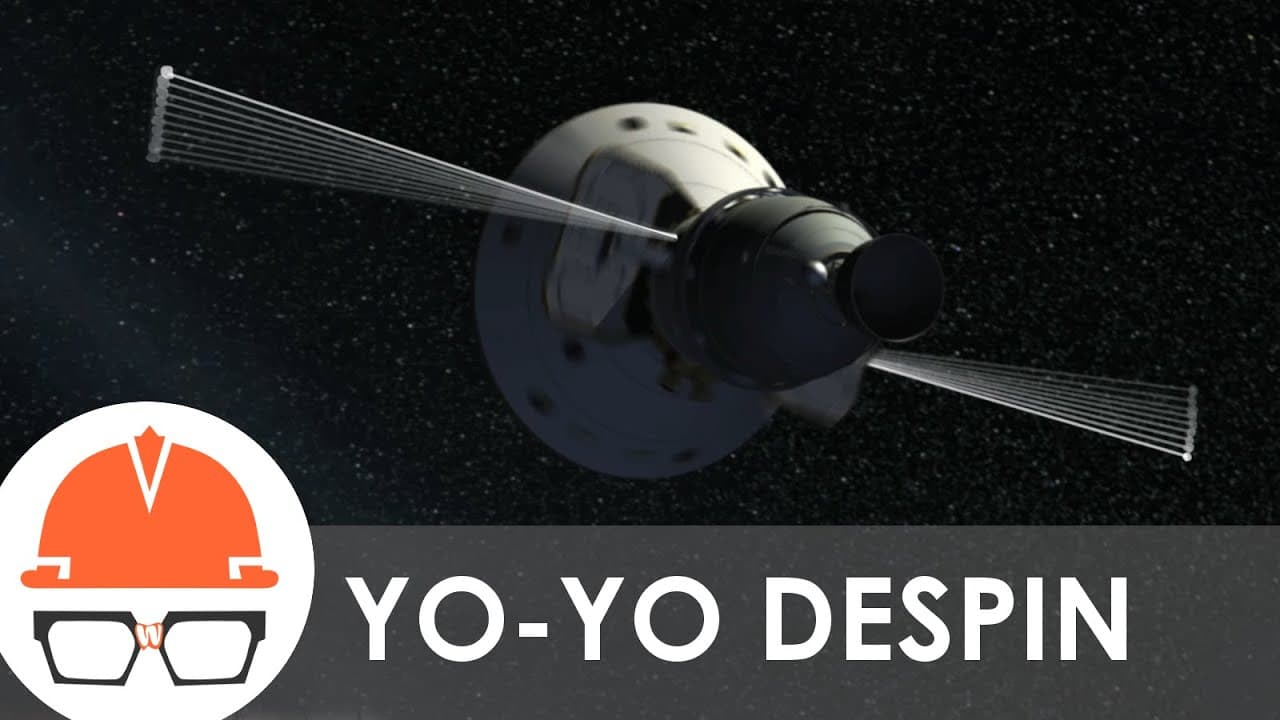
Can a satellite do a yo-yo trick?
TL;DR
Explains how spacecraft use yo-yo de-spin for stabilization.
Transcript
controlling a spacecraft is a little bit different than controlling an Earthly vehicle like a car or a plane mainly because outside Earth's atmosphere there's not much to push off of but aerospace engineers have some ingenious ways to get rockets and satellites where they're going you may have seen the yo-yo trick called around the world but you pr... Read More
Key Insights
- Spacecraft attitude control is crucial for maintaining the correct orientation in space, using various methods to counteract torques.
- Spin stabilization is a simple and effective method for attitude control, leveraging the gyroscopic effect to resist changes in orientation.
- The yo-yo de-spin technique involves deploying masses to increase moment of inertia, reducing angular velocity and stopping the spin.
- Attitude control methods must be reliable and simple due to the challenges of repairing spacecraft in space.
- The yo-yo de-spin mechanism uses basic physics principles, similar to a figure skater's spin, to achieve despinning.
- Engineers must consider factors like tether length and mass for effective yo-yo de-spin design, ensuring no space debris is created.
- The demonstration model uses fishing weights and quick-release mechanisms to illustrate the yo-yo de-spin concept.
- Despite its simplicity, the yo-yo de-spin mechanism is a clever application of physics, critical for space missions.
Install to Summarize YouTube Videos and Get Transcripts
Explore YouTube Video Summarizer or Get YouTube Transcript Extractor
Questions & Answers
Q: What is the primary challenge in spacecraft attitude control?
The primary challenge in spacecraft attitude control is maintaining the correct orientation in space, counteracting various torques that can affect the spacecraft. These torques can arise from aerodynamic forces, variations in gravity, magnetic fields, and internal imbalances, making it essential to have effective control methods.
Q: How does spin stabilization work for spacecraft?
Spin stabilization works by rotating the spacecraft around its main axis, leveraging the gyroscopic effect to resist changes in orientation. This method is simple and doesn't require additional moving parts, making it reliable for maintaining stability in space, although it may require subsequent despinning to prevent interference with instruments.
Q: What is the yo-yo de-spin technique?
The yo-yo de-spin technique involves deploying small masses attached to tethers from the spinning spacecraft. As the masses move outward, they increase the moment of inertia, which reduces the angular velocity and stops the spin. This method uses basic physics principles to achieve despinning without external forces.
Q: Why is simplicity important in spacecraft engineering?
Simplicity is crucial in spacecraft engineering because complex systems are more prone to failures, which are challenging to repair in space. Simple, reliable methods like spin stabilization and yo-yo de-spin reduce the risk of malfunctions, ensuring the spacecraft can maintain its mission-critical orientation without requiring maintenance.
Q: What are the key factors in designing a yo-yo de-spin mechanism?
Key factors in designing a yo-yo de-spin mechanism include the length of the tethers and the mass of the deployed weights. These parameters determine the effectiveness of the despin process, ensuring the spacecraft's angular momentum is adequately reduced without creating space debris or other complications.
Q: How does the demonstration model illustrate the yo-yo de-spin concept?
The demonstration model uses a disc with fishing weights attached to tethers, which are released using quick-release mechanisms. As the weights unwind, they increase the moment of inertia, reducing the spin rate. This model visually demonstrates the physics behind the yo-yo de-spin technique in a controlled environment.
Q: What is the significance of the gyroscopic effect in spin stabilization?
The gyroscopic effect is significant in spin stabilization because it allows the rotating spacecraft to resist changes in orientation. This effect is similar to how a spinning gyroscope maintains its axis, providing a simple and effective method for keeping the spacecraft stable despite external torques and disturbances.
Q: What are the potential issues with the yo-yo de-spin technique?
Potential issues with the yo-yo de-spin technique include the risk of creating space debris if the released masses are not adequately controlled. Engineers must design the mechanism to ensure the masses do not contribute to the growing problem of space junk, while still effectively reducing the spacecraft's angular momentum.
Summary & Key Takeaways
-
The video explains spacecraft attitude control, focusing on the yo-yo de-spin technique used to stabilize satellites after spin stabilization. By releasing masses attached to tethers, the moment of inertia increases, reducing angular velocity and stopping the spin.
-
Spin stabilization is a widely-used technique for spacecraft attitude control, leveraging the gyroscopic effect. However, the resulting spin can interfere with instruments, necessitating a despin method like the yo-yo de-spin.
-
The demonstration model uses fishing weights and quick-release mechanisms to show how the yo-yo de-spin works. The video highlights the importance of simplicity and reliability in spacecraft engineering to avoid complications in space.
Read in Other Languages (beta)
Share This Summary 📚
Summarize YouTube Videos and Get Video Transcripts with 1-Click
Try YouTube Summary with ChatGPT & Claude or YouTube Transcript Generator
Explore More Summaries from Practical Engineering 📚





Summarize YouTube Videos and Get Video Transcripts with 1-Click
Try YouTube Summary with ChatGPT & Claude or YouTube Transcript Generator