How Does the Superposition Theorem Work?
TL;DR
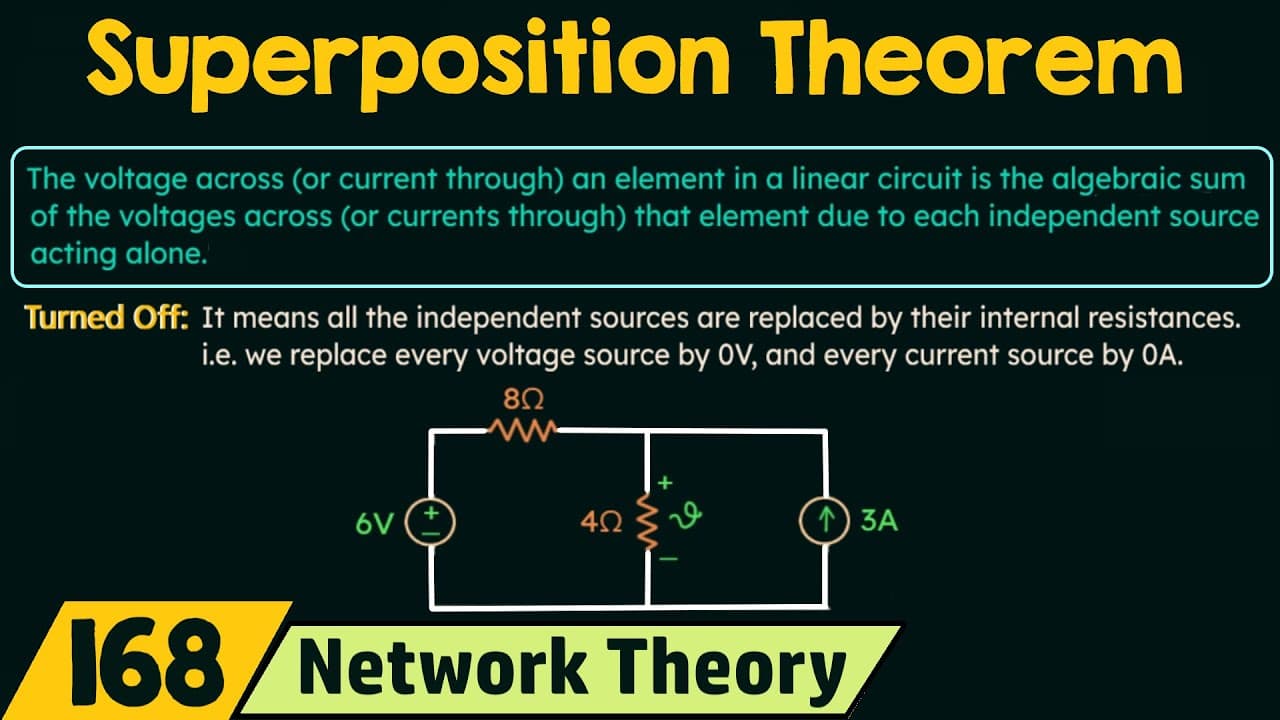
The superposition theorem states that in linear circuits, the total voltage or current across an element is the algebraic sum of individual responses from each independent source. To apply this theorem, turn off other sources by replacing voltage sources with short circuits and current sources with open circuits. Note that this method does not apply to non-linear circuits, and dependent sources remain active.
Transcript
in this lecture we are going to have discussion on superposition theorem we will see what is superposition theorem and how to use this theorem to do the analysis of linear bi-directional networks and we will start with the statement of superposition theorem superposition theorem states that the voltage across all the current through an element in a... Read More
Key Insights
- 😃 Superposition theorem allows us to simplify the analysis of linear bi-directional networks with multiple independent sources.
- ℹ️ The theorem states that the response in any element is the sum of responses obtained with one source acting at a time while turning off the other sources.
- ℹ️ Turning off independent sources involves short-circuiting voltage sources and open-circuiting current sources.
- ↩️ Dependent sources are not turned off in the superposition theorem.
Install to Summarize YouTube Videos and Get Transcripts
Explore YouTube Video Summarizer or Get YouTube Transcript Extractor
Questions & Answers
Q: What is the superposition theorem?
The superposition theorem states that the response in any element of a linear circuit with multiple independent sources is the sum of responses obtained with one source acting at a time while turning off the other sources.
Q: How do we turn off independent sources in the superposition theorem?
To turn off voltage sources, we short-circuit them, and to turn off current sources, we open-circuit them. This allows us to analyze the circuit with one source at a time.
Q: Can we turn off dependent sources in the superposition theorem?
No, dependent sources are not turned off in the superposition theorem. They are left as they are while analyzing the circuit with one independent source at a time.
Q: When is the superposition theorem not valid?
The superposition theorem is not valid in non-linear circuits. It only applies to linear circuits where the relationship between voltage and current is linear.
Key Insights:
- Superposition theorem allows us to simplify the analysis of linear bi-directional networks with multiple independent sources.
- The theorem states that the response in any element is the sum of responses obtained with one source acting at a time while turning off the other sources.
- Turning off independent sources involves short-circuiting voltage sources and open-circuiting current sources.
- Dependent sources are not turned off in the superposition theorem.
- The superposition theorem is only valid for linear circuits and does not apply to non-linear circuits.
Summary & Key Takeaways
-
Superposition theorem states that the voltage across or current through an element in a linear circuit is the algebraic sum of the voltages or currents due to each independent source acting alone.
-
To apply the superposition theorem, turn off the independent sources by short-circuiting voltage sources and open-circuiting current sources.
-
Superposition theorem is not valid in non-linear circuits and dependent sources are not turned off.
Read in Other Languages (beta)
Share This Summary 📚
Summarize YouTube Videos and Get Video Transcripts with 1-Click
Try YouTube Summary with ChatGPT & Claude or YouTube Transcript Generator
Explore More Summaries from Neso Academy 📚




Summarize YouTube Videos and Get Video Transcripts with 1-Click
Try YouTube Summary with ChatGPT & Claude or YouTube Transcript Generator