Simple Machines (3 of 7) Pulleys; Calculating Forces, Distances, MA, Part 2
TL;DR
Calculate input force and distance for simple machines; understand work principles.
Transcript
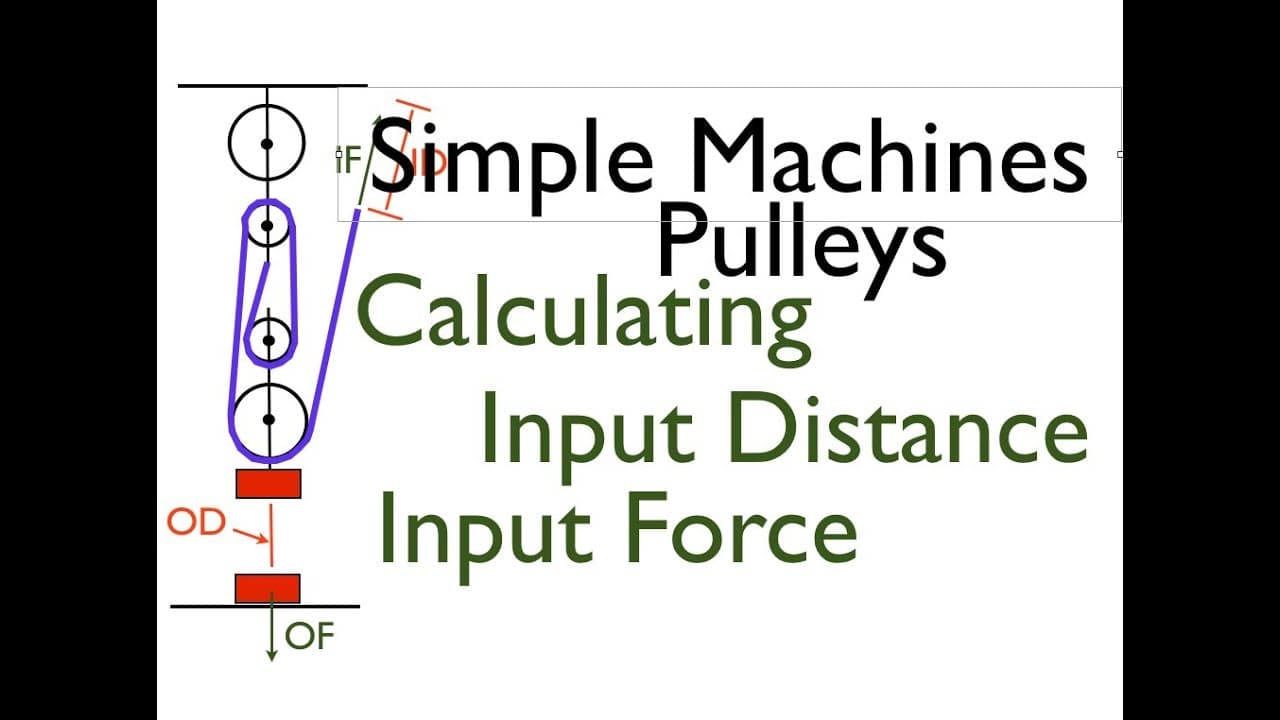
okay in today's video I'm going to go over two problems where we're going to calculate the input force and the uh input distance for simple machines and specifically as you can see for pce let's get started here's our simple pulley we're going to use this as our machine we have the upper pulley we have the lower pulley we have the object that we're... Read More
Key Insights
- 🦾 Calculating input force for a simple machine involves dividing the output force by the mechanical advantage.
- 🦾 Mechanical advantage can be easily determined in a pulley system by counting the supporting strings.
- 🦾 Input distance for a simple machine is calculated by multiplying the output distance by the mechanical advantage.
- 💦 Work remains the same regardless of using a simple machine, as demonstrated by input force and distance calculations.
- 💦 Understanding the principles of work in physics helps in realizing that machines do not make work easier.
- 💦 Simple machines play a role in changing the direction or magnitude of a force, but they do not reduce the amount of work done.
- 🔠 The relationship between input force, output force, input distance, and output distance is crucial in analyzing simple machines.
Install to Summarize YouTube Videos and Get Transcripts
Explore YouTube Video Summarizer or Get YouTube Transcript Extractor
Questions & Answers
Q: How is the input force calculated for a simple machine?
The input force for a simple machine is calculated by dividing the output force by the mechanical advantage of the machine. In the case of a pulley, this calculation helps determine how much force to apply to raise an object.
Q: What is the significance of determining the mechanical advantage of a pulley system?
Determining the mechanical advantage of a pulley system allows for understanding how the machine multiplies the input force. This information is crucial in calculating the input force required to lift an object with a known weight.
Q: How does the input distance relate to the output distance in a simple machine?
The input distance is determined by multiplying the output distance by the mechanical advantage of the machine. For a pulley system, this calculation shows how much distance the string needs to be pulled to raise the object the desired height.
Q: Why is it stated that simple machines do not make work easier?
While simple machines can help in changing the direction or magnitude of a force, they do not reduce the amount of work done. The input force and distance calculations demonstrate that work remains constant, proving that machines do not make work easier in a physics sense.
Summary & Key Takeaways
-
The video explains how to calculate input force and distance for a simple pulley machine.
-
The mechanical advantage is determined by counting the number of supporting strings.
-
Input force and distance calculations show that work remains consistent despite using simple machines.
Read in Other Languages (beta)
Share This Summary 📚
Summarize YouTube Videos and Get Video Transcripts with 1-Click
Try YouTube Summary with ChatGPT & Claude or YouTube Transcript Generator
Explore More Summaries from Step by Step Science 📚

Summarize YouTube Videos and Get Video Transcripts with 1-Click
Try YouTube Summary with ChatGPT & Claude or YouTube Transcript Generator