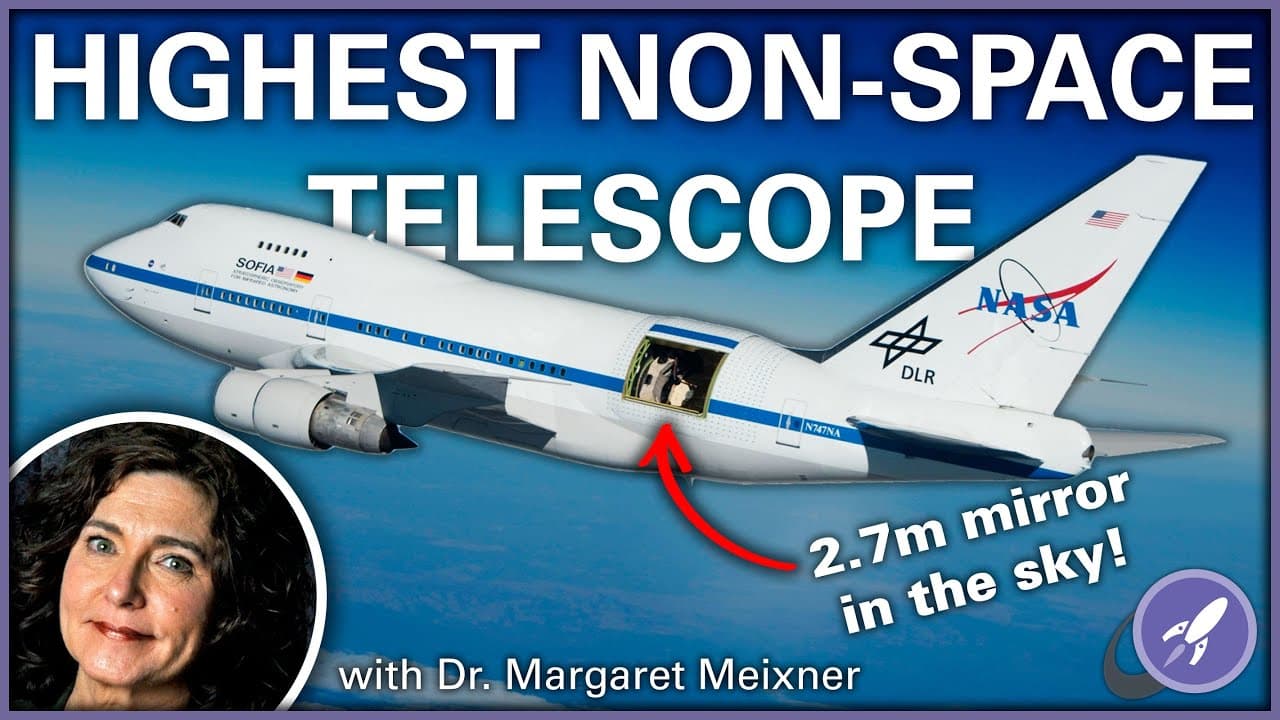
SOFIA the Flying Telescope with Dr. Margaret Meixner
TL;DR
- Dr. Margaret Meixner discusses the unique capabilities and discoveries of the Sofia Telescope in space exploration.
Transcript
hi everyone i'm fraser kane i'm the publisher of universe today i've been a space and astronomy journalist for over 20 years and in addition to all of the news and questions that i like to answer i like to bring you behind the scenes and interview some of the people who are actually generating creating the news in the first place and uh today i've ... Read More
Key Insights
- 🧑🌾 Sofia Telescope is a unique observatory on a Boeing 747 that studies far-infrared radiation.
- 🤩 The telescope's observations of gas, dust, and cooling lines provide critical insights into star and galaxy formation.
- 😒 Sofia's use of cryo coolers enables high-resolution spectroscopy without cooling the telescope itself.
- 💦 Understanding water presence in cosmic bodies like the Moon contributes to theories of Earth's water origins.
- 🤩 Sofia plays a pivotal role in studying magnetic fields and their impact on star formation.
- 👻 The telescope's high spectral resolution allows detailed observations of cosmic phenomena.
- ❓ Sofia's ability to conduct repeatable observations offers unique opportunities for pathfinding in astronomy.
Install to Summarize YouTube Videos and Get Transcripts
Explore YouTube Video Summarizer or Get YouTube Transcript Extractor
Questions & Answers
Q: What makes the Sofia Telescope unique in the realm of space telescopes?
The Sofia Telescope stands out as the only far-infrared observatory in the world, flying on a modified aircraft to reach the stratosphere and study elusive aspects of the universe.
Q: How does Sofia enable the study of star and galaxy formation through its observations?
Sofia's ability to reach above 99.9% of water vapor in the atmosphere allows it to detect far-infrared radiation crucial for understanding the creation of new stars and galaxies through gas and dust observations.
Q: Could Sofia Telescope's findings about water in the Moon's regolith offer insights into Earth's water origins?
Sofia's discovery of water on the Moon helps astronomers understand the water composition in celestial bodies closer to Earth, contributing to theories about the origin of Earth's oceans.
Q: What role does Sofia play in studying magnetic fields and their impact on star formation?
Sofia's measurements of magnetic fields using dust grains' orientation help unravel the influence of magnetic fields on star formation, offering insights into galactic evolution and stellar feedback mechanisms.
Summary & Key Takeaways
-
Dr. Meixner describes Sofia as a far-infrared observatory with a telescope on a Boeing 747.
-
Sofia flies into the stratosphere to observe the universe, studying gas, dust, and cooling lines crucial for understanding star and galaxy formation.
-
The telescope does not cool down but uses cryo coolers to reach near-absolute zero temperatures for detecting radiation.
Read in Other Languages (beta)
Share This Summary 📚
Summarize YouTube Videos and Get Video Transcripts with 1-Click
Try YouTube Summary with ChatGPT & Claude or YouTube Transcript Generator
Explore More Summaries from Fraser Cain 📚

Summarize YouTube Videos and Get Video Transcripts with 1-Click
Try YouTube Summary with ChatGPT & Claude or YouTube Transcript Generator