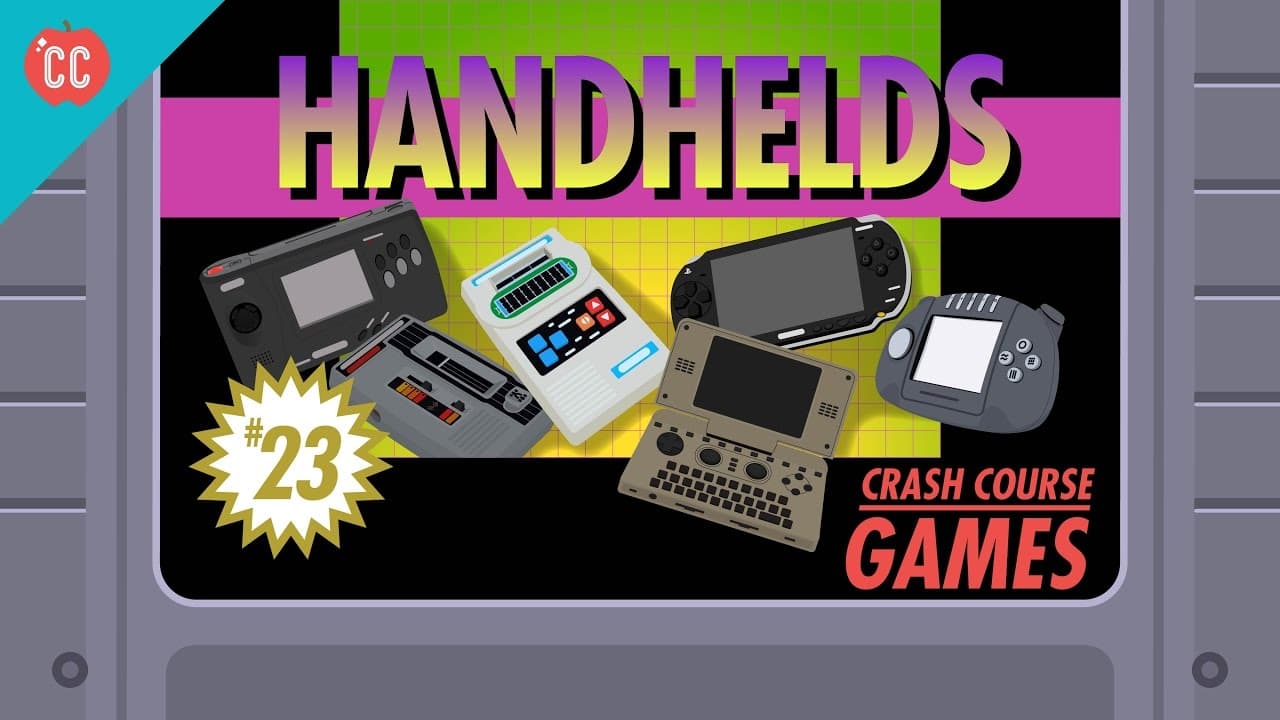
Handhelds: Crash Course Games #23
TL;DR
Handheld consoles evolved from simple devices to advanced gaming systems.
Transcript
Hi! I’m Andre Meadows and this is Crash Course Games. Today, we are going to look at how handhelds came to be, what made them popular, and why their future may not look so bright. A handheld game console takes the home console – the screen, speakers, controls, and the actual computer – and wraps it up in a neat package that can be carried and playe... Read More
Key Insights
- Handheld game consoles originated in the 1970s with simple devices like Mattel's Auto Race, evolving significantly over decades.
- Mattel's Auto Race, developed by Mark Lesser, was the first electronic handheld game, setting the stage for future developments.
- Nintendo's Game Boy, released in 1989, became a major success due to its affordability and game selection, despite not being the most advanced.
- Sega challenged Nintendo with the Game Gear, but ultimately couldn't compete due to issues like power consumption and bulkiness.
- Sony entered the handheld market with the PSP in 2005, offering strong competition with its multimedia capabilities.
- Handheld convergence devices, like the Tiger game.com, attempted to merge gaming with internet access but largely failed.
- Mobile gaming on smartphones and tablets presents a significant challenge to traditional handheld consoles due to convenience.
- Nintendo continues to innovate in the handheld market, potentially redefining it with devices like the rumored Nintendo NX.
Install to Summarize YouTube Videos and Get Transcripts
Explore YouTube Video Summarizer or Get YouTube Transcript Extractor
Questions & Answers
Q: What was the first electronic handheld game?
The first electronic handheld game was Mattel's Auto Race, released in 1976. It was developed by Mark Lesser, who repurposed a calculator chip to create the game. Despite initial skepticism, Auto Race exceeded expectations and laid the groundwork for future handheld gaming devices.
Q: How did Nintendo's Game Boy achieve success?
Nintendo's Game Boy achieved success due to its affordable price, extensive game library, and strategic bundling with popular games like Tetris. Despite not being the most technologically advanced, its accessibility and engaging game selection made it a favorite among consumers, selling over 118 million units.
Q: What challenges did Sega face with their handheld consoles?
Sega faced several challenges with their handheld consoles, including the Game Gear and Sega Nomad. The Game Gear's color screen and game selection were appealing, but its high power consumption and bulkiness were drawbacks. The Nomad, while offering a large game library, struggled with portability and battery life.
Q: How did Sony's PSP compete in the handheld market?
Sony's PSP entered the handheld market in 2005, offering strong competition with its sleek design, powerful hardware, and multimedia capabilities. It sold 82 million units, providing a more console-like experience compared to other handhelds. Despite its high price, the PSP was well-regarded for its features and design.
Q: What were handheld convergence devices, and why did they fail?
Handheld convergence devices attempted to combine gaming with internet access, like the Tiger game.com. They failed due to poor execution, limited game libraries, and inadequate internet capabilities. These devices couldn't compete with the rise of mobile gaming, which offered more comprehensive and accessible solutions.
Q: Why is mobile gaming a challenge for handheld consoles?
Mobile gaming on smartphones and tablets poses a challenge for handheld consoles due to their convenience and multifunctionality. These devices allow users to play games without needing a separate gaming device, offering a wide variety of games and applications that appeal to a broad audience.
Q: What is the potential future of handheld gaming with Nintendo?
Nintendo continues to innovate in the handheld market, with potential new devices like the rumored Nintendo NX. This device is speculated to be a hybrid of home and portable consoles, aiming to redefine the market by combining the best features of both. Nintendo's ongoing innovation suggests a commitment to the handheld market despite challenges.
Q: What advantages do dedicated gaming devices have over mobile gaming?
Dedicated gaming devices offer advantages over mobile gaming, such as superior controls, more immersive gaming experiences, and the ability to play high-quality games specifically designed for these platforms. While mobile gaming is convenient, dedicated devices often provide a more satisfying gaming experience for enthusiasts.
Summary & Key Takeaways
-
Handheld consoles began in the 1970s with basic devices using lights and simple displays. Over time, they evolved into more sophisticated systems like the Game Boy and PSP, offering better graphics and more features. Despite these advancements, the rise of mobile gaming has challenged the handheld market.
-
Nintendo's Game Boy revolutionized handheld gaming with its affordable price and extensive game library. Other companies like Sega and Sony also contributed to the market, but Nintendo remained dominant. Handheld convergence devices attempted to combine gaming with internet access but failed to gain traction.
-
The future of handheld gaming is uncertain due to the popularity of mobile gaming. However, Nintendo continues to innovate, with potential new devices like the Nintendo NX that could redefine the market. Despite challenges, dedicated gaming devices still offer advantages like better controls.
Read in Other Languages (beta)
Share This Summary 📚
Summarize YouTube Videos and Get Video Transcripts with 1-Click
Try YouTube Summary with ChatGPT & Claude or YouTube Transcript Generator
Explore More Summaries from CrashCourse 📚






Summarize YouTube Videos and Get Video Transcripts with 1-Click
Try YouTube Summary with ChatGPT & Claude or YouTube Transcript Generator