Gravitation (14 of 17) Total Mechanical Energy of a Satellite Orbiting Earth
TL;DR
Calculating total mechanical energy of Sputnik through potential and kinetic energy equations.
Transcript
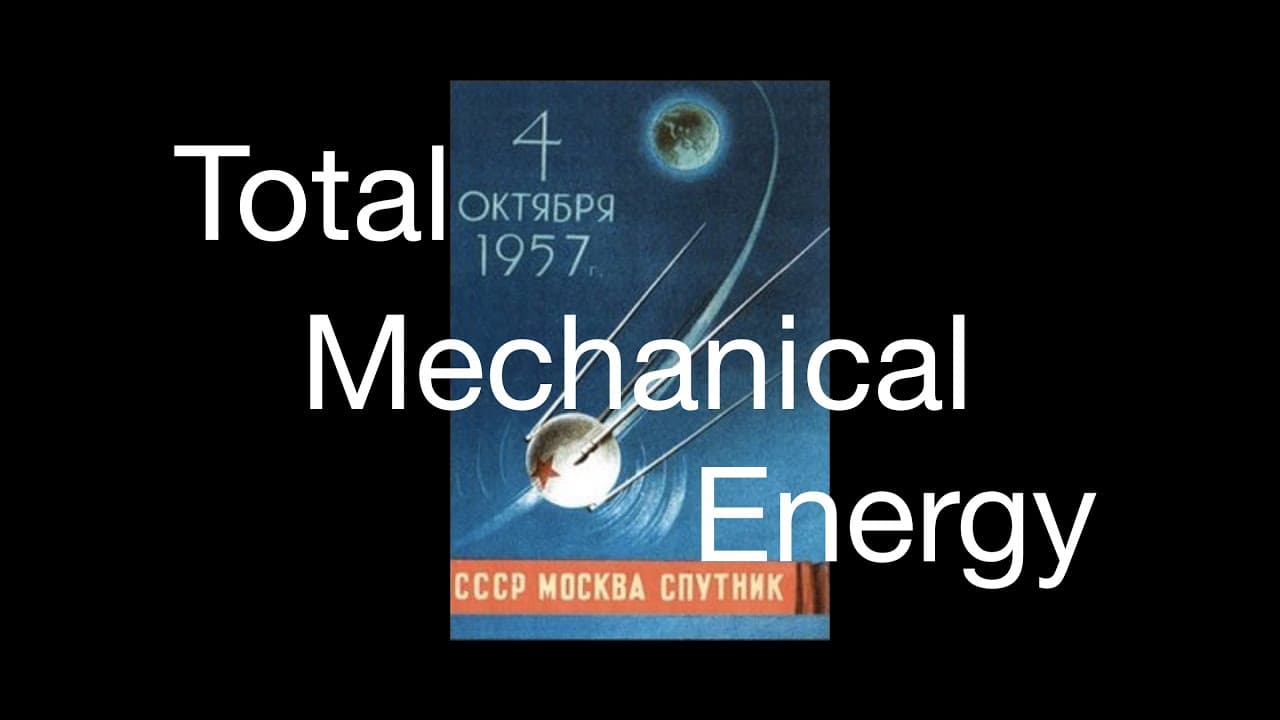
okay as you can see in today's video we're going to go over a problem involving gravitation and we're going to be calculating the total mechanical energy of this little puppy right here this is actually once again she would Nick but Nick you'll remember was launched in October on October 4th 1955 55 57 then I where I got 55 from 57 it was the first... Read More
Key Insights
- 🖐️ Gravitational constant and masses play a crucial role in calculating potential energy of orbiting objects.
- 🦾 Total mechanical energy is the sum of potential and kinetic energy, showcasing the balance in an orbiting system.
- ❓ Kinetic energy is directly related to orbital velocity, highlighting the significance of motion in energy calculations.
- 🛰️ Understanding the relationship between potential and kinetic energies provides insights into the energy dynamics of orbiting objects.
- 🤘 The negative sign in potential energy signifies the attractive nature of gravity in orbiting systems.
- 🫵 Energy equations offer a holistic view of the energy state of objects in gravitational fields.
- 🦾 Utilizing distance and masses in energy calculations enables accurate determination of total mechanical energy in orbital scenarios.
Install to Summarize YouTube Videos and Get Transcripts
Explore YouTube Video Summarizer or Get YouTube Transcript Extractor
Questions & Answers
Q: How is the total mechanical energy of Sputnik calculated?
The total mechanical energy is calculated by summing the potential and kinetic energies, derived from gravitational constant, masses, and distance in the orbiting system.
Q: Why is there a negative sign in the potential energy equation?
The negative sign in the potential energy equation denotes the attractive nature of gravity, indicating that the system is bound and energy is released when objects are separated.
Q: What is the significance of adding potential and kinetic energies for total mechanical energy?
Adding potential and kinetic energies provides a comprehensive understanding of the energy state of an orbiting object, showcasing the balance between its stored and motion energies.
Q: How does the calculation of kinetic energy relate to the orbital velocity of Sputnik?
By substituting orbital velocity into the kinetic energy equation, the relationship between velocity, mass, and distance in orbiting systems is established, unveiling the connection between energy and motion.
Summary & Key Takeaways
-
Explaining the calculation of total mechanical energy of Sputnik using potential and kinetic energy equations.
-
Utilizing the gravitational constant, masses of Earth and Sputnik, and distance for calculations.
-
Highlighting the relationship between potential and kinetic energies in orbiting objects.
Read in Other Languages (beta)
Share This Summary 📚
Summarize YouTube Videos and Get Video Transcripts with 1-Click
Try YouTube Summary with ChatGPT & Claude or YouTube Transcript Generator
Explore More Summaries from Step by Step Science 📚
Summarize YouTube Videos and Get Video Transcripts with 1-Click
Try YouTube Summary with ChatGPT & Claude or YouTube Transcript Generator