Protecting from Solar Flares, Tiny Rockets, Oldest Possible Ice | Q&A 209
TL;DR
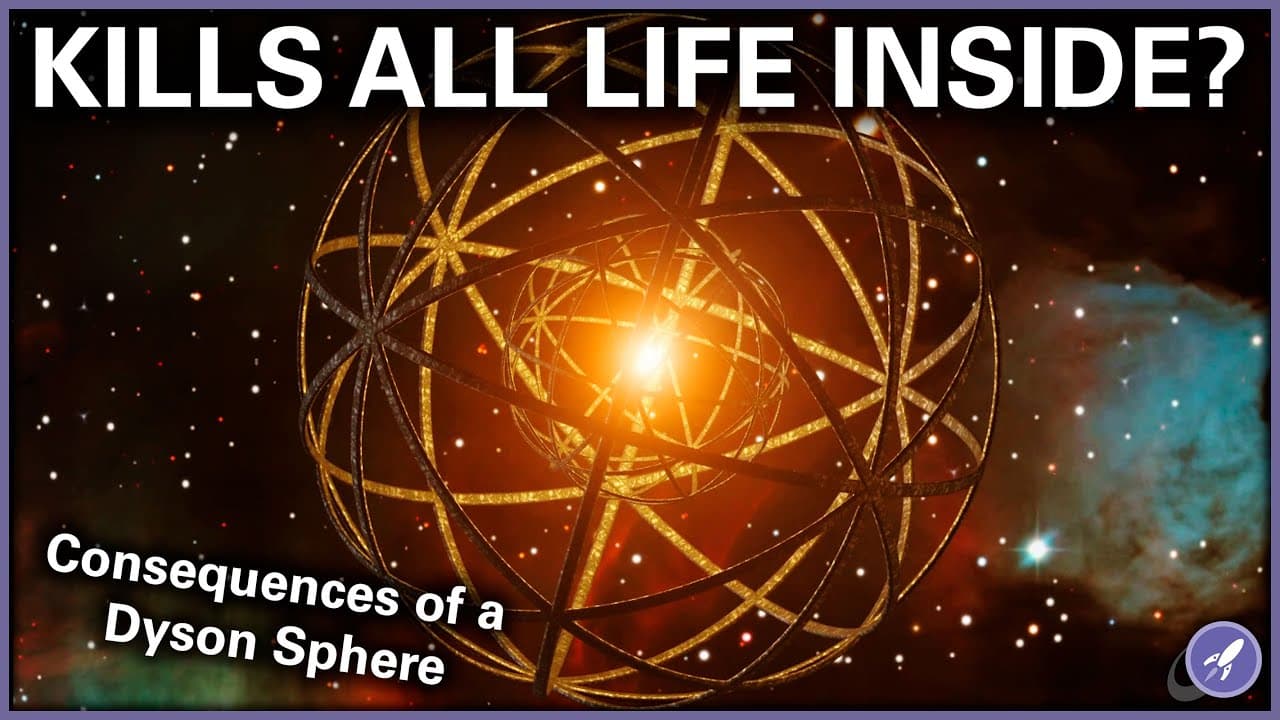
Solar sails can navigate spacecraft using sunlight, and positioning a Dyson Sphere near Earth could impact its livability.
Transcript
should every spacecraft have a solar sail would a Dyson Sphere make the Earth unlivable and why are planets spheres all this and more in this week's question show all right welcome to the question show your questions my answers now as always wherever you are across my channel if a question pops into your brain just write it down just like as a comm... Read More
Key Insights
- 🥶 Solar sails utilize sunlight for propulsion, offering a free and slow but effective method of navigation in space.
- 🥵 Dyson Spheres, if positioned near Earth, could reflect sunlight and heat, possibly impacting the planet's environment.
- 🪐 Planets, including Earth, are spherical due to gravity overcoming material resistance, ensuring hydrostatic equilibrium.
- ✊ The introduction of a Dyson Swarm around the Sun could pose challenges but could harness enormous solar power.
- 🙂 Detecting artificial light on exoplanets like Proxima B would be revealing but requires advanced telescopes and observation methods.
- 🥶 The universe's first ice potentially formed around 17 million years after the Big Bang if conditions were suitable.
- 🏗️ The construction of a Dyson Sphere involves building an array of satellites to harness solar energy, possibly reconfiguring energy usage on Earth in the future.
Install to Summarize YouTube Videos and Get Transcripts
Explore YouTube Video Summarizer or Get YouTube Transcript Extractor
Questions & Answers
Q: How do solar sails work in navigating spacecraft without fuel?
Solar sails utilize sunlight to propel spacecraft by reflecting light off the sail, causing thrust and altering the orbit.
Q: How could positioning a Dyson Sphere near Earth impact the planet's livability?
Proximity of a Dyson Sphere could reflect excess light and heat back to Earth, potentially causing adverse effects on the planet's environment.
Q: Why are planets spherical in shape?
Planets become spherical due to hydrostatic equilibrium, where gravity overcomes the tensile strength of the materials, smoothening out the planet's surface.
Q: Could an irregularly-shaped planet the size of Earth exist?
No, the Earth's gravity and material properties cause it to form a sphere, with mountains being stunted by gravity's continuous effort to level the surface.
Q: When could ice first form in the universe?
Ice could potentially form in the universe around 17 million years after the Big Bang if oxygen and appropriate conditions existed for water to freeze.
Summary & Key Takeaways
-
Solar sails act as propulsion by using sunlight to navigate spacecraft around the solar system.
-
Dyson Spheres, if positioned near Earth, could have detrimental effects due to reflected light and heat emissions.
-
Planets are spherical due to hydrostatic equilibrium, ensuring gravity overcomes material compressibility.
Read in Other Languages (beta)
Share This Summary 📚
Summarize YouTube Videos and Get Video Transcripts with 1-Click
Try YouTube Summary with ChatGPT & Claude or YouTube Transcript Generator
Explore More Summaries from Fraser Cain / Universe Today Podcast 📚



Summarize YouTube Videos and Get Video Transcripts with 1-Click
Try YouTube Summary with ChatGPT & Claude or YouTube Transcript Generator