Gatterman Koch Reaction
TL;DR
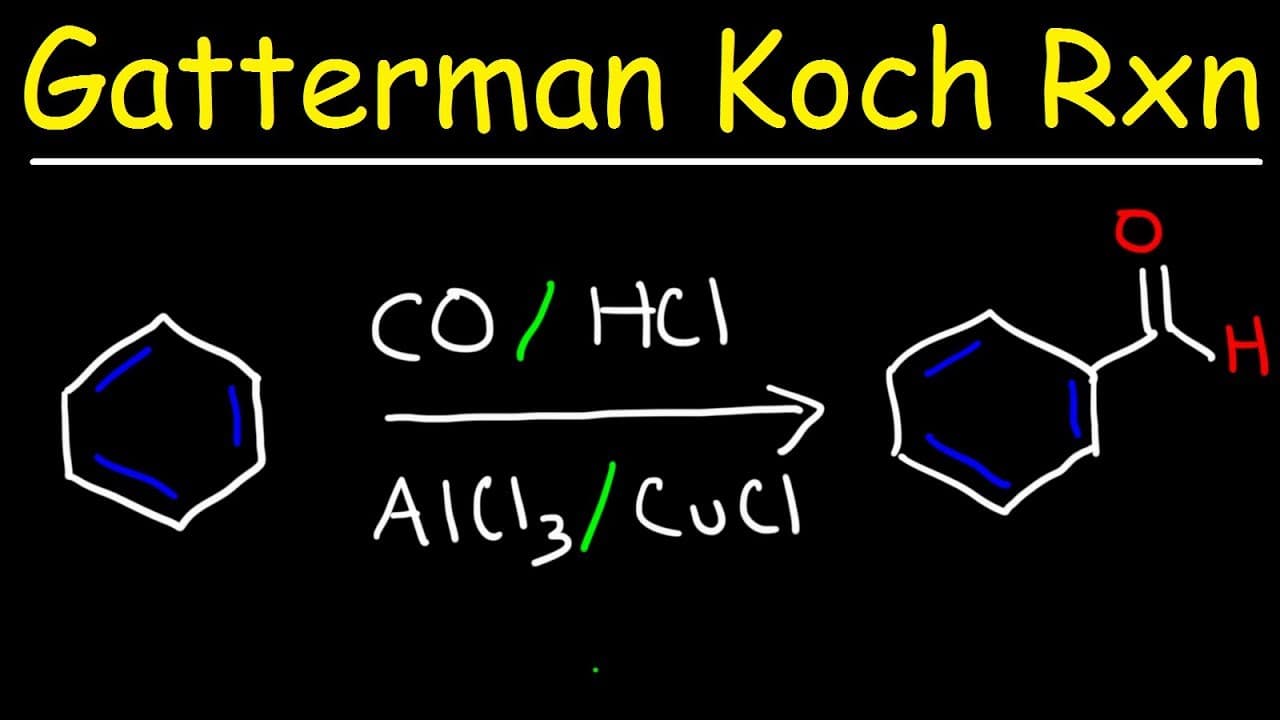
The Gatamine Koch Formulation Reaction converts benzene into benzaldehyde using carbon monoxide, hydrochloric acid, aluminum chloride, and copper chloride.
Transcript
in this video we're going to focus on the gatamine formulation reaction and this reaction basically converts benzene into benzaldehyde and the reagents that are part of this reaction include carbon monoxide hydrochloric acid aluminum chloride and copper chloride and so the end result is that you're replacing a hydrogen atom with an aldehyde functio... Read More
Key Insights
- ❓ The Gatamine Koch Formulation Reaction is a useful method for converting benzene into benzaldehyde.
- 🤩 Carbon monoxide, hydrochloric acid, aluminum chloride, and copper chloride are the key reagents in this reaction.
- 💁 The reaction proceeds through the formation of an unstable acid chloride and a formal cation intermediate.
- 🧑🏭 The reaction involves electrophilic aromatic substitution, with benzene acting as the nucleophile and the formal cation as the electrophile.
- 😋 Regeneration of the aromatic ring is achieved by using a base to remove the hydrogen atom from the carbon.
- ❓ The Gatamine Koch Formulation Reaction is a stepwise process involving multiple reaction steps and intermediates.
- ❓ This reaction can be modulated by varying the reagents or reaction conditions to achieve different products.
Install to Summarize YouTube Videos and Get Transcripts
Explore YouTube Video Summarizer or Get YouTube Transcript Extractor
Questions & Answers
Q: What is the purpose of the Gatamine Koch Formulation Reaction?
The purpose of this reaction is to convert benzene into benzaldehyde by replacing a hydrogen atom with an aldehyde functional group.
Q: What are the reagents involved in the Gatamine Koch Formulation Reaction?
The reagents involved in this reaction are carbon monoxide, hydrochloric acid, aluminum chloride, and copper chloride.
Q: How does the reaction proceed in the first step?
In the first step, carbon monoxide reacts with hydrochloric acid reversibly to produce an unstable acid chloride called formal chloride.
Q: How is the aromatic ring regenerated in the final step?
The aromatic ring is regenerated by using a base to remove the hydrogen atom from the carbon, breaking the carbon-hydrogen bond and regenerating the pi bond, resulting in the formation of benzaldehyde as the final product.
Summary & Key Takeaways
-
The Gatamine Koch Formulation Reaction converts benzene into benzaldehyde by replacing a hydrogen atom with an aldehyde functional group.
-
The reaction involves the use of carbon monoxide, hydrochloric acid, aluminum chloride, and copper chloride as reagents.
-
The reaction proceeds through the formation of an unstable acid chloride, followed by the generation of a formal cation intermediate, and finally, the regeneration of the aromatic ring using a base.
Read in Other Languages (beta)
Share This Summary 📚
Summarize YouTube Videos and Get Video Transcripts with 1-Click
Try YouTube Summary with ChatGPT & Claude or YouTube Transcript Generator
Explore More Summaries from The Organic Chemistry Tutor 📚




Summarize YouTube Videos and Get Video Transcripts with 1-Click
Try YouTube Summary with ChatGPT & Claude or YouTube Transcript Generator