Solar cells - working (and difference from photodiodes) | Semiconductors | Physics | Khan Academy
TL;DR
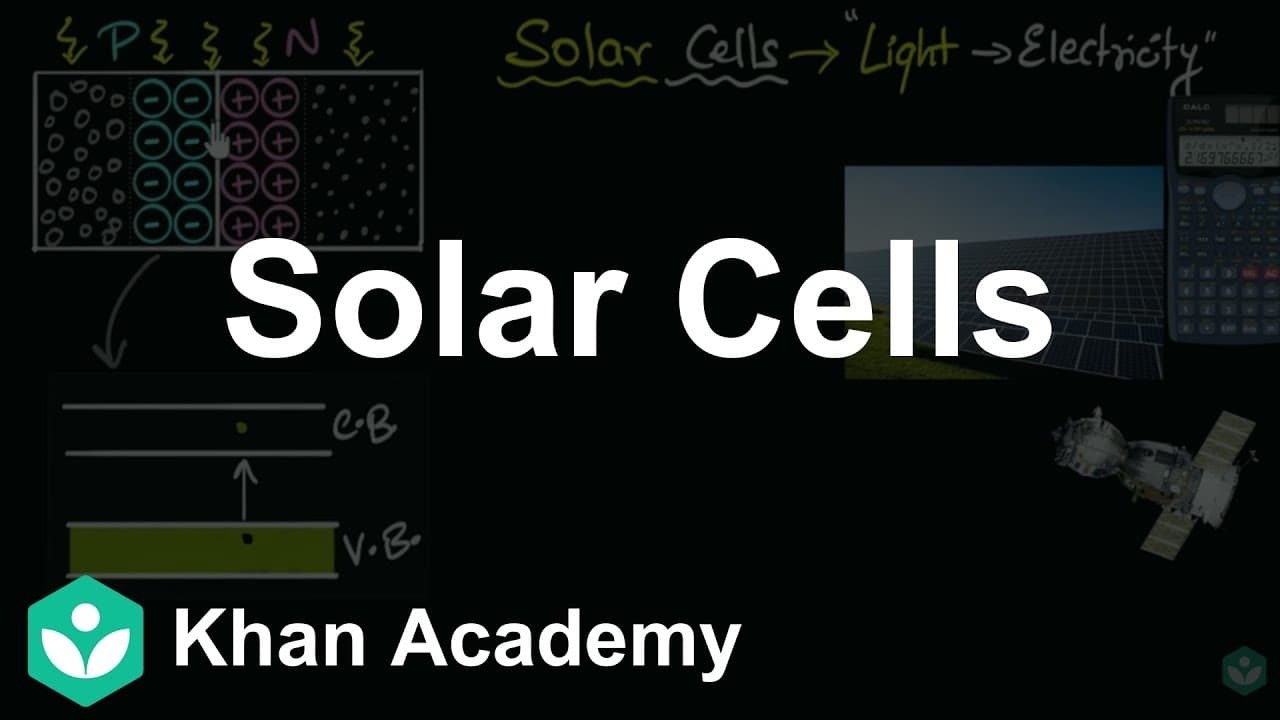
Solar cells are pn junction diodes that convert light into electricity, generating voltage and current through the photovoltaic effect.
Transcript
let's explore solar cells and see how they work so solar cells are basically pn junction diodes they are semiconductor devices pn junctions which convert light light into electricity electricity and it can be any light but since usually we tend to use sunlight because it's available in abundance we call them solar cells and you probably know where ... Read More
Key Insights
- 🙂 Solar cells are pn junction diodes that convert light into electricity through the photovoltaic effect.
- 🙂 The absorption of light photons in the depletion region of the pn junction creates electron-hole pairs.
- ⚡ The electric field in the depletion region sweeps the pairs apart, creating a voltage.
- 🧑🏭 Solar cells generate a continuous and constant current when connected to an external circuit, acting as a battery.
- 🙂 Photodiodes have a similar principle to solar cells but are used for generating a current proportional to light intensity, without allowing charge accumulation.
- 👷 The application and construction of solar cells and photodiodes differ based on their purpose.
- 👾 Solar cells are widely used in calculators, solar panels for generating electricity, and space probes.
Install to Summarize YouTube Videos and Get Transcripts
Explore YouTube Video Summarizer or Get YouTube Transcript Extractor
Questions & Answers
Q: What are solar cells used for?
Solar cells are used in various applications, including calculators, solar panels for generating electricity in homes, and space probes in outer space. They are an efficient way to convert light into electricity.
Q: How do solar cells generate voltage?
Solar cells generate voltage through the photovoltaic effect. When light photons with sufficient energy are absorbed in the depletion region of the pn junction, electron-hole pairs are formed. Before recombination, the electric field in the depletion region sweeps them apart, creating a voltage.
Q: How does the photovoltaic effect work in solar cells?
The photovoltaic effect in solar cells occurs when light photons with energy higher than the band gap of the semiconductor are absorbed, causing electron-hole pairs to be formed. These pairs are swept apart by the electric field, resulting in the accumulation of charges and the generation of voltage.
Q: How do solar cells differ from photodiodes?
Solar cells and photodiodes are based on the same principle of generating electron-hole pairs through light absorption. However, solar cells allow the charges to accumulate and generate a voltage, while photodiodes do not allow accumulation and are used for generating a current proportional to the light intensity.
Key Insights:
- Solar cells are pn junction diodes that convert light into electricity through the photovoltaic effect.
- The absorption of light photons in the depletion region of the pn junction creates electron-hole pairs.
- The electric field in the depletion region sweeps the pairs apart, creating a voltage.
- Solar cells generate a continuous and constant current when connected to an external circuit, acting as a battery.
- Photodiodes have a similar principle to solar cells but are used for generating a current proportional to light intensity, without allowing charge accumulation.
- The application and construction of solar cells and photodiodes differ based on their purpose.
- Solar cells are widely used in calculators, solar panels for generating electricity, and space probes.
- Understanding the working principle of solar cells helps in harnessing the power of sunlight for renewable energy generation.
Summary & Key Takeaways
-
Solar cells are semiconductor devices that convert light into electricity, commonly used in calculators, solar panels for houses, and space probes.
-
The heart of a solar cell is a pn junction, which consists of a doped semiconductor crystal with donor and acceptor impurities.
-
When light falls on the depletion region of the pn junction, electron-hole pairs are formed, and the electric field in the depletion region sweeps them apart, creating a voltage and current.
Read in Other Languages (beta)
Share This Summary 📚
Summarize YouTube Videos and Get Video Transcripts with 1-Click
Try YouTube Summary with ChatGPT & Claude or YouTube Transcript Generator
Explore More Summaries from Khan Academy India - English 📚


Summarize YouTube Videos and Get Video Transcripts with 1-Click
Try YouTube Summary with ChatGPT & Claude or YouTube Transcript Generator