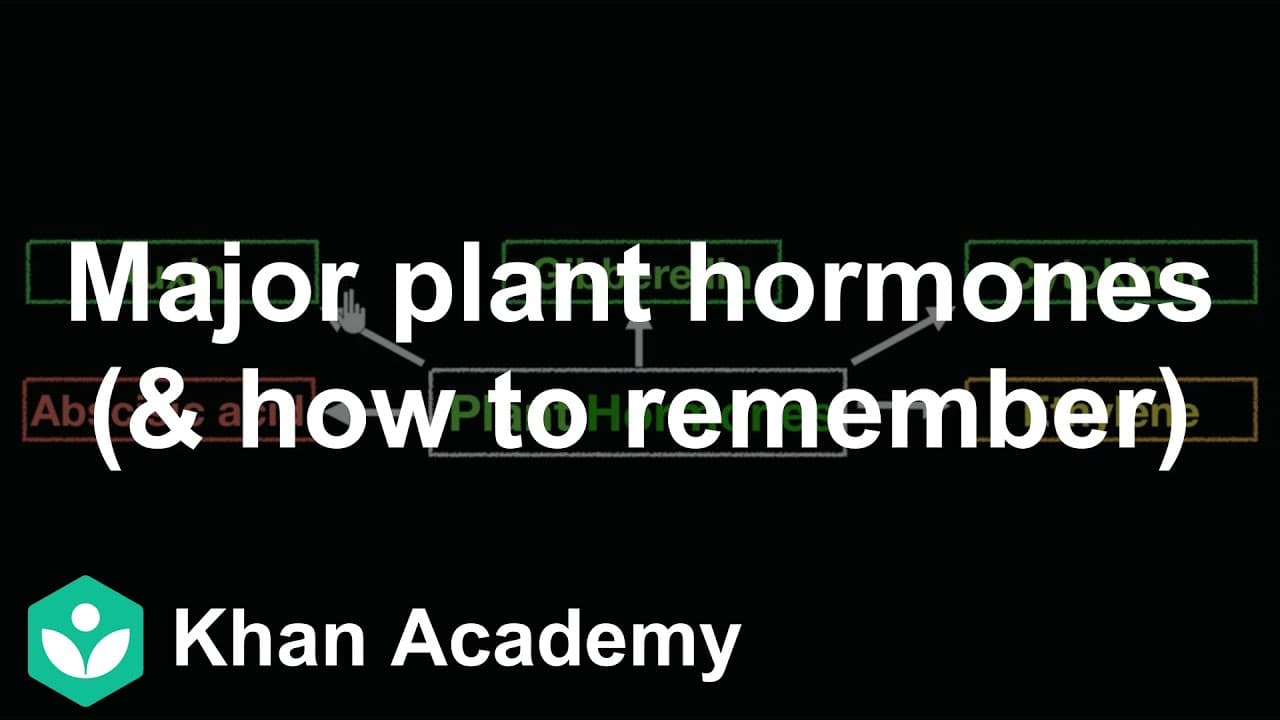
Major plant hormones (& how to remember) | Control & Coordination | Biology | Khan Academy
TL;DR
Learn about five major plant hormones and their functions, including auxin for cell elongation, gibberellin for stem elongation, cytokinin for cell division, abscisic acid for growth inhibition, and ethylene for fruit ripening.
Transcript
let's study the five major plant hormones see what their functions are and more importantly see how to remember them for our exams so let's start with the first one it's called auxin now i've written that in green because that's a growth hormone things which are in green are growth hormone okay so what does auxin do well auxin's main job is to caus... Read More
Key Insights
- ❓ Auxin is a growth hormone that promotes cell elongation and influences phototropism.
- 🌱 Gibberellin is a growth hormone involved in stem elongation, fruit growth, and seed germination.
- 🦻 Cytokinin is responsible for cell division, aiding in leaf and fruit growth, as well as branching.
- 🌱 Abscisic acid regulates stomata closure during drought conditions and inhibits seed germination.
- 🫢 Ethylene is a gas that promotes fruit ripening by breaking down cell walls and triggering a chain reaction.
Install to Summarize YouTube Videos and Get Transcripts
Explore YouTube Video Summarizer or Get YouTube Transcript Extractor
Questions & Answers
Q: How does auxin contribute to phototropism?
Auxin plays a crucial role in phototropism by accumulating on the shaded side of a plant when light is present. This differential accumulation causes the shaded side to elongate more, resulting in the bending of the plant towards the light source.
Q: What is the main function of gibberellin?
Gibberellin primarily promotes stem elongation in plants. It also influences fruit growth and seed germination. Higher levels of gibberellin can lead to taller plants, while lower levels can result in dwarfism.
Q: How does cytokinin contribute to plant growth?
Cytokinin is responsible for cell division in plants, allowing for the creation of new cells. This hormone plays a vital role in promoting leaf growth, fruit development, and branching in plants.
Q: How does abscisic acid regulate water loss in plants?
Abscisic acid ensures stomata closure during drought conditions by accumulating in the stomata cells. This closure prevents water loss through transpiration, helping the plant conserve water.
Q: What is the role of ethylene in fruit ripening?
As a gas, ethylene promotes fruit ripening by breaking down cell walls, making the fruit softer. It also stimulates the release of stored sugars, enhancing the fruit's sweetness. Additionally, ethylene can trigger a chain reaction, accelerating the ripening of nearby fruits.
Key Insights:
-
Auxin is a growth hormone that promotes cell elongation and influences phototropism.
-
Gibberellin is a growth hormone involved in stem elongation, fruit growth, and seed germination.
-
Cytokinin is responsible for cell division, aiding in leaf and fruit growth, as well as branching.
-
Abscisic acid regulates stomata closure during drought conditions and inhibits seed germination.
-
Ethylene is a gas that promotes fruit ripening by breaking down cell walls and triggering a chain reaction.
-
The tip of the shoot is where auxin is concentrated, leading to elongation and bending of the plant towards light.
-
Gibberellin promotes stem elongation, fruit growth, and seed germination.
-
Cytokinin is essential for cell division, leaf growth, and branching in plants.
-
Abscisic acid regulates stomata closure during drought conditions and is not responsible for the wilting of leaves.
-
Ethylene is a gas that accelerates fruit ripening and triggers ripening in other fruits.
Summary & Key Takeaways
-
Auxin is a growth hormone that causes cell elongation and is concentrated in the growing regions of a plant, such as the tip of the leaves and shoot. It is also responsible for phototropism, the plant's ability to turn towards light.
-
Gibberellin is another growth hormone that primarily promotes stem elongation, but it also plays a role in fruit growth and seed germination. High levels of gibberellin can result in taller plants, while lower levels can cause dwarfism.
-
Cytokinin is responsible for cell division in plants and plays a crucial role in creating new cells, promoting leaf and fruit growth, and encouraging branching.
-
Abscisic acid, contrary to its previous belief, is not responsible for the wilting of leaves. Instead, it regulates stomata closure during drought conditions and inhibits seed germination.
-
Ethylene is a gas that promotes fruit ripening by breaking down cell walls and releasing stored sugars. It also triggers a chain reaction in other fruits, accelerating their ripening process.
Read in Other Languages (beta)
Share This Summary 📚
Summarize YouTube Videos and Get Video Transcripts with 1-Click
Try YouTube Summary with ChatGPT & Claude or YouTube Transcript Generator
Explore More Summaries from Khan Academy India - English 📚
Summarize YouTube Videos and Get Video Transcripts with 1-Click
Try YouTube Summary with ChatGPT & Claude or YouTube Transcript Generator