The Use of Contextual Info in Sports Re-Conceptualized as Calibration & Education of Intention
TL;DR
Contextual information in sports aids action selection, not predictive modeling.
Transcript
hi everyone this is rob gray from asu in the perception action podcast in this presentation i want to talk to you about some ideas i've been thinking about on how to kind of reconceptualize our understanding of how athletes use contextual information um to perform sports skills and i'm going to mostly focus on fast ball sports like baseball and ten... Read More
Key Insights
- Athletes use contextual information to anticipate events, like a fastball in baseball, based on situational probabilities.
- Traditional models suggest athletes use this information to make initial movements or predictions, but evidence for this is limited.
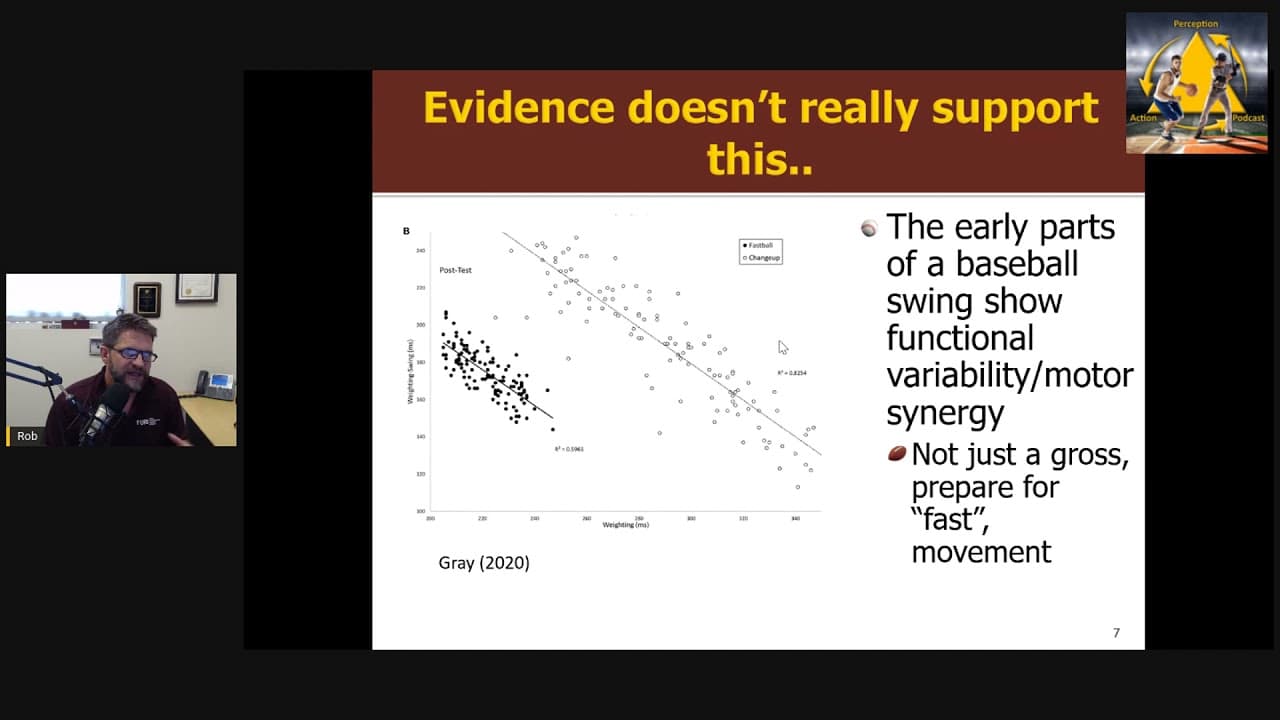
- Research shows anticipatory stepping in tennis is rare, challenging the idea of pre-planned movements based on context.
- Predictive control models, which rely on internal models, may not account for the adaptability and variability in sports.
- An alternative view is that contextual information helps athletes select actions rather than predict specific outcomes.
- Calibration, adjusting actions based on environmental conditions, offers a simpler explanation for context effects in sports.
- Athletes struggle against new opponents, which suggests learning and calibration are ongoing processes, not static models.
- A direct learning approach, focusing on action selection and calibration, may better explain how athletes use context.
Install to Summarize YouTube Videos and Get Transcripts
Explore YouTube Video Summarizer or Get YouTube Transcript Extractor
Questions & Answers
Q: What is the traditional view of how athletes use contextual information?
The traditional view holds that athletes use contextual information to feed into an internal model, which predicts upcoming events and programs movements. This approach relies on situational probabilities and combines context with other cues, like opponent kinematics, to generate predictions and guide actions.
Q: Why does the presenter challenge the predictive control models?
The presenter challenges predictive control models because they may not account for the adaptability and variability required in sports. These models often displace the problem of movement control into the mind without explaining how predictions translate into actions. Additionally, they assume a static knowledge base, which does not align with the dynamic nature of sports.
Q: What evidence contradicts the idea of pre-planned movements based on context?
Evidence from tennis shows that anticipatory stepping, a pre-planned movement based on context, is rare. Studies found it occurs in only 6-13% of observed events, suggesting that athletes do not rely heavily on pre-planned movements. In baseball, force plate data indicate more complex interactions than simple weight shifts based on pitch probability.
Q: How does the presenter propose athletes use contextual information instead?
The presenter proposes that athletes use contextual information to select actions and adjust their movements through calibration. This approach emphasizes direct learning, where athletes adapt to changing conditions and use context to determine the most appropriate action, rather than relying on internal predictions.
Q: What is the role of calibration in this new perspective?
Calibration plays a crucial role in the new perspective by allowing athletes to adjust their actions based on environmental conditions. It involves continuously adapting to factors like pitch speed or opponent tendencies, ensuring that athletes can respond effectively to varying contexts without relying on fixed internal models.
Q: Why do athletes struggle against new opponents, according to this perspective?
According to this perspective, athletes struggle against new opponents because learning and calibration are ongoing processes. Without prior experience or established patterns, athletes must rapidly adjust and calibrate their actions, highlighting the importance of adaptability and the limitations of static predictive models.
Q: What is the significance of the 'third time through the order penalty' in baseball?
The 'third time through the order penalty' in baseball illustrates that batters perform better after facing a pitcher multiple times. This phenomenon challenges the idea of stored knowledge and suggests that ongoing calibration and learning are essential. It supports the view that athletes continuously adapt to opponents rather than relying on fixed priors.
Q: How does the direct learning approach differ from predictive models?
The direct learning approach differs by emphasizing action selection and calibration over predictive modeling. It focuses on how athletes interact with their environment in real-time, using context to choose actions rather than relying on internal predictions. This approach highlights adaptability and continuous learning as key components of athletic performance.
Summary & Key Takeaways
-
The presentation challenges traditional views on how athletes use contextual information, suggesting it aids in selecting actions rather than programming movements. Contextual cues are seen as part of a broader ecological approach, emphasizing direct learning and calibration over internal predictive models.
-
Research in sports like baseball and tennis shows that athletes use situational probabilities to anticipate events. However, evidence suggests they do not use this information to make pre-planned movements, questioning the validity of predictive control models.
-
An alternative perspective is proposed, focusing on how athletes use contextual information to select actions and calibrate their responses. This approach offers a more parsimonious explanation for context effects, emphasizing adaptability and ongoing learning.
Read in Other Languages (beta)
Share This Summary 📚
Summarize YouTube Videos and Get Video Transcripts with 1-Click
Try YouTube Summary with ChatGPT & Claude or YouTube Transcript Generator
Explore More Summaries from Rob Gray 📚
Summarize YouTube Videos and Get Video Transcripts with 1-Click
Try YouTube Summary with ChatGPT & Claude or YouTube Transcript Generator