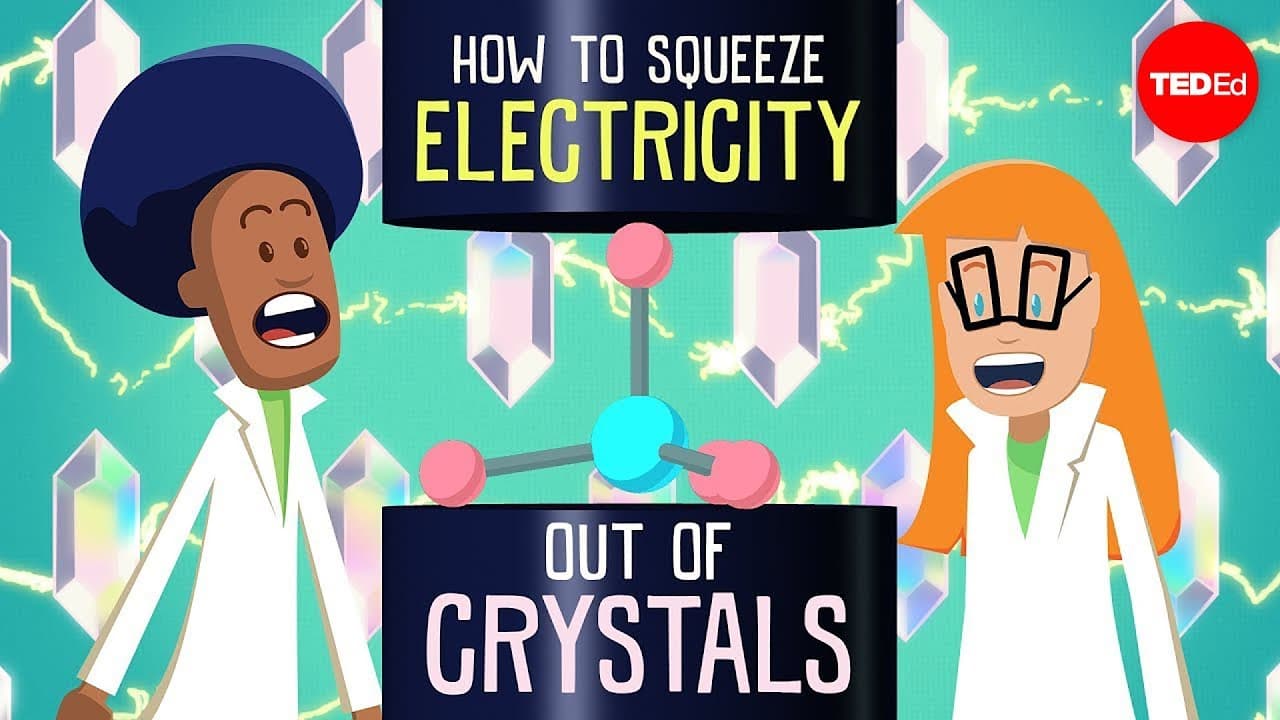
How to squeeze electricity out of crystals - Ashwini Bharathula
TL;DR
Sugar crystals can generate electricity due to piezoelectricity, discovered in 1880 by the Curie brothers, with practical applications ranging from sonar instruments to everyday items.
Transcript
This is a crystal of sugar. If you press on it, it will actually generate its own electricity. How can this simple crystal act like a tiny power source? Because sugar is piezoelectric. Piezoelectric materials turn mechanical stress, like pressure, sound waves, and other vibrations into electricity and vice versa. This odd phenomenon was first dis... Read More
Key Insights
- 🦾 Piezoelectric materials, like sugar crystals, convert mechanical stress into electricity.
- 🥺 The Curie brothers discovered piezoelectricity, leading to practical applications in sonar instruments during World War I.
- 🫀 Material atomic structure and charge distribution determine piezoelectric properties.
- 😒 Modern technology uses synthetic piezoelectric materials in diverse applications.
- ✊ Piezoelectricity powers everyday items like watches, musical greeting cards, and even grill lighters.
- 🤣 Future applications of piezoelectricity include harnessing mechanical energy from footsteps and dance floors.
- ☠️ DNA, bone, and silk are natural piezoelectric materials capable of converting mechanical energy into electrical energy.
Install to Summarize YouTube Videos and Get Transcripts
Explore YouTube Video Summarizer or Get YouTube Transcript Extractor
Questions & Answers
Q: How does sugar behave like a power source through piezoelectricity?
Sugar crystals generate electricity when pressure is applied due to piezoelectric properties, converting mechanical stress into electrical energy, discovered by the Curie brothers.
Q: What practical applications of piezoelectricity were developed during World War I?
Piezoelectric quartz crystals were used in sonar instruments to detect German submarines, converting alternating voltage into ultrasound waves for distance measurement.
Q: What makes a material piezoelectric, and how does it function?
Piezoelectricity depends on the material's atomic structure and charge distribution, with non-symmetrical crystalline materials like quartz producing a net charge when compressed.
Q: How has piezoelectricity been used in modern-day technology?
Synthetic piezoelectric materials have various applications in medical imaging, inkjet printers, watch movements, musical greeting cards, and barbecue lighters, showing the versatility of this phenomenon.
Summary & Key Takeaways
-
Sugar crystals can produce electricity through piezoelectricity, converting mechanical stress into electrical energy.
-
The phenomenon of piezoelectricity was discovered by Pierre and Jacques Curie in 1880.
-
Practical applications of piezoelectricity include sonar instruments and everyday items like clap-activated lights.
Read in Other Languages (beta)
Share This Summary 📚
Summarize YouTube Videos and Get Video Transcripts with 1-Click
Try YouTube Summary with ChatGPT & Claude or YouTube Transcript Generator
Explore More Summaries from TED-Ed 📚






Summarize YouTube Videos and Get Video Transcripts with 1-Click
Try YouTube Summary with ChatGPT & Claude or YouTube Transcript Generator