What Is Long Short-Term Memory (LSTM) in Neural Networks?
TL;DR
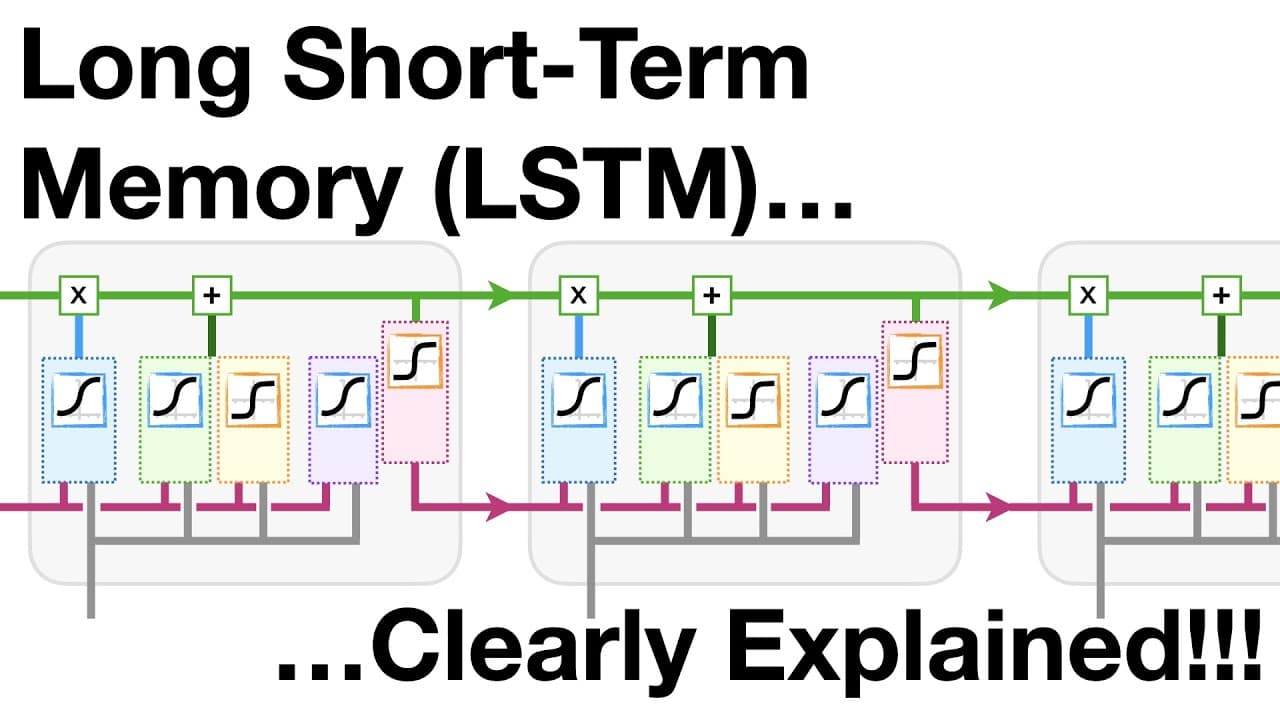
Long Short-Term Memory (LSTM) networks solve the exploding and vanishing gradient problem experienced in traditional recurrent neural networks (RNNs). They achieve this by utilizing separate paths for long-term and short-term memories, which allows for better retention of information and more accurate predictions over longer sequences.
Transcript
Long short-term memories. I've got them both and so does this network. Hooray! StatQuest! Hello, i'm Josh Starmer and welcome to StatQuest. Today we're going to talk about a Long Short-Term Memory, LSTM, and it's going to be clearly explained! Lightning, yeah! Gonna deploy your models in just a few days not months. Yeah! This StatQuest is also brou... Read More
Key Insights
- 💥 LSTM networks are designed to overcome the gradient vanishing/exploding problem in traditional recurrent neural networks.
- 🍉 The use of separate paths for long-term and short-term memories allows for more precise predictions and better information retention.
- 😇 Activation functions, such as sigmoid and tan-h, play a crucial role in determining the amount of memory to remember and update in an LSTM unit.
- 🏑 LSTM networks can be used in various fields, such as stock market prediction, where historical data is crucial for accurate forecasting.
- 🛟 The development of LSTM networks serves as a stepping stone towards understanding more advanced network architectures like Transformers.
- 🆘 Understanding the terminology used in LSTM units, such as Forget Gate, Input Gate, and Output Gate, helps clarify their specific functions.
- 🏋️ LSTM networks rely on shared weights and biases, enabling them to accommodate input sequences of different lengths.
Install to Summarize YouTube Videos and Get Transcripts
Explore YouTube Video Summarizer or Get YouTube Transcript Extractor
Questions & Answers
Q: What is the main problem that LSTM networks aim to solve?
LSTM networks address the issue of exploding/vanishing gradients in basic recurrent neural networks, which hinders their training efficiency.
Q: How does an LSTM unit determine the percentage of long-term memory to remember?
The first stage in an LSTM unit, called the Forget Gate, uses a sigmoid activation function to determine what percentage of the long-term memory should be retained based on the current input.
Q: How does an LSTM unit update the long-term memory?
The second stage, known as the Input Gate, combines the short-term memory and the input to create a potential long-term memory. A sigmoid activation function then determines what percentage of that potential memory should be added to the long-term memory.
Q: How does an LSTM unit update the short-term memory?
The final stage, called the Output Gate, uses a sigmoid activation function to determine what percentage of the potential short-term memory should be passed on as the new short-term memory.
Q: What advantages does an LSTM network offer over basic vanilla recurrent neural networks?
LSTM networks can unroll longer sequences of input data, making them suitable for tasks that involve processing extensive sequential data.
Key Insights:
- LSTM networks are designed to overcome the gradient vanishing/exploding problem in traditional recurrent neural networks.
- The use of separate paths for long-term and short-term memories allows for more precise predictions and better information retention.
- Activation functions, such as sigmoid and tan-h, play a crucial role in determining the amount of memory to remember and update in an LSTM unit.
- LSTM networks can be used in various fields, such as stock market prediction, where historical data is crucial for accurate forecasting.
- The development of LSTM networks serves as a stepping stone towards understanding more advanced network architectures like Transformers.
- Understanding the terminology used in LSTM units, such as Forget Gate, Input Gate, and Output Gate, helps clarify their specific functions.
- LSTM networks rely on shared weights and biases, enabling them to accommodate input sequences of different lengths.
- StatQuest provides comprehensive study guides and resources, including PDFs, a book, and merchandise, for those interested in further learning.
Summary & Key Takeaways
-
Long Short-Term Memory (LSTM) networks solve the problem of exploding/vanishing gradients in basic vanilla recurrent neural networks.
-
LSTM networks use separate paths for long-term memories and short-term memories, allowing for more efficient and accurate predictions.
-
The intricacies of LSTM units involve various activation functions and gates to determine the percentage of memories to remember and update.
Read in Other Languages (beta)
Share This Summary 📚
Summarize YouTube Videos and Get Video Transcripts with 1-Click
Try YouTube Summary with ChatGPT & Claude or YouTube Transcript Generator
Explore More Summaries from StatQuest with Josh Starmer 📚


Summarize YouTube Videos and Get Video Transcripts with 1-Click
Try YouTube Summary with ChatGPT & Claude or YouTube Transcript Generator