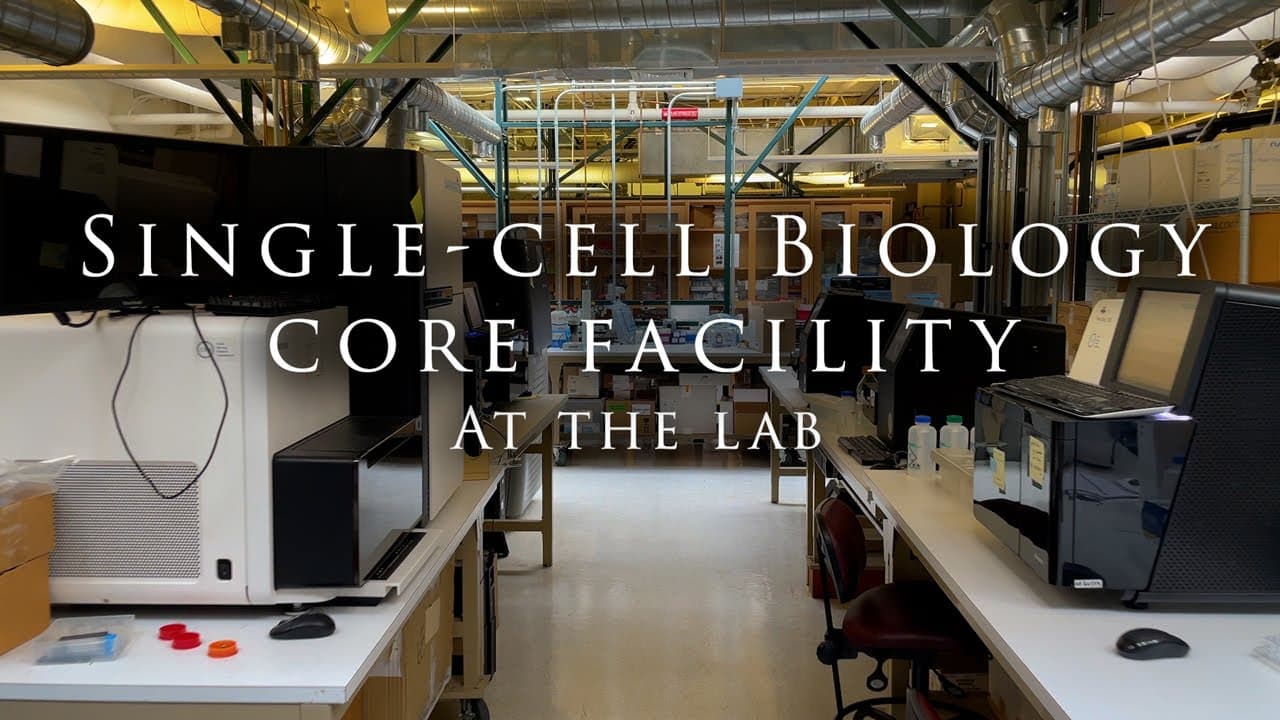
Single-cell Biology Core Facility At the lab
TL;DR
Single-cell analysis is revolutionizing biological research across various fields.
Transcript
[music] Any tissue is comprised of dozens of kinds of cells. And so all of them collectively respond to biological perturbations in a way that's potentially relevant to whatever disease you’re studying or developmental process you’re studying. And understanding the sort of harmony about how all that happens is what is exciting to researchers now... Read More
Key Insights
- Single-cell analysis allows researchers to study the response of individual cell types to biological perturbations, providing insights into diseases and developmental processes.
- The genomics era has enabled the simultaneous analysis of all genes in every individual cell, enhancing our understanding of cellular functions.
- Collaborations often begin with consultations to discuss project plans and goals, highlighting the importance of communication in scientific research.
- Single-cell analysis can yield detailed insights into how specific cell types react within a complex tissue, aiding targeted interventions.
- Cold Spring Harbor Laboratory supports diverse research fields, including cancer, plant biology, and neuroscience, fostering interdisciplinary collaboration.
- Spatial biology is emerging as a new frontier, focusing on the location and interactions of cells within tissues.
- New technologies are allowing researchers to preserve and study the spatial context of cells, overcoming previous limitations in tissue analysis.
- Researchers are eager to explore high-resolution interactions between immune and cancer cells within tissues, indicating a shift towards more detailed biological investigations.
Install to Summarize YouTube Videos and Get Transcripts
Explore YouTube Video Summarizer or Get YouTube Transcript Extractor
Questions & Answers
Q: What is the significance of single-cell analysis in biological research?
Single-cell analysis is significant because it allows researchers to examine the behavior and response of individual cell types within complex tissues. This detailed level of analysis can reveal how specific cells contribute to diseases or developmental processes, providing insights that are critical for developing targeted treatments and understanding biological functions.
Q: How has the genomics era impacted single-cell biology?
The genomics era has revolutionized single-cell biology by enabling the simultaneous analysis of all genes within individual cells. This capability allows researchers to gain comprehensive insights into cellular functions and interactions, facilitating a deeper understanding of how cells respond to various biological perturbations and contributing to advancements in personalized medicine.
Q: What role does Cold Spring Harbor Laboratory play in single-cell research?
Cold Spring Harbor Laboratory plays a pivotal role in single-cell research by providing a collaborative environment that supports diverse scientific disciplines, including cancer, plant biology, and neuroscience. The laboratory fosters interdisciplinary collaborations, enabling researchers to tackle complex biological questions and drive innovation in single-cell analysis techniques and applications.
Q: What is spatial biology, and why is it important?
Spatial biology is an emerging field that focuses on understanding the location and interactions of cells within their natural tissue context. It is important because it allows researchers to preserve and study the spatial organization of cells, which is crucial for understanding how cells communicate, interact, and contribute to tissue structure and function. This knowledge can lead to new insights into disease mechanisms and therapeutic strategies.
Q: How are new technologies advancing the study of cell interactions within tissues?
New technologies are advancing the study of cell interactions within tissues by allowing researchers to maintain the spatial context of cells during analysis. This advancement overcomes previous limitations where tissue structure information was lost, enabling high-resolution studies of cellular interactions and providing a more accurate understanding of how cells influence each other in their natural environment.
Q: What are researchers at Cold Spring Harbor Laboratory particularly excited about in single-cell analysis?
Researchers at Cold Spring Harbor Laboratory are particularly excited about the potential of spatial biology to provide high-resolution insights into cell interactions within tissues. This includes studying how the immune system interacts with cancer cells, which could reveal new therapeutic targets and strategies for treating diseases by understanding the cellular microenvironment in greater detail.
Q: What challenges do researchers face in single-cell data analysis?
Researchers face significant challenges in single-cell data analysis due to the complexity and volume of data generated. Analyzing thousands of measurements across numerous cells requires sophisticated computational tools and methods to extract meaningful insights. Collaborations and consultations are often necessary to address these challenges and tailor analyses to specific research goals.
Q: Why is the consultation process important in single-cell research collaborations?
The consultation process is important in single-cell research collaborations because it allows researchers to align their project plans and goals, ensuring that the analysis methods are tailored to the specific needs of the study. This initial communication helps establish a clear understanding of the research objectives and facilitates effective collaboration, ultimately leading to more successful outcomes.
Summary & Key Takeaways
-
Single-cell analysis has transformed biological research by allowing detailed study of individual cell types' responses to various stimuli. This approach has become crucial for understanding diseases and developmental processes, offering insights that were previously unattainable.
-
Cold Spring Harbor Laboratory is at the forefront of single-cell biology, supporting research across multiple disciplines, including cancer, plant biology, and neuroscience. The collaborative environment fosters innovative approaches to complex biological questions.
-
The advent of spatial biology marks a significant advancement, enabling researchers to study cells within their natural tissue context. This development promises to enhance our understanding of cellular interactions and tissue structure, paving the way for new therapeutic strategies.
Read in Other Languages (beta)
Share This Summary 📚
Summarize YouTube Videos and Get Video Transcripts with 1-Click
Try YouTube Summary with ChatGPT & Claude or YouTube Transcript Generator
Explore More Summaries from Cold Spring Harbor Laboratory 📚


Summarize YouTube Videos and Get Video Transcripts with 1-Click
Try YouTube Summary with ChatGPT & Claude or YouTube Transcript Generator