How We Know The Universe is Ancient
TL;DR
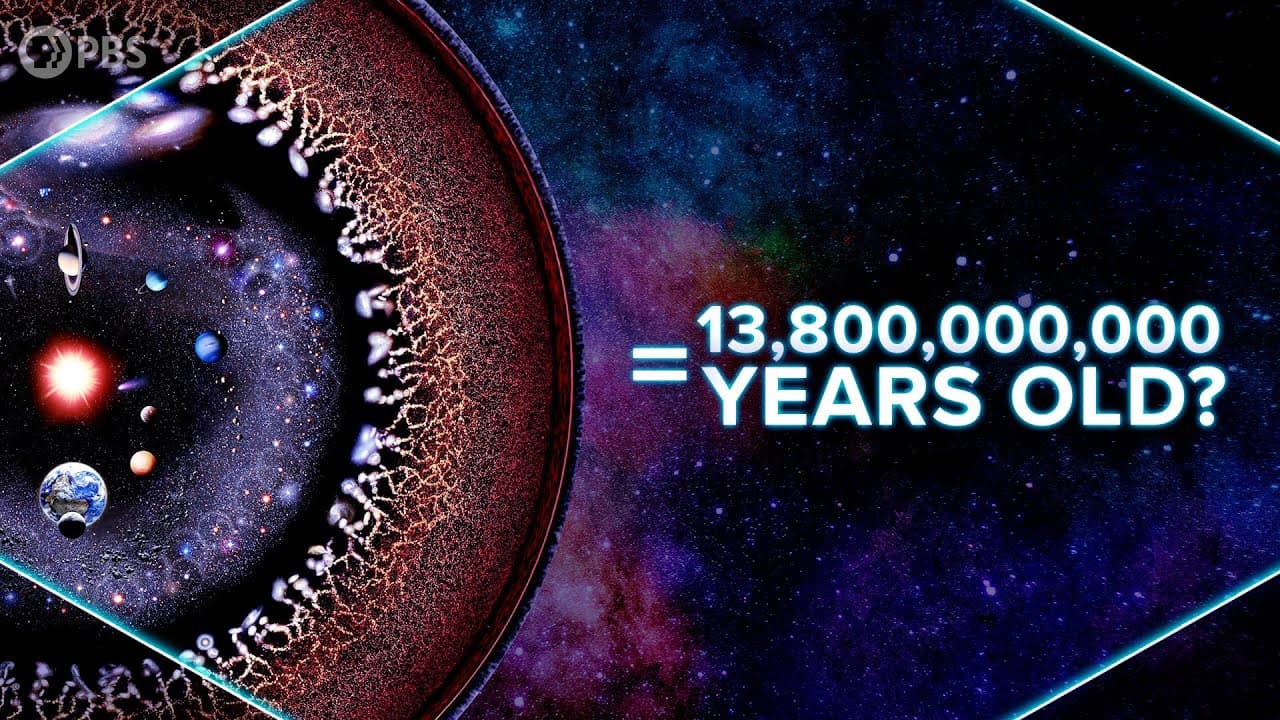
The universe is 13.8 billion years old, determined through scientific methods.
Transcript
The universe is precisely 13.8 billion year old - or so our best scientific methods tell us. But how do you learn the age of the universe when there’s no trace left of its beginnings? We see the same constellations on the night sky as did our astronomer ancestors. Familiar star-maps are recorded in cave paintings tens of thousands of years old. We ... Read More
Key Insights
- The universe is estimated to be 13.8 billion years old, determined by scientific methods including the cosmic microwave background radiation.
- The discovery of galaxies moving away from us led to the understanding that the universe is expanding, contradicting the earlier belief of a static universe.
- Edwin Hubble's discovery of galaxies' recession was pivotal, although initial distance calculations were incorrect due to Cepheid variable star misclassifications.
- The Hubble constant, which measures the rate of expansion of the universe, has been crucial in estimating the universe's age.
- The concept of the Big Bang was initially mocked but later accepted as evidence mounted for an expanding universe from a dense, hot state.
- The universe's age estimation had to account for factors like dark energy and gravity affecting the expansion rate over time.
- Advancements in measuring the cosmic microwave background have refined our understanding of the universe's composition and age.
- The role of dark energy was discovered as a necessary factor to explain the universe's accelerated expansion, influencing age calculations.
Install to Summarize YouTube Videos and Get Transcripts
Explore YouTube Video Summarizer or Get YouTube Transcript Extractor
Questions & Answers
Q: How do scientists determine the age of the universe?
Scientists determine the age of the universe by analyzing the cosmic microwave background radiation and measuring the Hubble constant, which indicates the rate of expansion. These methods, combined with calculations involving the universe's composition, including dark energy and matter, provide an estimate of 13.8 billion years.
Q: What was the role of Edwin Hubble in understanding the universe's age?
Edwin Hubble played a crucial role by discovering that galaxies are moving away from us, suggesting an expanding universe. He measured distances using Cepheid variable stars, although initial calculations were flawed due to misclassifications. His work led to the development of the Hubble constant, vital for age estimation.
Q: What is the significance of the Hubble constant in cosmology?
The Hubble constant measures the rate at which the universe is expanding, linking a galaxy's distance to its speed of recession. This constant is crucial for estimating the universe's age, as it provides a framework for understanding the expansion dynamics and integrating factors like gravity and dark energy.
Q: How has the understanding of dark energy influenced the age estimation of the universe?
The discovery of dark energy, which drives the accelerated expansion of the universe, has significantly impacted age estimation. It counters gravity's slowing effect, necessitating adjustments in calculations. Including dark energy in models has refined the estimated age to 13.8 billion years, aligning with observations.
Q: What challenges did early astronomers face in estimating the universe's age?
Early astronomers faced challenges like misclassifying Cepheid variable stars, leading to incorrect distance measurements. Additionally, assumptions of a static universe and lack of understanding of dark energy and its effects on expansion rates complicated early age estimates, which have since been corrected with new data.
Q: How does the cosmic microwave background radiation contribute to our understanding of the universe's age?
The cosmic microwave background radiation, the oldest light we can observe, provides a snapshot of the early universe. Analyzing its properties helps determine the universe's composition and expansion history, offering essential data for calculating age and validating models involving dark energy and matter distribution.
Q: Why was the Big Bang theory initially mocked, and how did it gain acceptance?
The Big Bang theory was initially mocked, notably by Fred Hoyle, due to prevailing beliefs in a static universe. However, accumulating evidence of an expanding universe from a dense, hot state, supported by observations like galaxy recession and cosmic microwave background radiation, led to its acceptance in the scientific community.
Q: What advancements have been made in refining the universe's age estimation?
Advancements include better understanding of Cepheid variables, precise measurements of the cosmic microwave background, and incorporation of dark energy effects. These refinements, along with improved technology and observational techniques, have led to a more accurate age estimation of 13.8 billion years, consistent with various cosmological models.
Summary & Key Takeaways
-
The universe is 13.8 billion years old, determined through scientific methods including the cosmic microwave background radiation and the Hubble constant. Initial beliefs about a static universe were overturned by discoveries of galaxies moving away from us, indicating expansion.
-
Edwin Hubble's work on galaxies' recession and the Hubble constant were key in understanding the universe's expansion and age. However, early calculations were flawed due to Cepheid variable star misclassifications, leading to revisions in the universe's estimated age.
-
The Big Bang theory emerged from evidence of an expanding universe from a dense, hot state. The role of dark energy and gravity in the universe's expansion rate has been critical in refining age estimates, with the cosmic microwave background providing key data for these calculations.
Read in Other Languages (beta)
Share This Summary 📚
Summarize YouTube Videos and Get Video Transcripts with 1-Click
Try YouTube Summary with ChatGPT & Claude or YouTube Transcript Generator
Explore More Summaries from PBS Space Time 📚
Summarize YouTube Videos and Get Video Transcripts with 1-Click
Try YouTube Summary with ChatGPT & Claude or YouTube Transcript Generator