First Ever Picture of a Baby Planet!
TL;DR
Astronomers capture image of planet forming around young star, using innovative technology.
Transcript
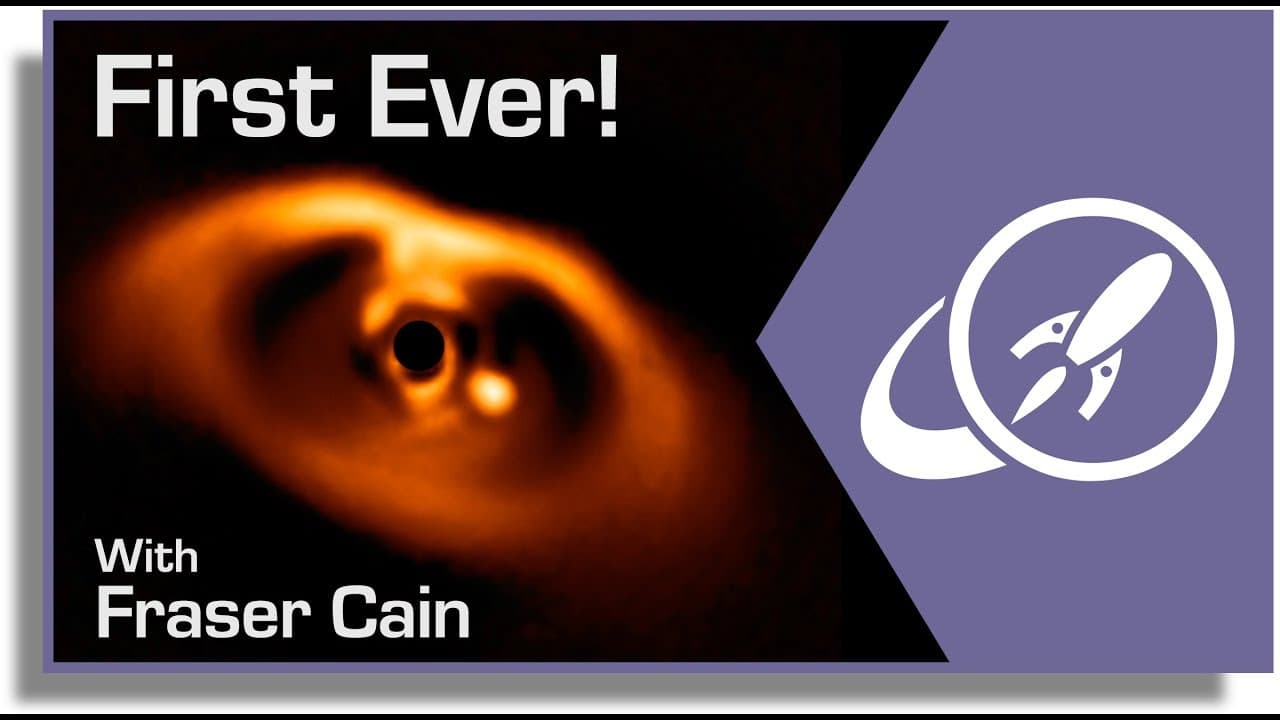
For the first time ever, astronomers have captured a direct image of a newly forming planet orbiting around a newly forming star. It’s a stunning photograph, not only for the science and what was observed, but what it means the future of exoplanetary astronomy. For the longest time, astronomers puzzled over how the planets in the Solar System forme... Read More
Key Insights
- 🤩 Direct image of a forming planet around a young star captured for the first time.
- 💁 Advanced technology like the SPHERE instrument provides detailed insights into protoplanetary disks and planet formation.
- 🪐 The newly discovered planet, PDS 70b, is located within a large gap in the protoplanetary disk and has a cloudy atmosphere.
- 💨 Discoveries like this pave the way for future advancements in exoplanetary astronomy.
- 🛝 Ground-based observatories like the Very Large Telescope play a crucial role in observing and studying extrasolar planets.
- 🥹 Future supertelescopes like the Giant Magellan Telescope and Extremely Large Telescope hold promise for further breakthroughs in astronomy.
- 💁 The detection of PDS 70b reinforces existing theories of planetary formation within protoplanetary disks.
Install to Summarize YouTube Videos and Get Transcripts
Explore YouTube Video Summarizer or Get YouTube Transcript Extractor
Questions & Answers
Q: How did astronomers capture the first direct image of a planet forming around a star?
Astronomers used the Very Large Telescope and the SPHERE instrument to observe the protoplanetary disk of the star PDS 70, allowing them to detect the newly forming planet, PDS 70b.
Q: What significance does the discovery of a forming planet hold for exoplanetary astronomy?
This discovery provides crucial insights into the process of planetary formation and validates theories about how planets evolve within protoplanetary disks around young stars.
Q: What technology was employed to detect the presence of the newly forming planet?
The SPHERE instrument, equipped with a coronagraph to block out the central star's light, enabled astronomers to detect the faint signal of the newly forming planet, PDS 70b.
Q: How does the discovery of PDS 70b contribute to our understanding of extrasolar planets?
The direct observation of PDS 70b showcases the capabilities of ground-based observatories like the Very Large Telescope in studying extrasolar planets, opening up possibilities for future discoveries.
Summary & Key Takeaways
-
Astronomers observe a newly forming planet orbiting a young star, providing insights into planetary formation.
-
Utilizing advanced technology, astronomers study the protoplanetary disk around the star PDS 70, revealing a significant gap.
-
The newly discovered planet, PDS 70b, is several times the mass of Jupiter, has a cloudy atmosphere, and is located within the protoplanetary disk.
Read in Other Languages (beta)
Share This Summary 📚
Summarize YouTube Videos and Get Video Transcripts with 1-Click
Try YouTube Summary with ChatGPT & Claude or YouTube Transcript Generator
Explore More Summaries from Fraser Cain 📚





Summarize YouTube Videos and Get Video Transcripts with 1-Click
Try YouTube Summary with ChatGPT & Claude or YouTube Transcript Generator