How Do Bridge Foundations Stay Stable?
TL;DR
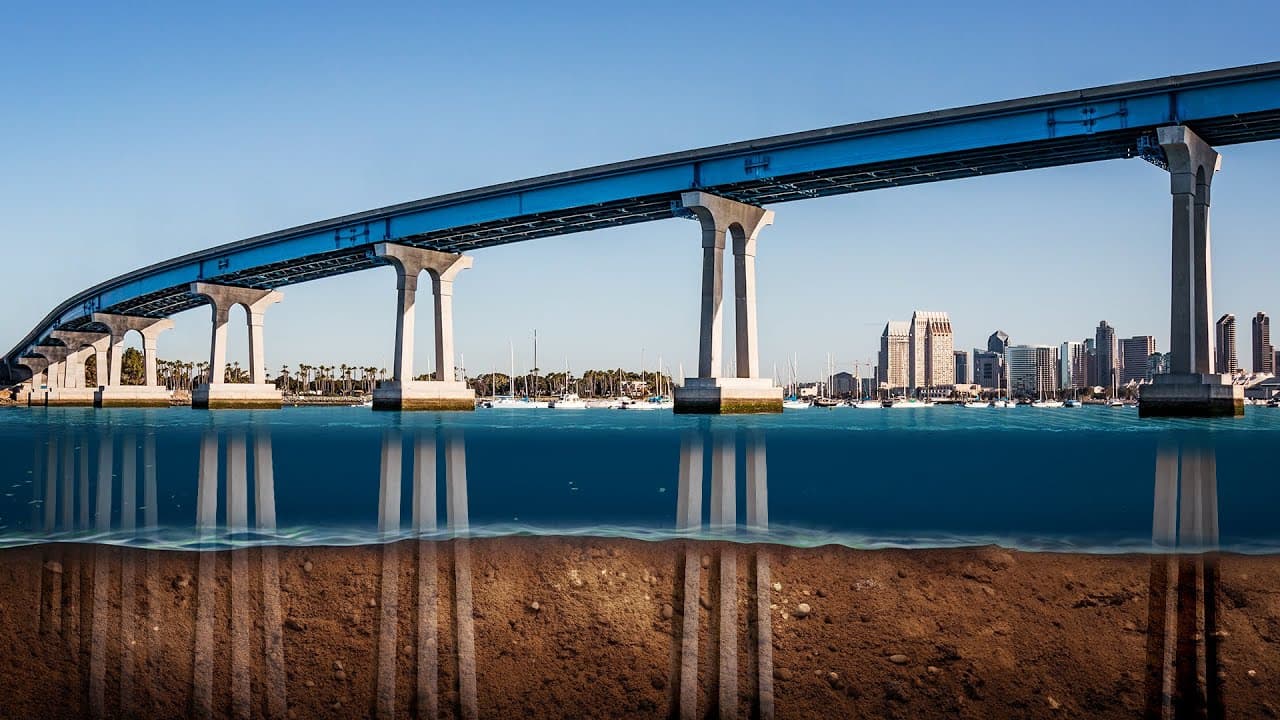
Bridge foundations are built using deep foundations like driven piles and drilled shafts, which transfer loads to stable soil or bedrock. These foundations resist vertical and lateral forces through end-bearing and skin friction. Despite challenges like soft soils and underwater conditions, engineering techniques ensure bridge stability.
Transcript
The essence of a bridge is not just that it goes over something, but that there’s clear space underneath for a river, railway, or road. Maybe this is already obvious to you, but bridges present a unique structural challenge. In a regular road, the forces are transferred directly into the ground. On a bridge, all those forces on the span get con... Read More
Key Insights
- Bridges present unique structural challenges because they must span clear spaces and transfer loads to piers or abutments.
- Bridge foundations often use driven piles, which are long poles driven into the ground to reach stable soil layers.
- Driven piles rely on end-bearing and skin friction to resist vertical loads, with deeper piles providing more friction.
- Drilled shafts are another type of deep foundation, involving drilling holes and filling them with concrete to support structures.
- Underwater installation of drilled shafts involves using a tremie to prevent concrete dilution and ensure proper placement.
- Inclined piles, or battered piles, are used to resist lateral loads, such as those from wind or water currents.
- Pile driving is noisy and disruptive, making it less suitable for dense urban areas where vibrations can affect nearby structures.
- Alternative deep foundation techniques include helical piles, stone columns, and continuous flight auger piles, each suited to specific conditions.
Install to Summarize YouTube Videos and Get Transcripts
Explore YouTube Video Summarizer or Get YouTube Transcript Extractor
Questions & Answers
Q: How do bridge foundations remain stable in soft soils?
Bridge foundations remain stable in soft soils by using deep foundations like driven piles and drilled shafts. Driven piles transfer loads through end-bearing and skin friction, compacting surrounding soil for additional support. Drilled shafts use concrete-filled holes to reach stable layers, ensuring load transfer to firmer ground, even in challenging conditions.
Q: What are the main types of deep foundations used in bridge construction?
The main types of deep foundations used in bridge construction are driven piles and drilled shafts. Driven piles are long poles driven into the ground, relying on end-bearing and skin friction for load resistance. Drilled shafts involve drilling holes and filling them with concrete, often using a tremie for underwater installations, providing stability in various soil conditions.
Q: How do driven piles resist vertical loads?
Driven piles resist vertical loads through end-bearing and skin friction. End-bearing involves driving the pile to a strong soil or rock layer, while skin friction compacts and densifies surrounding soil, creating friction along the pile walls. The deeper the pile, the more friction it generates, enhancing load resistance and stability.
Q: What challenges do engineers face when installing bridge foundations underwater?
Engineers face challenges like soft, mucky soils and water dilution during underwater bridge foundation installation. Drilled shafts require techniques like using a tremie to pour concrete without mixing with water, ensuring proper strength. Casings support the walls during drilling, and methods like raising pile caps above water reduce construction complexity.
Q: Why are inclined piles used in bridge construction?
Inclined piles, or battered piles, are used in bridge construction to resist lateral loads from wind, water currents, and other forces. By taking advantage of shaft resistance, inclined piles enhance the foundation's stability against horizontal forces, providing additional support and preventing movement in challenging conditions.
Q: How do drilled shafts differ from driven piles?
Drilled shafts differ from driven piles in that they involve drilling holes into the ground and filling them with concrete, rather than driving poles. This method allows for larger diameters and deeper installations, accommodating varying soil conditions. Drilled shafts can be used in soft or wet soils, often employing casings and tremies for stability and proper concrete placement.
Q: What are the limitations of driven piles in construction?
Driven piles have limitations like noise and disruption during installation, making them unsuitable for dense urban areas. The vibrations can affect nearby structures, and they struggle to penetrate hard geological layers. Additionally, driven piles may not withstand installation forces, and their path can be unpredictable, leading to potential issues during construction.
Q: What alternative deep foundation techniques exist beyond driven piles and drilled shafts?
Alternative deep foundation techniques include helical piles, which twist into the ground reducing vibrations; stone columns, used for compressive loads by filling holes with compacted aggregate; and continuous flight auger piles, which combine drilling and concreting in one step. These methods address specific challenges, offering solutions for various geotechnical conditions.
Summary & Key Takeaways
-
Bridge foundations use deep foundations like driven piles and drilled shafts to transfer loads to stable soil, ensuring stability. Driven piles rely on end-bearing and skin friction, while drilled shafts involve drilling and concrete filling. These foundations resist vertical and lateral forces, accommodating changes in soil conditions.
-
Driven piles are installed by hammering long poles into the ground, relying on end-bearing and skin friction for load resistance. Drilled shafts, used in soft or wet soils, involve drilling holes and filling them with concrete, often using a tremie to prevent dilution during underwater installations.
-
Inclined piles, or battered piles, enhance resistance to lateral loads from wind or water. Despite challenges like noise and disruption during installation, alternative techniques like helical piles and stone columns offer solutions for specific conditions, highlighting the complexity of geotechnical engineering in bridge construction.
Read in Other Languages (beta)
Share This Summary 📚
Summarize YouTube Videos and Get Video Transcripts with 1-Click
Try YouTube Summary with ChatGPT & Claude or YouTube Transcript Generator
Explore More Summaries from Practical Engineering 📚





Summarize YouTube Videos and Get Video Transcripts with 1-Click
Try YouTube Summary with ChatGPT & Claude or YouTube Transcript Generator