Kinetics of radioactive decay | Kinetics | AP Chemistry | Khan Academy
TL;DR
Radioactive isotopes decay at a constant rate, determined by their half-life, and can be calculated using exponential decay graphs and mathematical equations.
Transcript
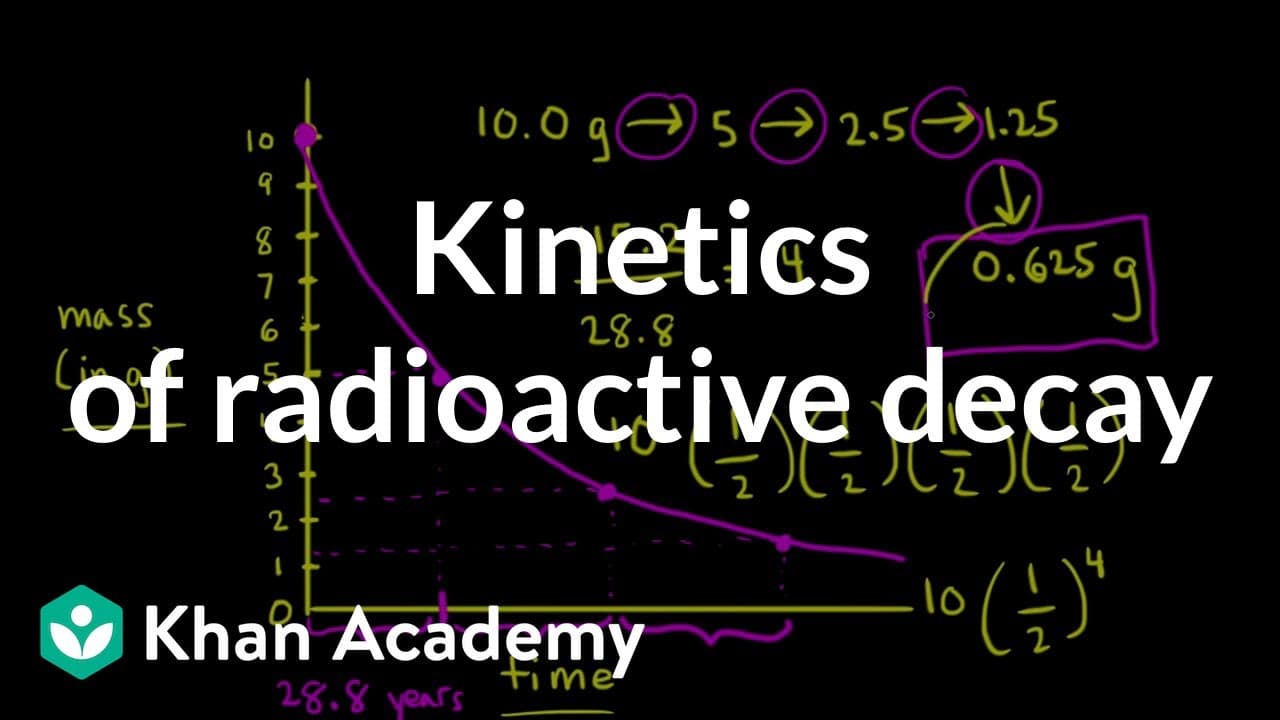
- [Instructor] Strontium-90 is a radioactive isotope that undergoes beta decay. Because radioactive decay is a first-order process, radioactive isotopes have constant half-lives. Half-life is symbolized by t1/2, and it's the time required for 1/2 of a sample of a particular radioactive isotope to decay. For example, the half-life of Strontium-90 is... Read More
Key Insights
- ☢️ Radioactive decay is a first-order process, meaning the rate of decay is proportional to the amount of radioactive material present.
- 🛟 The half-life of a radioactive isotope remains constant regardless of the initial amount of the isotope.
- 💆 Exponential decay graphs can be used to visualize the decrease in mass over time.
- ☠️ The rate constant is determined by the half-life and can be used to calculate the rate of decay at different times.
- ☢️ The integrated rate law for a first-order reaction can be applied to radioactive decay by substituting the concentration of reactant with the number of radioactive nuclei.
Install to Summarize YouTube Videos and Get Transcripts
Explore YouTube Video Summarizer or Get YouTube Transcript Extractor
Questions & Answers
Q: What is the half-life of Strontium-90?
The half-life of Strontium-90 is 28.8 years, meaning it takes 28.8 years for half of the initial sample to decay.
Q: How can the remaining mass of Strontium-90 be determined after a certain time period?
The remaining mass can be found by dividing the time period by the half-life. Each half-life reduces the mass by half, so the number of half-lives can be used to calculate the final mass.
Q: What is the rate law for radioactive decay?
The rate of radioactive decay is described by the equation rate = k * N^1, where N represents the number of radioactive nuclei in a sample and k is the rate constant.
Q: How can the rate constant for radioactive decay be calculated?
The rate constant can be found using the equation k = 0.693 / t1/2, where t1/2 is the half-life of the radioactive isotope.
Summary & Key Takeaways
-
Strontium-90 undergoes radioactive decay through beta decay, with a half-life of 28.8 years.
-
The decay of Strontium-90 can be represented on an exponential decay graph, showing the decreasing mass of the isotope over time.
-
Calculating the remaining mass of Strontium-90 after a specific time period involves dividing the time by the half-life and using the concept of half-lives.
Read in Other Languages (beta)
Share This Summary 📚
Summarize YouTube Videos and Get Video Transcripts with 1-Click
Try YouTube Summary with ChatGPT & Claude or YouTube Transcript Generator
Explore More Summaries from Khan Academy 📚




Summarize YouTube Videos and Get Video Transcripts with 1-Click
Try YouTube Summary with ChatGPT & Claude or YouTube Transcript Generator