Acquiring a new skill with pain
TL;DR
Pain affects motor skill learning and coordination differently.
Transcript
hi everyone this is rob gray from asu and the perception action podcast again back with another article review today i want to look at an article addressing a really interesting topic of what are the consequences of trying to acquire a new motor skill when you have pain right you have pain related to a sports injury or something like that there's b... Read More
Key Insights
- Pain may not significantly impair motor skill acquisition but can alter the coordination and variability of movements.
- Individuals tend to reorganize their movement strategies around pain, treating it as a new constraint.
- The study used capsain gel to induce pain, simulating the effects of sports injuries during motor learning.
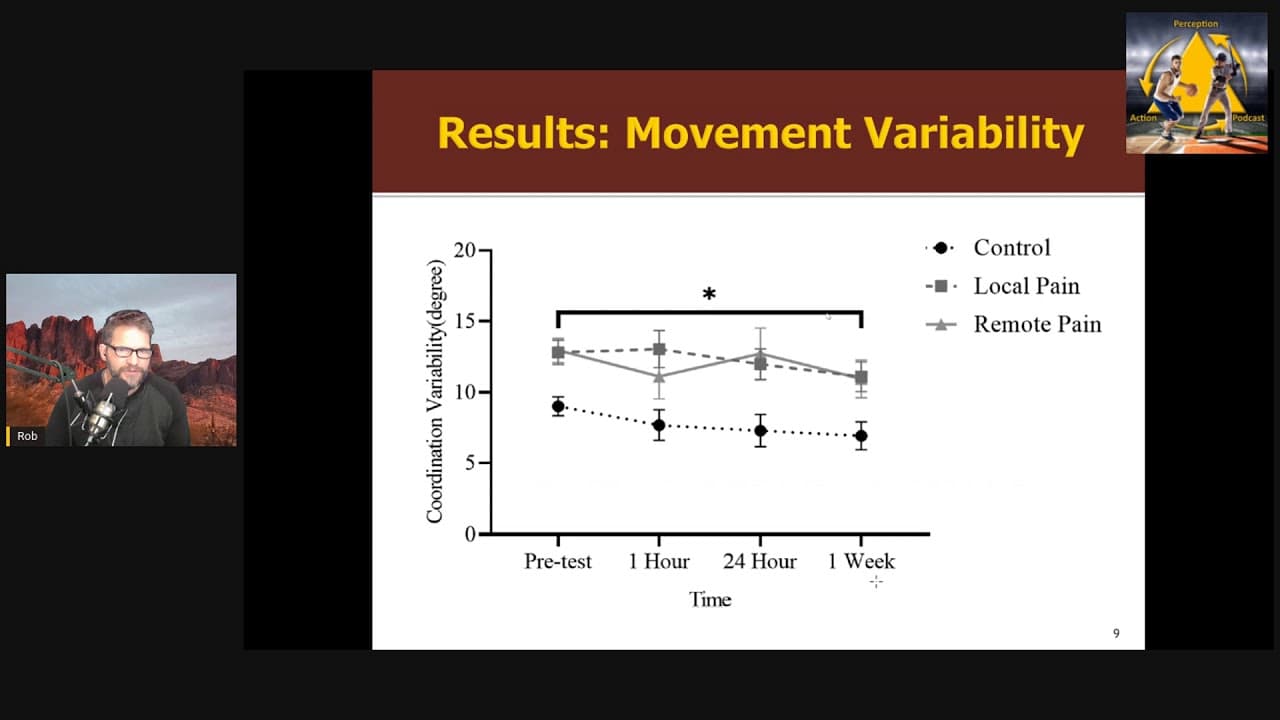
- Pain led to higher movement variability compared to pain-free controls, although all groups improved in task performance.
- The research highlights the potential challenges of learning new skills under pain, especially in tasks with low variability constraints.
- Pre-existing differences in movement variability suggest that pain might not be the sole factor affecting coordination.
- The study proposes that pain can act as a constraint, influencing the degrees of freedom in movement organization.
- Future research should explore more complex tasks and analyze whether pain-induced variability is beneficial or detrimental.
Install to Summarize YouTube Videos and Get Transcripts
Explore YouTube Video Summarizer or Get YouTube Transcript Extractor
Questions & Answers
Q: How does pain affect motor skill learning according to the study?
The study found that while pain did not significantly impair the accuracy of motor skill learning, it did affect the coordination and variability of movements. Participants with pain reorganized their movement strategies, treating pain as a new constraint and demonstrating higher variability in their joint angles compared to pain-free participants.
Q: What method was used to induce pain in the study participants?
The study used capsain gel, which contains the active component of red peppers, to induce pain in participants. The gel was applied locally to the elbow for the task-related pain group and to the knee for the remote pain group. Participants rated their pain on a visual analog scale, and the application was adjusted to maintain a high level of pain.
Q: What were the main findings regarding movement variability in the study?
The study found significant differences in movement variability between pain and control groups. While all groups showed reduced variability with practice, the pain groups had higher variability than controls. This suggests that pain affects how movements are coordinated, potentially limiting the ability to find optimal movement solutions and increasing the risk of re-injury.
Q: What implications does the study have for rehabilitation practices?
The study suggests that while individuals with pain can still perform tasks, they reorganize their movements differently. This has implications for rehabilitation, indicating that while some movement is necessary even with pain, learning entirely new skills might be less effective. Pain acts as a constraint, potentially hindering the ability to find optimal movement solutions.
Q: What are the limitations of the study?
One limitation is the focus on a simple task with low variability constraints, which may not fully represent the complexity of real-world motor learning scenarios. Additionally, there were pre-existing differences in movement variability between groups before pain induction, which could confound the results. The study also used a non-specific pain stimulus, which might not accurately simulate injury-related pain.
Q: How might future research build on this study's findings?
Future research could explore more complex tasks with varying constraints to better understand how pain affects motor learning in dynamic environments. Researchers could also use more specific pain stimuli to simulate injury-related pain more accurately. Analyzing whether the observed variability is beneficial or detrimental to performance could provide deeper insights into pain's effects on motor learning.
Q: What was the experimental design used in the study?
The study involved 30 male participants divided into three groups: local pain, remote pain, and control. Each group performed a dart-throwing task with 150 trials, followed by retention tests one hour, 24 hours, and one week later. Pain was induced using capsain gel, and motion tracking was used to measure joint angles and movement variability.
Q: What are the potential risks of learning new skills with pain?
Learning new skills with pain may lead to suboptimal movement strategies and increased risk of re-injury. Pain acts as a constraint, potentially limiting the exploration of movement solutions and reducing movement variability, which is essential for finding optimal strategies. Avoiding new skill acquisition until pain-free may be advisable to prevent these risks.
Summary & Key Takeaways
-
The study investigates the impact of pain on learning a new motor skill, specifically dart throwing, using capsain gel to simulate pain. Results showed no significant difference in task performance between groups with and without pain, although movement variability was higher in pain groups.
-
Pain acts as a constraint, altering movement coordination and variability during motor learning. Despite similar performance improvements across groups, those experiencing pain exhibited different joint angle strategies, indicating a reorganization of movement to accommodate the painful stimulus.
-
The research suggests that while pain might not hinder skill acquisition, it affects how movements are coordinated. The study's limitations include its focus on a simple task with low variability, and further research could explore more complex scenarios to better understand pain's impact on motor learning.
Read in Other Languages (beta)
Share This Summary 📚
Summarize YouTube Videos and Get Video Transcripts with 1-Click
Try YouTube Summary with ChatGPT & Claude or YouTube Transcript Generator
Explore More Summaries from Rob Gray 📚
Summarize YouTube Videos and Get Video Transcripts with 1-Click
Try YouTube Summary with ChatGPT & Claude or YouTube Transcript Generator