First Law of Thermodynamics Applied Steam Nozzle and Boiler
TL;DR
This video discusses the application of the first law of thermodynamics to flow processes, specifically focusing on steam nozzles and boilers.
Transcript
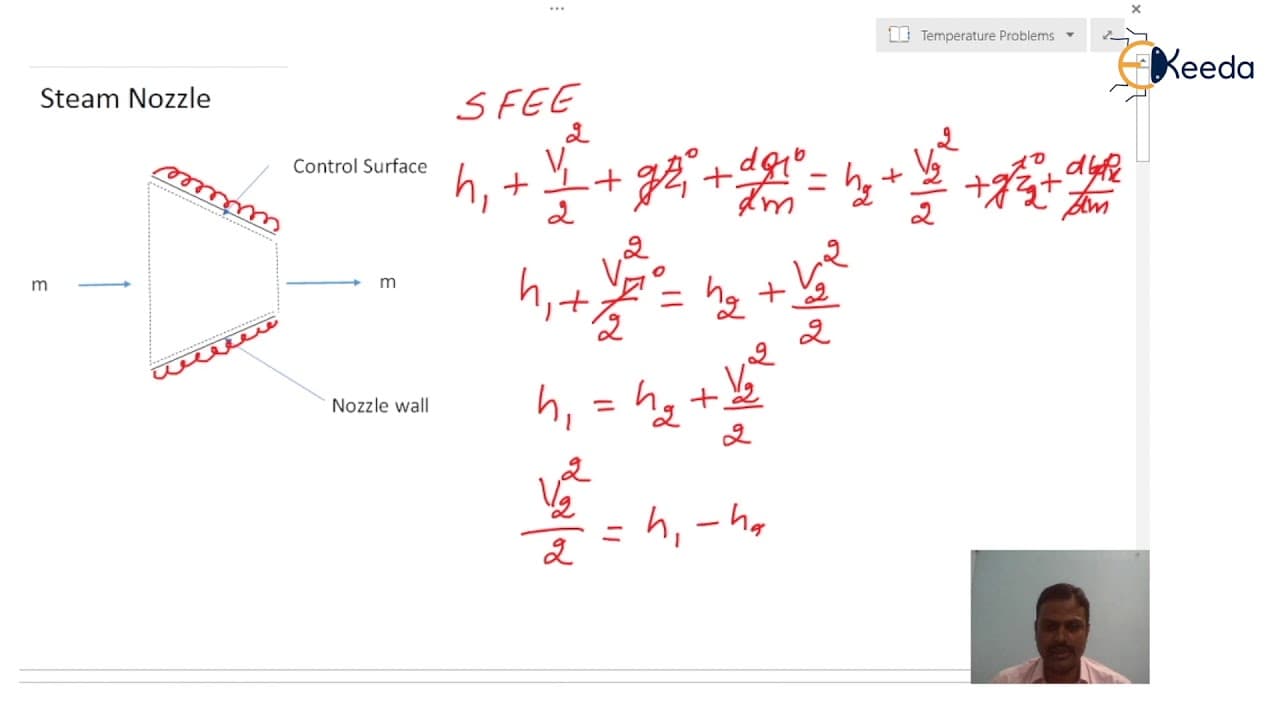
hello friends so in this video i am going to discuss the application of first law of thermodynamics to flow process that is devices which are steam nozzle and boiler nozzle is a device which increases the velocity or kinetic energy of the fluid at the exit of nozzle that is by at the expense of its pressure so let us consider a nozzle this is its c... Read More
Key Insights
- 😤 A steam nozzle increases the velocity of fluid by reducing its pressure, in accordance with the first law of thermodynamics.
- 💱 By neglecting potential energy changes and considering insulated walls, the relationship between the enthalpy and velocity at the inlet and exit of the nozzle can be simplified.
- 🥵 A boiler generates steam by receiving heat from fuel combustion, and the first law of thermodynamics can be applied to determine the required heat transfer.
Install to Summarize YouTube Videos and Get Transcripts
Explore YouTube Video Summarizer or Get YouTube Transcript Extractor
Questions & Answers
Q: What is the purpose of a steam nozzle?
The steam nozzle increases the velocity of a fluid by reducing its pressure, allowing for efficient energy transfer and power generation. This is achieved through the application of the first law of thermodynamics.
Q: How does the first law of thermodynamics apply to a steam nozzle?
The first law of thermodynamics, applied to a steam nozzle, relates the enthalpy and velocity at the inlet and exit. By neglecting potential energy changes and considering insulated walls, the relationship can be simplified to h1 = h2 + (v2^2)/2.
Q: What is the role of a boiler in the context of the first law of thermodynamics?
A boiler is a device that generates steam by receiving heat from the combustion of fuel. The first law of thermodynamics can be applied to determine the heat transfer (q) required to increase the enthalpy (h) from the liquid state at the inlet to the steam state at the exit.
Q: How is the heat transfer (q) related to the mass flow rate (m) in a boiler?
The heat transfer (q) is equal to the mass flow rate (m) multiplied by the change in enthalpy (h2 - h1). This equation, q = m * (h2 - h1), describes the relationship between the heat supplied to the water flowing through the boiler tubes and the increase in enthalpy.
Summary & Key Takeaways
-
The video explains the application of the first law of thermodynamics to steam nozzles, which increase the velocity of fluid at the expense of its pressure.
-
It also explores how the first law of thermodynamics can be applied to boilers, where steam is generated by receiving heat from fuel combustion.
-
The equations derived from these applications provide insights into the relationships between enthalpy, velocity, and heat transfer in these processes.
Read in Other Languages (beta)
Share This Summary 📚
Summarize YouTube Videos and Get Video Transcripts with 1-Click
Try YouTube Summary with ChatGPT & Claude or YouTube Transcript Generator
Explore More Summaries from Ekeeda 📚




Summarize YouTube Videos and Get Video Transcripts with 1-Click
Try YouTube Summary with ChatGPT & Claude or YouTube Transcript Generator