Products
Features
YouTube Video Summarizer
Summarize YouTube videos
Web & PDF Highlighter
Highlight web pages & PDFs
Chat with PDF
Ask any PDF questions with AI
Ask AI Clone
Chat with your highlights & memories
Audio Transcriber
Transcribe audio files to text
Glasp Reader
Read and highlight articles
Kindle Highlight Export
Export your Kindle highlights
Idea Hatch
Hatch ideas from your highlights
Integrations
Obsidian Plugin
Notion Integration
Pocket Integration
Instapaper Integration
Medium Integration
Readwise Integration
Snipd Integration
Hypothesis Integration
Apps & Extensions
Chrome Extension
Safari Extension
Edge Add-ons
Firefox Add-ons
iOS App
Android App
Discover
Discover
Ideas
Discover new ideas and insights
Articles
Curated articles and insights
Books
Book recommendations by great minds
Posts
Essays and notes from readers
Quotes
Inspiring quotes collection
Videos
Curated videos and summaries
Explore Glasp
Glasp Newsletter
Weekly insights and updates
Glasp Talk
Interview series with great minds
Glasp Blog
Latest news and articles
Glasp Use Cases
Learn how others use Glasp
Build & Support
Glasp API
Access Glasp's API for developers
MCP Connector
Connect Glasp to Claude & ChatGPT
Community
Glasp Reddit Community
Students
Student discount and benefits
FAQs
Frequently Asked Questions
AboutPricing
DashboardLog inSign up

Working Principle of Opto-Mechanical Comparators - Design of Gauge
218 views
•
April 6, 2022
by
Ekeeda
YouTube video player
Working Principle of Opto-Mechanical Comparators - Design of Gauge

TL;DR

Optomechanical comparators magnify readings using mechanical lever and optical system, providing high accuracy but requiring electricity and a dark environment.

Transcript

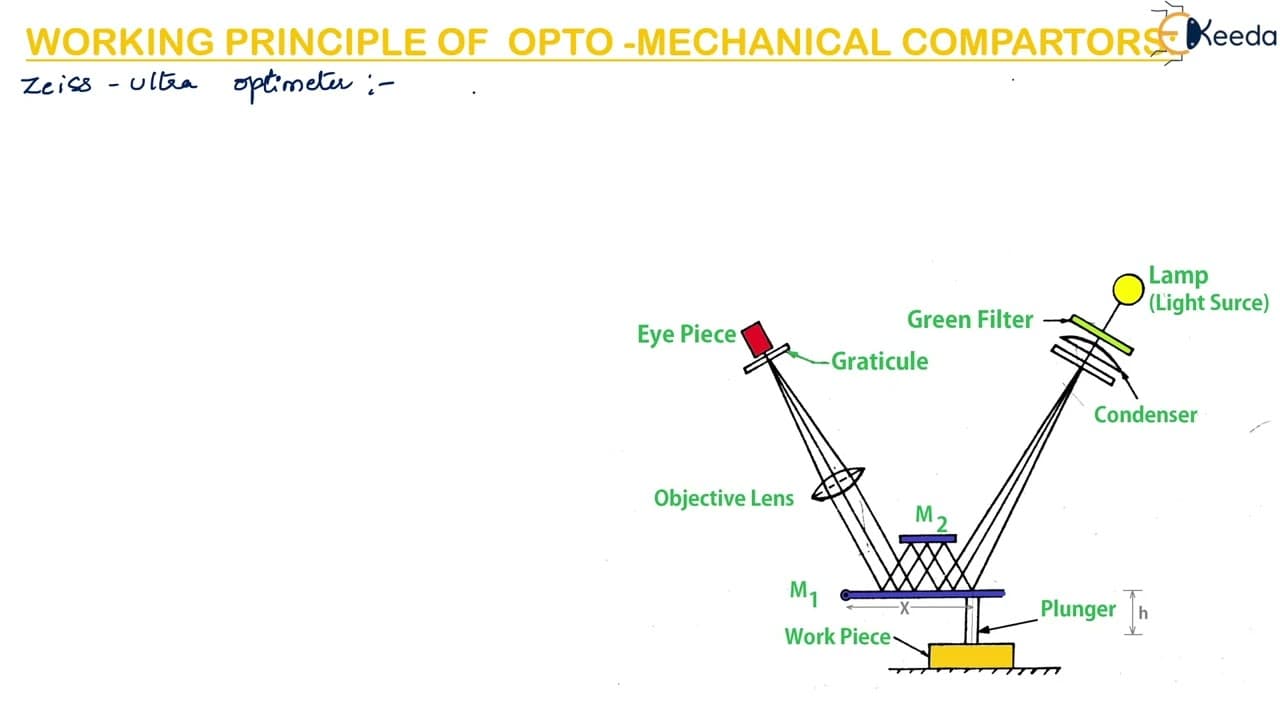
hello students today we will learn the working principle of optomechanical comparator optomechanical comparator which is also called as mechanical optical comparator so this is the schematic diagram of the optomechanical or mechanical optical comparator so here this optomechanical comparator uses two principles for magnifying the readings so first ... Read More

Key Insights

  • 😒 Optomechanical comparators use both mechanical and optical principles to amplify readings.
  • 🦾 The mechanical lever amplifies small displacements, while the optical system projects the magnified image.
  • 👻 The scale and readings are viewed on a screen, allowing for precise measurements.
  • 💚 Green filters are used to enhance visibility by filtering out unwanted rays.
  • ✋ Optomechanical comparators provide high accuracy but require an electric supply and a dark environment for optimal performance.
  • 😒 Continuous use of certain optomechanical comparators might not be convenient due to the need for manual viewing through an eyepiece.
  • 🙂 Heat from the light source can cause drift in the device's settings, making careful maintenance necessary.

Install to Summarize YouTube Videos and Get Transcripts

Explore YouTube Video Summarizer or Get YouTube Transcript Extractor

Questions & Answers

Q: How does an optomechanical comparator magnify readings?

The optomechanical comparator uses a mechanical lever to amplify small displacements of the measuring plunger. The lever causes the mirror to tilt, magnifying the image of the index on a green screen.

Q: What is the role of the optical system in an optomechanical comparator?

The optical system in an optomechanical comparator includes a projection lens, a glass plate with an index line, and a collimator lens. It collects and projects the reflected rays from the mirror, allowing the image of the index to be viewed.

Q: What is the advantage of using a green filter in the optomechanical comparator?

The green filter in the optomechanical comparator filters all rays except the green light, which causes less fatigue to the eyes. This ensures better visibility and reduces eye strain during readings.

Q: Why is an electric supply necessary for operating optomechanical comparators?

Optomechanical comparators require an electric supply to power the light source, such as a lamp. The lamp sends light rays through filters and lenses, enabling the projection of the image onto the scale.

Summary & Key Takeaways

  • Optomechanical comparators use a mechanical lever to amplify small displacements and a mirror and optical system to project the amplified readings onto a scale.

  • The mechanical lever causes the mirror to tilt, magnifying the image of the index on a green screen.

  • The reflected rays pass through a projection lens, a glass plate with an index line, and a collimator lens, and are viewed through a scale on a screen.


Read in Other Languages (beta)

English

Share This Summary 📚

Summarize YouTube Videos and Get Video Transcripts with 1-Click

Download browser extensions on:

Try YouTube Summary with ChatGPT & Claude or YouTube Transcript Generator

Explore More Summaries from Ekeeda 📚
Problem 2 on Centroid on Cut-Out Section - Centroid and Centre of Gravity - Engineering Mechanics thumbnail
Problem 2 on Centroid on Cut-Out Section - Centroid and Centre of Gravity - Engineering Mechanics
Ekeeda
Problem 3 Based on Multiplication By 't' Property - Laplace Transform - Engineering Mathematics 3 thumbnail
Problem 3 Based on Multiplication By 't' Property - Laplace Transform - Engineering Mathematics 3
Ekeeda
Attributes Of WCDMA System - 3G Technology - Mobile Communication System thumbnail
Attributes Of WCDMA System - 3G Technology - Mobile Communication System
Ekeeda
How to Project an Isosceles Triangle in Engineering Drawing thumbnail
How to Project an Isosceles Triangle in Engineering Drawing
Ekeeda
Solution of Differential Equation in Laplace Transform | Signals and Systems | Problem 04 thumbnail
Solution of Differential Equation in Laplace Transform | Signals and Systems | Problem 04
Ekeeda
IBM Rational functional and Selenium - Test Automation - Software Testing and Quality Assurance thumbnail
IBM Rational functional and Selenium - Test Automation - Software Testing and Quality Assurance
Ekeeda

Summarize YouTube Videos and Get Video Transcripts with 1-Click

Download browser extensions on:

Try YouTube Summary with ChatGPT & Claude or YouTube Transcript Generator

Apps & Extensions

  • Chrome Extension
  • Safari Extension
  • Edge Add-ons
  • Firefox Add-ons
  • iOS App
  • Android App

Key Features

  • YouTube Video Summarizer
  • Web & PDF Summarizer
  • Web & PDF Highlighter
  • Chat with PDF
  • Ask AI Clone
  • Audio Transcriber
  • Glasp Reader
  • Kindle Highlight Export
  • Idea Hatch

Integrations

  • Obsidian Plugin
  • Notion Integration
  • Pocket Integration
  • Instapaper Integration
  • Medium Integration
  • Readwise Integration
  • Snipd Integration
  • Hypothesis Integration

More Features

  • APIs
  • MCP Connector
  • Blog & Post
  • Embed Links
  • Image Highlight
  • Personality Test
  • Quote Shots

Company

  • About us
  • Blog
  • Community
  • FAQs
  • Job Board
  • Newsletter
  • Pricing
Terms

•

Privacy

•

Guidelines

© 2026 Glasp Inc. All rights reserved.