Former Microsoft Executive on Apple’s Hidden China Problem
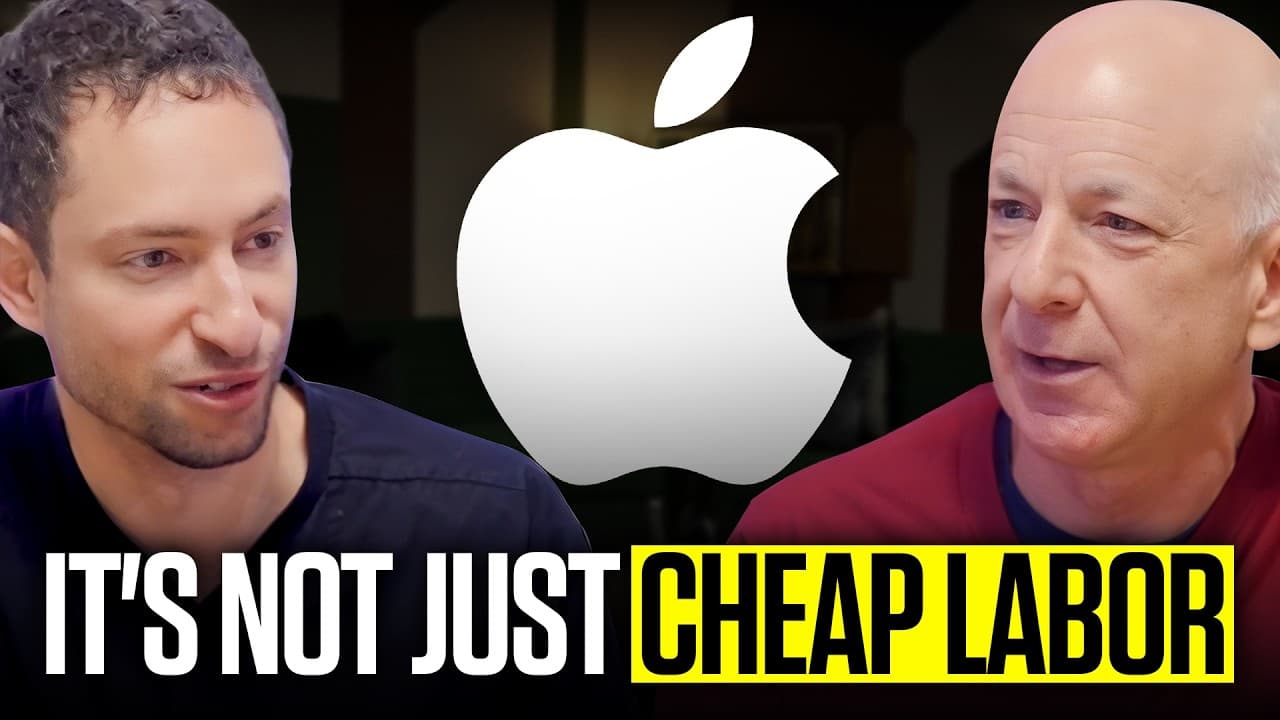
TL;DR
Apple's China manufacturing success now poses strategic risks.
Transcript
as Tim Cook says people think that China is about cheap manufacturing it's the skills they have apple would just argue there was no way we could even have started the iPhone anywhere else all the experts in 1999 were like two things yay for global trade this is what we all want and also don't worry China they're going to stay a third world dictator... Read More
Key Insights
- Apple's manufacturing shift to China was initially celebrated for its efficiency and innovation, but now presents strategic risks due to geopolitical tensions.
- The integration of China into the global economy was seen as a positive step in the late 1990s, but experts underestimated China's rapid development and influence.
- Tim Cook's operational strategies at Apple have significantly influenced the global tech industry, particularly through supply chain innovations.
- Microsoft's Surface launch highlighted challenges in hardware innovation, underscoring the competitive landscape Apple navigated to maintain its market position.
- Apple's reliance on China for manufacturing has become a liability, especially in light of recent global events that exposed vulnerabilities in the supply chain.
- COVID-19 highlighted the fragility of global manufacturing dependencies, prompting companies to reconsider their supply chain strategies.
- Intellectual property and national policy are increasingly intersecting with technological advancements, affecting global trade dynamics.
- The evolution of Apple's manufacturing in China has been a pivotal factor in the company's growth, but also a point of contention in the current geopolitical climate.
Install to Summarize YouTube Videos and Get Transcripts
Explore YouTube Video Summarizer or Get YouTube Transcript Extractor
Questions & Answers
Q: What was the initial reaction to Apple's manufacturing shift to China?
Initially, Apple's shift to manufacturing in China was celebrated as a modern business strategy that leveraged global trade opportunities. It was seen as a way to enhance efficiency and innovation, aligning with the global trend of outsourcing to focus on core competencies.
Q: How did experts in 1999 misjudge China's trajectory?
Experts in 1999 underestimated China's potential for rapid development and its ability to become a global manufacturing powerhouse. They believed China would remain a third-world dictatorship, failing to anticipate its significant economic and technological advancements.
Q: What role did Tim Cook play in Apple's manufacturing strategy?
Tim Cook played a crucial role in shaping Apple's manufacturing strategy by focusing on operational efficiency and supply chain innovations. His approach significantly influenced the global tech industry, setting new standards for manufacturing and product design.
Q: What were the challenges Microsoft faced with the Surface launch?
Microsoft faced significant challenges in hardware innovation with the Surface launch, particularly in convincing PC makers to adopt new manufacturing techniques. This highlighted the competitive landscape and the barriers to entry that Apple successfully navigated to maintain its market position.
Q: Why has Apple's reliance on China become a liability?
Apple's reliance on China has become a liability due to geopolitical tensions and the exposure of supply chain vulnerabilities during global events like COVID-19. This dependence poses risks to Apple's operations and market stability.
Q: How did COVID-19 impact global manufacturing dependencies?
COVID-19 exposed the fragility of global manufacturing dependencies by disrupting supply chains and highlighting single points of failure. Companies are now reconsidering their strategies to mitigate risks and enhance resilience in their operations.
Q: What is the role of intellectual property in US-China competition?
Intellectual property plays a critical role in US-China competition, as both countries navigate the complexities of technological advancements and global trade. Protecting IP rights while fostering innovation is a key challenge in this evolving landscape.
Q: How does the episode view the future of manufacturing?
The episode suggests that the future of manufacturing will involve increased automation and innovation to address current dependencies and vulnerabilities. Companies like Apple are expected to lead in developing new manufacturing techniques to ensure sustainability and competitiveness.
Summary & Key Takeaways
-
Apple's decision to shift its manufacturing to China was initially driven by the pursuit of design excellence and supply chain efficiency. This move significantly contributed to China's rise as a manufacturing superpower. However, this partnership is now under scrutiny due to geopolitical tensions.
-
The episode explores how Apple's operational strategies, particularly under Tim Cook, reshaped the global tech industry. It also delves into the challenges faced by Microsoft in hardware innovation, highlighting the competitive landscape Apple navigated to maintain its market position.
-
COVID-19 exposed the fragility of global supply chains, prompting a reevaluation of manufacturing dependencies. The discussion also touches on the intersection of national policy, intellectual property, and technological advancements, which are reshaping the global trade landscape.
Read in Other Languages (beta)
Share This Summary 📚
Summarize YouTube Videos and Get Video Transcripts with 1-Click
Try YouTube Summary with ChatGPT & Claude or YouTube Transcript Generator
Explore More Summaries from a16z 📚






Summarize YouTube Videos and Get Video Transcripts with 1-Click
Try YouTube Summary with ChatGPT & Claude or YouTube Transcript Generator