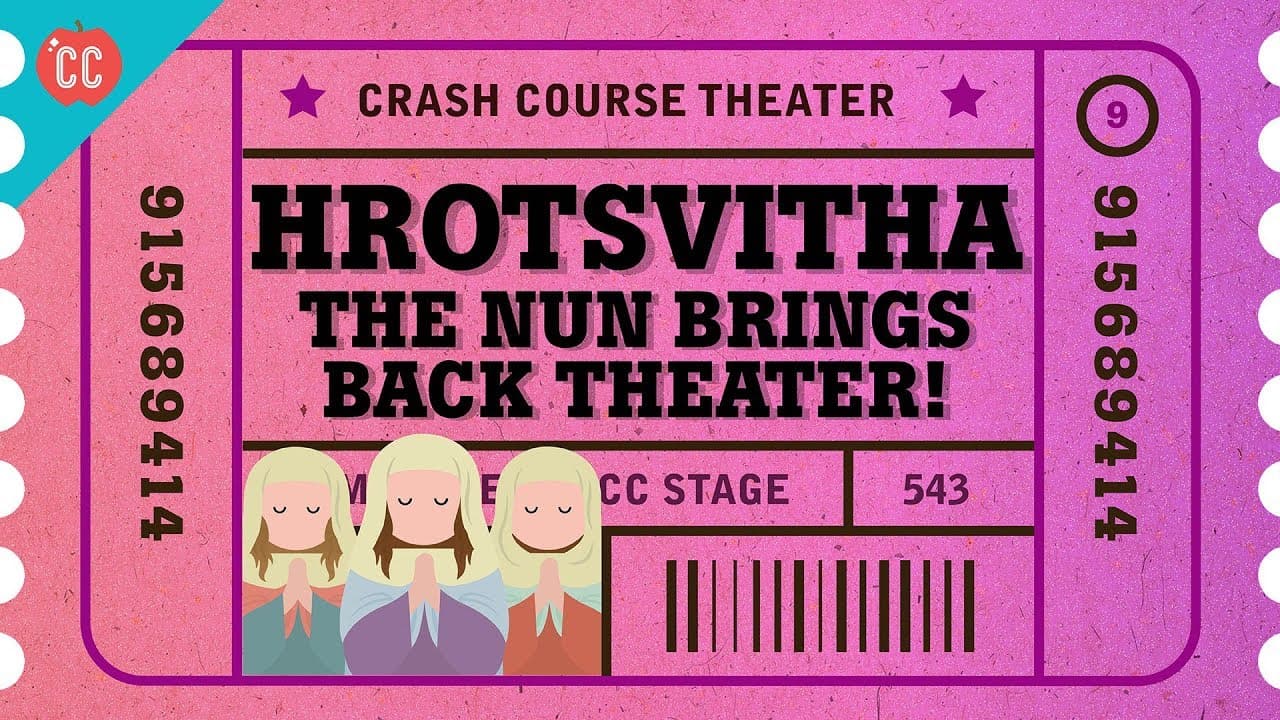
Hrotsvitha, Hildegard, and the Nun who Resurrected Theater: Crash Course Theater #9
TL;DR
Medieval nuns revived theater with moral comedies.
Transcript
Hey there! My name is Mike Rugnetta, this is Crash Course Theater and Last time, we looked at how the liturgical drama—specifically a call-and-response section smuggled into the Easter liturgy—helped bring theater back to the West. Today we’ll look at another way theater got snuck back into the Christian world. Who did the sneaking? A canoness! Wha... Read More
Key Insights
- Hrotsvitha, a 10th-century nun, is considered the first female playwright, known for her comedic plays with moral undertones.
- Hrotsvitha's works, known as Comaedia Sacrae, were inspired by Terence but focused on chastity and repentance instead of secular themes.
- Her plays were primarily closet dramas, meant to be read rather than performed, though they have seen performances in modern times.
- Dulcitius, one of Hrotsvitha's plays, humorously depicts the martyrdom of three Christian sisters, blending comedy with religious themes.
- Hildegard of Bingen, another medieval playwright, composed 'The Order of Virtues,' a liturgical drama with accompanying music.
- Hildegard's play is an allegory where the human soul chooses between Virtues and the Devil, emphasizing Christian values.
- Both Hrotsvitha and Hildegard used theater as a medium to reinforce Christian teachings and showcase female characters' strength.
- Their works contributed to the re-emergence of theater in the West, alongside the liturgical dramas of the period.
Install to Summarize YouTube Videos and Get Transcripts
Explore YouTube Video Summarizer or Get YouTube Transcript Extractor
Questions & Answers
Q: Who was Hrotsvitha and what was her contribution to theater?
Hrotsvitha was a 10th-century nun from Lower Saxony, Germany, recognized as the world's first known female playwright. She contributed to theater by creating a new genre of plays known as Comaedia Sacrae, or Sacred Comedies, which were comedic yet focused on moral and religious themes, countering the secular nature of Roman comedies.
Q: What were the themes of Hrotsvitha's plays?
Hrotsvitha's plays primarily focused on themes of chastity and repentance. Inspired by Roman playwright Terence, she intended to provide an alternative to the secular and often lewd themes found in Roman comedies. Her works aimed to reinforce Christian values, particularly the virtue of chastity, through comedic storytelling.
Q: What is the significance of the play 'Dulcitius'?
'Dulcitius' is one of Hrotsvitha's most famous plays, noted for its blend of humor and religious themes. It tells the story of three Christian sisters who are martyred, with comedic elements arising from the bumbling actions of the Roman governor Dulcitius. The play highlights the theme of chastity and the triumph of faith over persecution.
Q: Who was Hildegard of Bingen and what was her role in theater?
Hildegard of Bingen was a 12th-century abbess, composer, philosopher, and playwright, often referred to as 'the Sibyl of the Rhine.' She played a significant role in theater by composing 'The Order of Virtues,' a liturgical drama that is the first known morality play with surviving music. Her work emphasized the moral struggle between virtues and vices.
Q: What is 'The Order of Virtues' about?
'The Order of Virtues' is a liturgical drama composed by Hildegard of Bingen, depicting the allegorical struggle of the human soul, Anima, between the Virtues and the Devil. The play emphasizes the importance of choosing virtue over vice and is notable for its accompanying music, showcasing Hildegard's talents as both a playwright and composer.
Q: How did Hrotsvitha and Hildegard's works influence theater?
Hrotsvitha and Hildegard's works played a crucial role in the revival of theater during the medieval period. By creating plays with strong moral and religious themes, they provided a foundation for the development of liturgical and morality plays. Their emphasis on Christian values and the portrayal of strong female characters influenced the evolution of theater in the West.
Q: What challenges did Hrotsvitha face in creating her plays?
Hrotsvitha faced the challenge of countering the secular and often lewd themes of Roman comedies while maintaining a comedic style. She was concerned about the potential corrupting influence of polished pagan literature on Christian audiences and sought to create plays that were both entertaining and morally instructive, focusing on themes like chastity and repentance.
Q: Why are Hrotsvitha's plays considered closet dramas?
Hrotsvitha's plays are considered closet dramas because they were primarily intended to be read rather than performed. This genre of drama was typical during the medieval period when theater was not widely practiced. Her works were likely read aloud in private settings, and it wasn't until the late 19th century that they began to be performed more frequently.
Summary & Key Takeaways
-
Hrotsvitha, a 10th-century nun from Lower Saxony, is recognized as the world's first known female playwright, creating comedies with a moral focus. Her plays, inspired by Terence, aimed to counteract the secular themes of Roman comedies by emphasizing chastity and repentance.
-
Dulcitius, one of Hrotsvitha's notable plays, humorously portrays the martyrdom of three Christian sisters, blending comedic elements with religious themes. While primarily closet dramas, her works have been performed in modern times, showcasing her influence on theater's revival.
-
Hildegard of Bingen, another influential medieval playwright, composed 'The Order of Virtues,' a liturgical drama with accompanying music. Her play is an allegorical depiction of the human soul's choice between Virtues and the Devil, reinforcing Christian values.
Read in Other Languages (beta)
Share This Summary 📚
Summarize YouTube Videos and Get Video Transcripts with 1-Click
Try YouTube Summary with ChatGPT & Claude or YouTube Transcript Generator
Explore More Summaries from CrashCourse 📚





Summarize YouTube Videos and Get Video Transcripts with 1-Click
Try YouTube Summary with ChatGPT & Claude or YouTube Transcript Generator