How to Find Linearization of a Function Using Tangent Lines
TL;DR
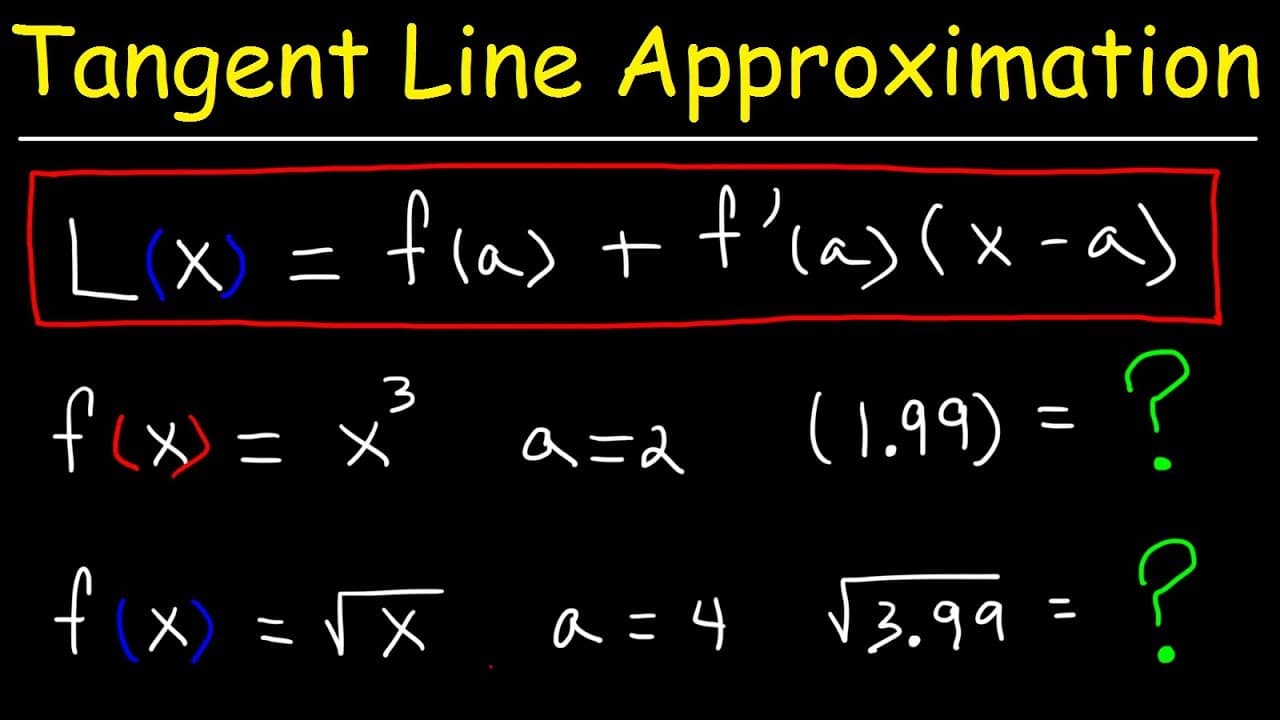
To find the linearization of a function at a specific point, use the formula l(x) = f(a) + f'(a)(x - a), where f(a) is the function value at a and f'(a) is the derivative at a. This method allows for easy approximation of function values near that point without using a calculator.
Transcript
in this video we're going to talk about how to find the linearization of a function at a certain value so let's try this problem let's say that f of x is equal to x cubed and we want to find the linearization at a equals two so basically what we really are trying to do is we're looking for the tangent line equation when x is two that's the basic id... Read More
Key Insights
- 🫥 Linearization is finding the tangent line equation at a specific point on a function.
- ❓ The formula for linearization is l(x) = f(a) + f'(a)(x - a), where f(a) is the function value at a and f'(a) is the derivative at a.
- 🫥 Linearization can be used to approximate function values without a calculator by using the tangent line.
- 😥 Accuracy of the linearization approximation decreases as the value being estimated moves further from the point of intersection.
- ⛔ Linearization is not limited to polynomial functions; it can be used for any function with a derivative.
- 😚 The closer a value is to the point of intersection, the more accurate the linearization approximation will be.
- 🔨 Linearization provides a useful tool for approximating difficult function values in a practical setting.
Install to Summarize YouTube Videos and Get Transcripts
Explore YouTube Video Summarizer or Get YouTube Transcript Extractor
Questions & Answers
Q: How do you find the linearization of a function at a specific value?
To find the linearization, use the formula l(x) = f(a) + f'(a)(x - a), where f(a) is the function value at a and f'(a) is the derivative at a. Plug in the values and simplify to get the linearization equation.
Q: How does linearization help in function approximation?
Linearization allows us to approximate function values without a calculator by using the tangent line. The linearization equation provides a close approximation when the value is near the point of intersection.
Q: Why does linearization accuracy depend on the closeness of the value to the point of intersection?
Linearization accuracy depends on the closeness of the value to the point of intersection because the tangent line approximates the curve at that point. As the value gets further from the point, a new tangent line must be created, resulting in less accuracy.
Q: Can linearization be used for functions other than polynomials?
Yes, linearization can be used for any function as long as its derivative exists. The process of finding the linearization remains the same, using the function value and derivative at the given point.
Summary & Key Takeaways
-
The linearization of a function at a given value is the equation of the tangent line at that point.
-
To find the linearization, use the formula l(x) = f(a) + f'(a)(x - a), where f(a) is the function value at a and f'(a) is the derivative at a.
-
Linearization helps approximate difficult function values without a calculator by using the tangent line.
Read in Other Languages (beta)
Share This Summary 📚
Summarize YouTube Videos and Get Video Transcripts with 1-Click
Try YouTube Summary with ChatGPT & Claude or YouTube Transcript Generator
Explore More Summaries from The Organic Chemistry Tutor 📚

Summarize YouTube Videos and Get Video Transcripts with 1-Click
Try YouTube Summary with ChatGPT & Claude or YouTube Transcript Generator