How Do Charged Particles Move in Electric Fields?
TL;DR
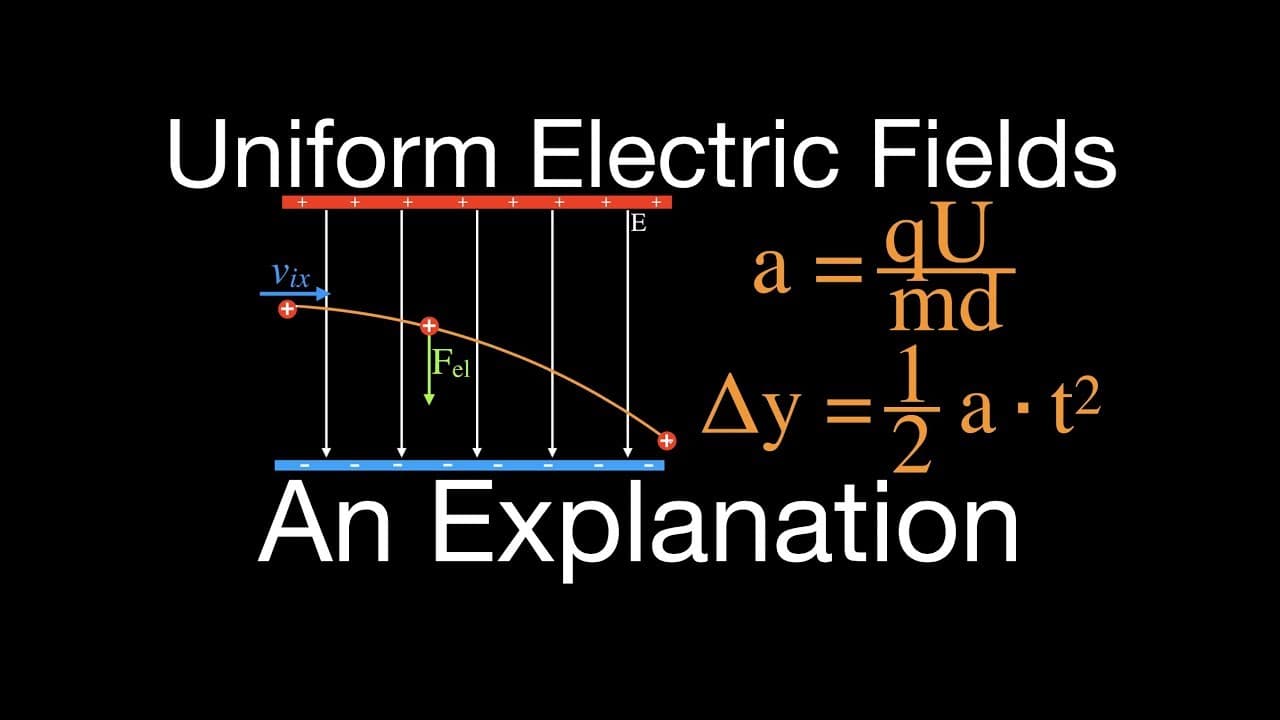
Charged particles moving perpendicular to electric fields follow parabolic trajectories due to the electric force acting in the vertical direction. While maintaining constant velocity in the horizontal direction, these particles experience acceleration due to the unbalanced electric force in the vertical direction. The time taken to traverse distances in both dimensions is equal, simplifying velocity and displacement calculations.
Transcript
okay in today's video we are going to be going over the motion of charged particles in electric fields and we're gonna be talking about charged particles that are moving across or perpendicular to the electric field if you want to know about charged particles that are moving parallel or along the electric field then link to those videos in the uppe... Read More
Key Insights
- 🏑 Electric fields cause charged particles to follow parabolic paths.
- 🔌 Only the electric force influences the motion of charged particles in electric fields.
- ☺️ Balanced forces in the X direction lead to constant velocity.
- 🔌 Acceleration occurs in the Y direction due to unbalanced electric forces.
- 🥡 Time taken in X and Y directions is equal for charged particles in electric fields.
- 🧑🏭 Velocity calculations consider both initial conditions and forces acting on charged particles.
- 🔺 Magnitudes and angles of velocities are determined using vector addition and trigonometric functions.
Install to Summarize YouTube Videos and Get Transcripts
Explore YouTube Video Summarizer or Get YouTube Transcript Extractor
Questions & Answers
Q: How do electric fields affect the motion of charged particles?
Electric fields influence the path of charged particles, causing them to accelerate and move in parabolic trajectories.
Q: What forces act on charged particles in X and Y directions in electric fields?
In the X direction, no forces exist, leading to constant velocity, while in the Y direction, electric forces cause acceleration.
Q: How is time calculated for charged particles moving in electric fields?
Time calculations involve understanding the balance of forces in X and Y directions, determining the time taken to traverse a given distance.
Q: How are velocities calculated for charged particles in electric fields?
Velocities are computed by considering the initial conditions, forces, and distances traveled by charged particles in electric fields.
Summary & Key Takeaways
-
Explanation of the motion of charged particles in electric fields and their parabolic path.
-
Discussion on the forces acting on charged particles in the X and Y directions.
-
Solving problems involving acceleration, time taken, distance traveled, and velocity in electric fields.
Read in Other Languages (beta)
Share This Summary 📚
Summarize YouTube Videos and Get Video Transcripts with 1-Click
Try YouTube Summary with ChatGPT & Claude or YouTube Transcript Generator
Explore More Summaries from Step by Step Science 📚



Summarize YouTube Videos and Get Video Transcripts with 1-Click
Try YouTube Summary with ChatGPT & Claude or YouTube Transcript Generator