Algebra 86 - Graphing Polynomial Functions - Part 1
TL;DR
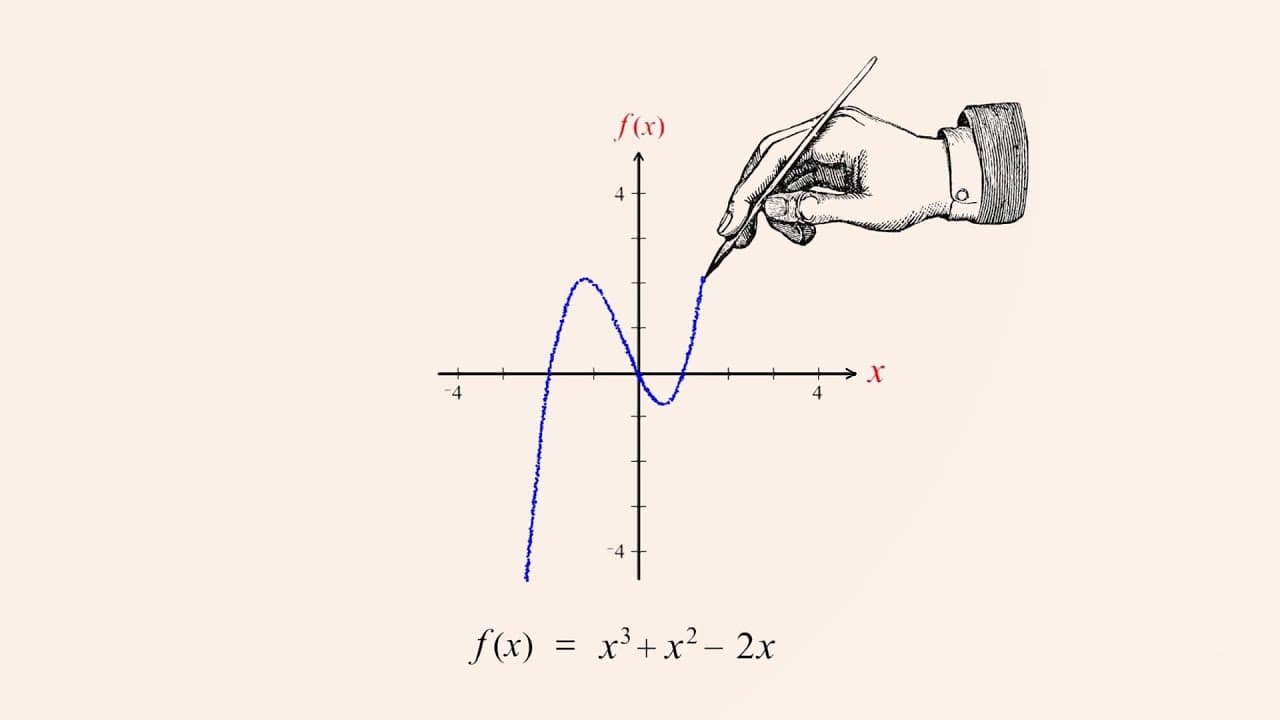
This video explains how to graph polynomial functions, highlighting their continuity, smoothness, and the importance of x-intercepts.
Transcript
Hello. I'm Professor Von Schmohawk and welcome to Why U. So far, we have discussed polynomial functions and showed that their graphs can have interesting and varied shapes. As in previous lectures, the polynomial functions we will be discussing are functions of a single real variable "x". But given a particular polynomial function, how can ... Read More
Key Insights
- 🍳 The graphs of polynomial functions are continuous, meaning they have no breaks or jumps.
- ☺️ Discontinuities in polynomial functions can occur at specific x values, such as zero, or in cases of finite jumps.
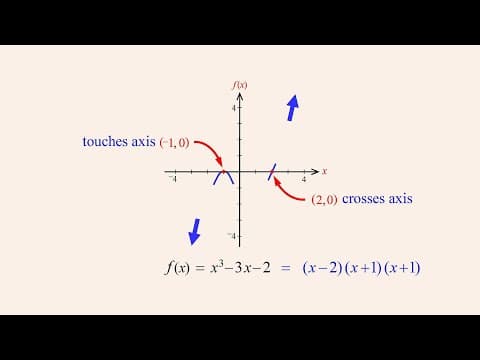
- 👈 X-intercepts, which are the points where a polynomial function's graph intersects the x-axis, are important for graphing.
- 🖤 The smoothness of a graph refers to its lack of sharp corners and continuous slope.
- ☺️ Roots, also known as zeros or solutions, are the x values where a polynomial function intersects the x-axis.
- ❓ The solutions to first and second-degree polynomial equations can be found through factoring or using the quadratic formula.
- ✋ Algebraic methods exist for finding roots of third-degree and fourth-degree polynomial functions, while higher-degree polynomials can be approximated using computational techniques.
Install to Summarize YouTube Videos and Get Transcripts
Explore YouTube Video Summarizer or Get YouTube Transcript Extractor
Questions & Answers
Q: What are the characteristics of the graphs of polynomial functions?
Polynomial graphs are continuous, smooth, and have no breaks or jumps.
Q: How can a function be discontinuous?
A function can be discontinuous if there is a break, jump, or missing point in its graph. This can occur at certain x values or in cases of finite jumps.
Q: What are x-intercepts and why are they important when graphing polynomial functions?
X-intercepts are the points where a polynomial function's graph intersects the x-axis. They are important because they indicate regions of the function's domain that produce interesting graph behavior.
Q: How can the roots of a polynomial function be found?
The roots of a polynomial function, also known as zeros or solutions, can be found by factoring the polynomial and setting each term equal to zero, then solving resulting linear equations.
Summary & Key Takeaways
-
Polynomial functions can have various shapes, and their graphs are continuous, meaning they have no breaks or jumps.
-
Discontinuities can occur in polynomial functions at certain x values, such as zero or in the case of finite jumps.
-
The graph of a polynomial function is smooth, meaning it has no sharp corners, and its slope is continuous at every point.
Read in Other Languages (beta)
Share This Summary 📚
Summarize YouTube Videos and Get Video Transcripts with 1-Click
Try YouTube Summary with ChatGPT & Claude or YouTube Transcript Generator
Explore More Summaries from MyWhyU 📚

Summarize YouTube Videos and Get Video Transcripts with 1-Click
Try YouTube Summary with ChatGPT & Claude or YouTube Transcript Generator