Probability of Mutually Exclusive Events With Venn Diagrams
TL;DR
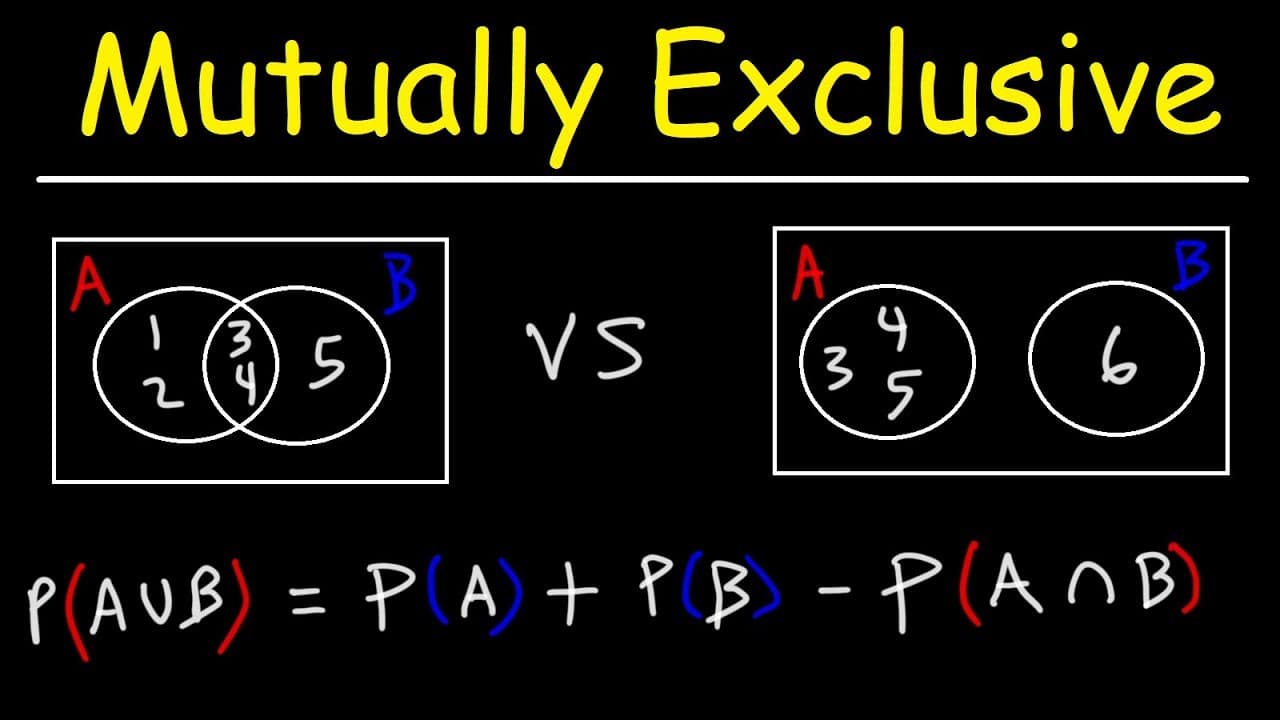
Mutually exclusive events are events that cannot occur at the same time because they do not share any outcomes, and their probability of occurring together is always zero.
Transcript
in this lesson we're going to focus on mutually exclusive events now what is a mutually exclusive event so these are events that cannot occur at the same time so what does that mean let's see if we have two events event a and event b events a and b will not occur at the same time if they do not share any outcomes now what we're going to do is illus... Read More
Key Insights
- ⌛ Mutually exclusive events cannot occur at the same time because they do not share any outcomes.
- 0️⃣ The probability of two mutually exclusive events occurring together is always zero.
- ❓ Events can be determined as mutually exclusive or not by finding the intersection of their outcomes.
- ❓ Events with a common outcome are not mutually exclusive.
- 🔙 The probability of getting a non-mutually exclusive event is calculated using the formula P(A or B) = P(A) + P(B) - P(A and B).
- 🔙 For mutually exclusive events, the formula simplifies to P(A or B) = P(A) + P(B).
- ⭕ Mutually exclusive events are represented in Venn diagrams by separate circles that do not overlap.
Install to Summarize YouTube Videos and Get Transcripts
Explore YouTube Video Summarizer or Get YouTube Transcript Extractor
Questions & Answers
Q: What are mutually exclusive events?
Mutually exclusive events are events that cannot occur at the same time because they do not share any outcomes. For example, rolling a dice and getting an odd number or getting an even number are mutually exclusive events.
Q: How do you calculate the probability of getting a mutually exclusive event?
The probability of getting a mutually exclusive event is always zero. This is because mutually exclusive events do not share any outcomes.
Q: Can events with a common outcome be mutually exclusive?
No, events with a common outcome cannot be mutually exclusive. Mutually exclusive events should not share any outcomes. If events share one or more outcomes, they are not mutually exclusive.
Q: How can you represent mutually exclusive events using Venn diagrams?
In Venn diagrams, mutually exclusive events are represented by two separate circles that do not overlap. Each circle represents an event, and there is no intersection between the circles since the events do not share any outcomes.
Summary & Key Takeaways
-
Mutually exclusive events are events that cannot occur simultaneously because they do not share any outcomes.
-
The probability of two mutually exclusive events occurring together is always zero.
-
To determine if events are mutually exclusive, you need to find the probability of getting those two events. If it is zero, they are mutually exclusive; if it is anything but zero, they are not mutually exclusive.
Read in Other Languages (beta)
Share This Summary 📚
Summarize YouTube Videos and Get Video Transcripts with 1-Click
Try YouTube Summary with ChatGPT & Claude or YouTube Transcript Generator
Explore More Summaries from The Organic Chemistry Tutor 📚



Summarize YouTube Videos and Get Video Transcripts with 1-Click
Try YouTube Summary with ChatGPT & Claude or YouTube Transcript Generator