Einstein's General Theory of Relativity | Lecture 5

Transcript
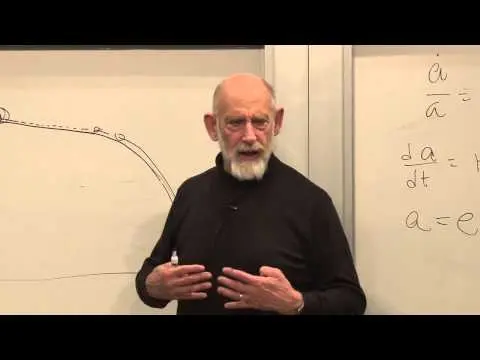
this program is brought to you by Stanford University please visit us at stanford.edu all right let's we want to we want to move on to a slippery and somewhat uh abstract and frankly a little bit difficult subject the notion well first of all the subject is tensor Cal calculus we've done about everything that you can do with tensor algebra and tens... Read More
Install to Summarize YouTube Videos and Get Transcripts
Explore YouTube Video Summarizer or Get YouTube Transcript Extractor
Summary
In this video, the concept of tensor calculus is introduced. Tensors are important to express relationships in geometry and physics. Tensors are objects that have components which can be transformed based on different coordinate systems. The video explores the concept of covariant derivatives, which allows for the differentiation of tensors while maintaining their transformation properties. The covariant derivative introduces an extra term, represented by the gamma tensor, that helps in expressing the non-constant nature of vectors in different coordinate systems.
Questions & Answers
Q: Why do we introduce tensors?
Tensors are introduced to express the properties of geometries and physical laws in terms of objects that can transform in a coordinate-independent manner. While it is possible to express physics without coordinate systems, it is more convenient to use tensors and their components to describe and compute physical quantities.
Q: What are the properties of tensors?
Tensors have the property that if their components are equal in one coordinate system, then they are equal in all coordinate systems. This means that tensors transform consistently and maintain their properties across different coordinate systems.
Q: Why do we need coordinates to describe physics?
While coordinate-free descriptions of physics are possible, it is more convenient to use coordinates when computing and describing physical quantities. Coordinates allow us to assign numerical values to the components of vectors and tensors, which makes it easier to perform numerical calculations and simulations.
Q: How do tensors transform?
Tensors transform based on the properties of their indices and the coordinate system being used. If the indices of two tensors match and their components are equal in one coordinate system, then they will be equal in all coordinate systems.
Q: Are all derivatives of tensors tensors?
No, not all derivatives of tensors are tensors. Ordinary derivatives of tensors are not tensors themselves. To differentiate a tensor and obtain another tensor, an extra term called the gamma tensor is introduced. The gamma tensor depends on the metric tensor and its derivatives.
Q: How is the covariant derivative defined?
The covariant derivative of a tensor is obtained by taking the ordinary derivative of the tensor and adding an extra term involving the gamma tensor. The gamma tensor depends on the metric tensor and its derivatives.
Q: Why is the covariant derivative necessary?
The covariant derivative is necessary because ordinary derivatives of tensors do not transform as tensors themselves. The extra term involving the gamma tensor ensures that the derivative of a tensor also transforms as a tensor, maintaining the coordinate independence of tensors.
Q: Can all tensors be differentiated covariantly?
Yes, all tensors can be differentiated covariantly using the covariant derivative. The covariant derivative follows a set of rules where each index is treated as a vector index, and an extra term involving the gamma tensor is added for each index.
Q: Can a vector with constant components have a non-zero covariant derivative?
Yes, a vector with constant components in one coordinate system can have a non-zero covariant derivative. The covariant derivative takes into account the variation of the coordinates and picks up the non-constant nature of the vector.
Q: How is the gamma tensor related to the metric tensor?
The gamma tensor is constructed from the components of the metric tensor. Specifically, the gamma tensor depends on the derivatives of the metric tensor. The exact relationship between the gamma tensor and the metric tensor depends on the specific coordinates and their transformation properties.
Read in Other Languages (beta)
Share This Summary 📚
Summarize YouTube Videos and Get Video Transcripts with 1-Click
Try YouTube Summary with ChatGPT & Claude or YouTube Transcript Generator
Explore More Summaries from Stanford 📚


Summarize YouTube Videos and Get Video Transcripts with 1-Click
Try YouTube Summary with ChatGPT & Claude or YouTube Transcript Generator