The Antikythera Mechanism: A Shocking Discovery from Ancient Greece.
TL;DR
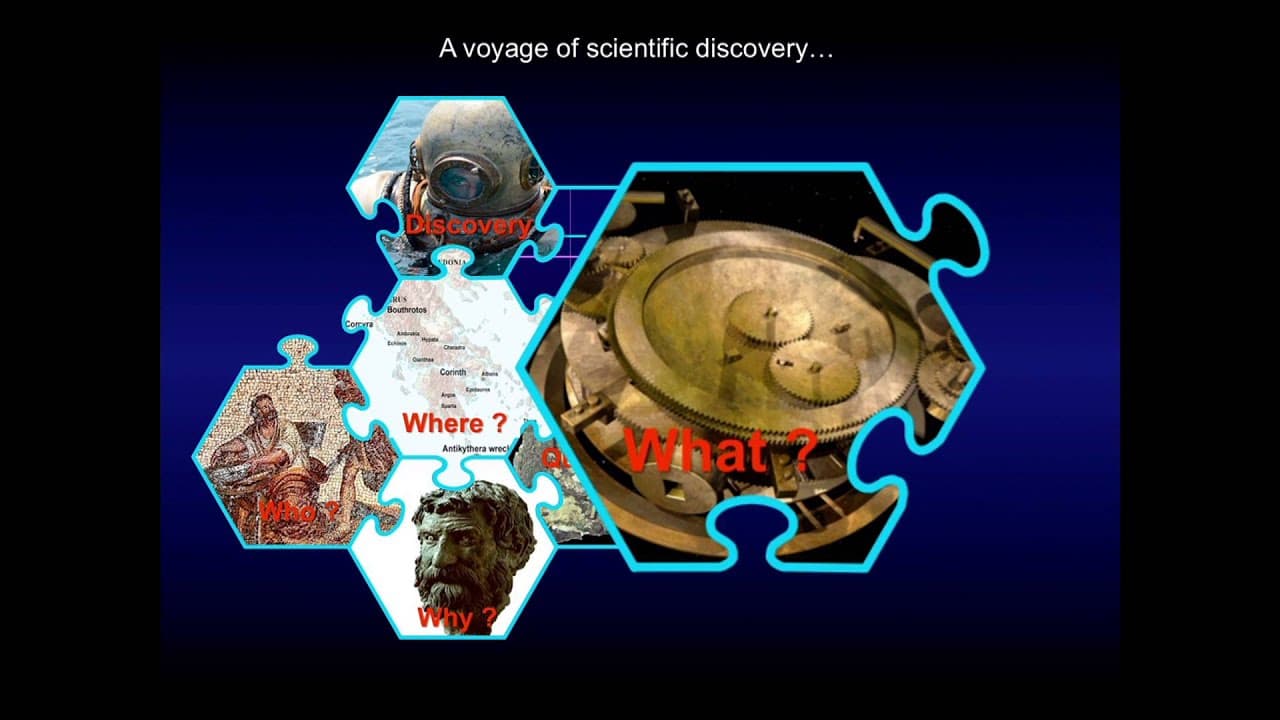
The Antikythera Mechanism is an ancient Greek device that functions as an early analog computer, capable of predicting eclipses and tracking celestial bodies. Discovered in a shipwreck, it showcases the remarkable mechanical ingenuity of the ancient Greeks, revealing advanced astronomical knowledge that challenges previous understandings of their technological capabilities.
Transcript
[MUSIC] Stanford University. This program is brought to by the Stanford Humanities Center. For more information please visit us at shc.stanford.edu. Good evening. My name is Grant Parker. On behalf of Stanford's Department of Classics, I'd like to welcome you to the 12th Lawrence Eitner Lecture on Classical Art and Culture, a lecture series aimed a... Read More
Key Insights
- 🧘 The Antikythera Mechanism was a highly advanced device that could predict eclipses and calculate the positions of celestial bodies.
- ❓ The device showcases the advanced knowledge and technology of the ancient Greeks.
- 🫵 The discovery of the Antikythera Mechanism challenges traditional views of ancient civilizations and their technological capabilities.
- ❓ The mechanism provides valuable insights into ancient Greek astronomy and the study of celestial bodies.
Install to Summarize YouTube Videos and Get Transcripts
Explore YouTube Video Summarizer or Get YouTube Transcript Extractor
Questions & Answers
Q: What is the Antikythera Mechanism?
The Antikythera Mechanism is a complex device discovered in Greece that contains numerous gears and dials. It was used to predict eclipses and calculate the positions of celestial bodies.
Q: How was the Antikythera Mechanism used?
The mechanism was operated using a series of gears and dials. By turning the dials, users could accurately predict eclipses and determine the positions of celestial bodies.
Q: What does the discovery of the Antikythera Mechanism suggest about ancient Greek knowledge and technology?
The Antikythera Mechanism demonstrates that the ancient Greeks had a sophisticated understanding of astronomy and the ability to create complex and intricate devices.
Q: What do the inscriptions found on the Antikythera Mechanism indicate?
The inscriptions on the mechanism provide additional information about the device's functions and the positions of celestial bodies.
Summary
This video is a recorded lecture on the Antikythera Mechanism, a complex ancient Greek artifact discovered in 1900. The speaker, Dr. Tony Freeth, discusses the shocking nature of the discovery and the importance of collaborative research in understanding its function. He highlights the contributions of previous researchers, such as Albert Rehm and Derek de Solla Price, who made significant progress in understanding the mechanism's astronomical calculations. Dr. Freeth also introduces the work of Michael Wright and his analysis of the mechanism's gears. He then describes his own research using advanced imaging techniques to uncover new insights into the mechanism's structure and purpose.
Questions & Answers
Q: What is the Antikythera Mechanism?
The Antikythera Mechanism is a highly complex ancient Greek artifact that was discovered in 1900. It is considered one of the most extraordinary discoveries from the ancient world and is often referred to as the world's first computer. The mechanism consists of gears, pins, bearings, and inscriptions that were used to calculate various astronomical cycles.
Q: How was the mechanism discovered?
The mechanism was discovered in 1900 by a sponge fisherman named Fotis Lindiakos. While seeking shelter from a storm near the island of Antikythera, Lindiakos' crew accidentally stumbled upon an ancient wreck containing numerous artifacts, including the mechanism. The Greek authorities organized the first major underwater archaeology expedition, which recovered additional artifacts from the wreck.
Q: Who were some of the key researchers who studied the mechanism?
Albert Rehm, a German philologist, was one of the early researchers who made significant progress in understanding the mechanism's astronomical calculations. Derek de Solla Price, an American historian of science, built upon Rehm's work and proposed the concept of epicyclic and differential gears in the mechanism. Michael Wright, a curator of mechanical engineering, further analyzed the gears and proposed the presence of celestial pointers for the planets.
Q: What were some of the key insights from Dr. Tony Freeth's research?
Dr. Tony Freeth focused on understanding the mechanical structure and purpose of the Antikythera Mechanism. Through advanced imaging techniques, such as 3D X-rays and surface mapping, he was able to examine the intricate gears and inscriptions of the mechanism. His research uncovered new insights into the role of the gears in calculating astronomical cycles and eclipse predictions.
Q: How did the researchers determine the purpose of the mechanism?
The researchers used a combination of archaeological evidence, analysis of the mechanism's gears and inscriptions, and knowledge of ancient astronomical practices to determine its purpose. By studying the tooth counts of the gears and the presence of inscriptions related to astronomical cycles and eclipse predictions, they deduced that the mechanism was a highly advanced astronomical calculator used to track celestial phenomena.
Q: What were some of the key astronomical cycles calculated by the mechanism?
The Antikythera Mechanism was capable of calculating several astronomical cycles, including the Metonic cycle, which involves the repetition of lunar phases every 19 years; the Saros cycle, which predicts eclipses of the sun and moon; and the Draconitic month, which indicates the possibility of an eclipse occurring.
Q: How did Dr. Tony Freeth's research challenge previous models of the mechanism?
Dr. Freeth's research challenged previous models, such as Derek de Solla Price's differential gear system. He proposed a simpler mechanical structure for the mechanism, focusing on the function and relationship of the gears in calculating specific astronomical cycles. He also identified the presence of eclipse predictions and their corresponding glyphs around the mechanism's dials.
Q: What were the major discoveries from Dr. Tony Freeth's research?
Dr. Freeth's research uncovered new details about the mechanism's mechanical structure and purpose. He was able to reconstruct the arrangement of the gears and inscriptions, shedding light on the mechanism's calculation of astronomical cycles and eclipse predictions. His work also highlighted the intricacy and advanced nature of the mechanism's design, challenging previous assumptions about ancient Greek technology.
Q: How did Dr. Tony Freeth's research contribute to the understanding of the Antikythera Mechanism?
Dr. Freeth's research significantly advanced the understanding of the Antikythera Mechanism by providing new insights into its mechanical structure and purpose. His analysis of the gears and inscriptions, combined with advanced imaging techniques, allowed for a more accurate reconstruction and interpretation of the device. His research built upon the work of previous scholars and bridged the gap between mathematics, archaeology, and ancient astronomy.
Q: What is the significance of the Antikythera Mechanism?
The Antikythera Mechanism is significant because it challenges our preconceptions about ancient Greek technology and demonstrates the sophistication and knowledge of ancient astronomers and engineers. It represents a remarkable feat of engineering and serves as evidence of the advanced scientific and mathematical achievements of the ancient world. The mechanism also highlights the importance of interdisciplinary research in unraveling the mysteries of the past.
Takeaways
The Antikythera Mechanism is an extraordinary ancient Greek artifact that functions as an astronomical calculator. Through collaboration and advanced imaging techniques, researchers have made significant progress in understanding its mechanical structure and purpose. The mechanism's gears and inscriptions reveal its calculation of astronomical cycles, such as the Metonic and Saros cycles, as well as eclipse predictions. The Antikythera Mechanism challenges our assumptions about ancient Greek technology and highlights the ingenuity and complexity of ancient engineering. This remarkable artifact serves as a testament to the scientific and mathematical knowledge of the ancient world.
Summary & Key Takeaways
-
The Antikythera Mechanism is a highly intricate and advanced device discovered in Greece that can accurately predict eclipses and calculate the positions of celestial bodies.
-
The mechanism was found in an ancient shipwreck and is considered one of the most remarkable artifacts from the ancient world.
-
It was made up of numerous gears and dials, which were used to represent celestial bodies and their movements.
-
The artifact provides evidence of the advanced knowledge and technology of the ancient Greeks.
Read in Other Languages (beta)
Share This Summary 📚
Summarize YouTube Videos and Get Video Transcripts with 1-Click
Try YouTube Summary with ChatGPT & Claude or YouTube Transcript Generator
Explore More Summaries from Stanford 📚


Summarize YouTube Videos and Get Video Transcripts with 1-Click
Try YouTube Summary with ChatGPT & Claude or YouTube Transcript Generator