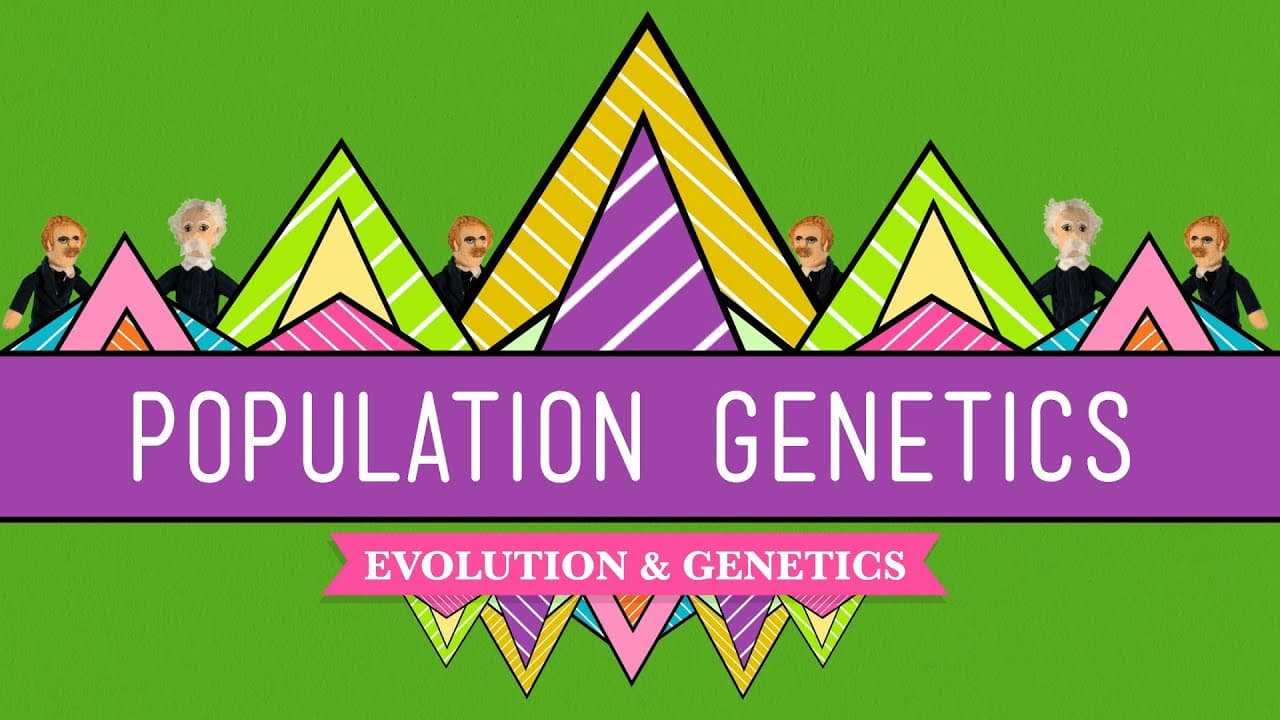
Population Genetics: When Darwin Met Mendel - Crash Course Biology #18
TL;DR
Explores how population genetics combines Darwin and Mendel's ideas.
Transcript
Hey look! It's our friend Gregor Mendel, the supermonk who discovered the basic principles of genetics. Hopefully you remember all of this. Both parents contribute one version of each of their genes called an allele, to their offspring. And some of those alleles are dominant, or always expressed, while others are recessive and only expressed when t... Read More
Key Insights
- Population genetics studies how species' populations change genetically over time, leading to evolution. It combines principles from Mendel's genetics and Darwin's natural selection.
- Allele frequency changes are central to understanding evolution. Factors like natural selection, sexual selection, mutation, genetic drift, and gene flow influence these changes.
- Natural selection favors alleles that enhance survival and reproduction, while sexual selection favors alleles that increase mating success.
- Mutations introduce new alleles into a population. They can be harmful, neutral, or beneficial, with beneficial mutations potentially increasing in frequency over generations.
- Genetic drift causes random changes in allele frequencies, especially in small populations, where chance events can have significant effects.
- Gene flow involves the movement of alleles between populations, often through immigration or emigration, altering allele frequencies.
- The Hardy-Weinberg Principle provides a model for allele frequencies in a non-evolving population, assuming no selection, mutation, genetic drift, or gene flow.
- The Hardy-Weinberg Equation (p^2 + 2pq + q^2 = 1) describes genotype frequencies in a population, helping identify evolutionary influences when deviations occur.
Install to Summarize YouTube Videos and Get Transcripts
Explore YouTube Video Summarizer or Get YouTube Transcript Extractor
Questions & Answers
Q: What is population genetics?
Population genetics is the study of how populations of a species change genetically over time, leading to evolution. It combines principles from Mendel's genetics and Darwin's natural selection, examining factors like allele frequency changes and their causes.
Q: How do natural and sexual selection differ?
Natural selection favors alleles that enhance an organism's survival and reproductive success in its environment. In contrast, sexual selection favors alleles that increase an individual's attractiveness to mates, often focusing on traits that enhance mating success rather than survival.
Q: What role do mutations play in population genetics?
Mutations introduce new alleles into a population's gene pool. While some mutations may be harmful or neutral, beneficial mutations can enhance an organism's fitness, potentially increasing in frequency over generations and contributing to evolutionary changes.
Q: How does genetic drift affect allele frequencies?
Genetic drift causes random changes in allele frequencies, particularly in small populations. These changes occur due to chance events, such as natural disasters, leading to significant shifts in allele distribution that may not necessarily enhance fitness.
Q: What is gene flow and how does it impact populations?
Gene flow involves the movement of alleles between populations, often through immigration or emigration. This mixing of genetic material can alter allele frequencies, introducing new genetic variations and potentially affecting a population's evolutionary trajectory.
Q: What is the Hardy-Weinberg Principle?
The Hardy-Weinberg Principle provides a theoretical model for allele frequencies in a non-evolving population. It assumes no selection, mutation, genetic drift, or gene flow, and requires random mating and large population sizes to maintain constant allele frequencies.
Q: How does the Hardy-Weinberg Equation describe genotype frequencies?
The Hardy-Weinberg Equation (p^2 + 2pq + q^2 = 1) describes expected genotype frequencies in a population. It calculates the frequencies of homozygous dominant, heterozygous, and homozygous recessive genotypes, providing a baseline for identifying evolutionary influences when deviations occur.
Q: Why is the Hardy-Weinberg model significant in population genetics?
The Hardy-Weinberg model is significant because it provides a baseline for understanding how allele frequencies should behave in a non-evolving population. Deviations from this model indicate the presence of evolutionary forces, helping scientists identify factors like selection, mutation, or gene flow at work.
Summary & Key Takeaways
-
Population genetics explores genetic changes in species' populations over time, combining Mendel's and Darwin's ideas. It examines factors like natural selection, sexual selection, mutation, genetic drift, and gene flow that influence allele frequencies.
-
The Hardy-Weinberg Principle provides a theoretical model for non-evolving populations, assuming no selection, mutation, genetic drift, or gene flow. The Hardy-Weinberg Equation describes expected genotype frequencies, aiding in identifying evolutionary influences.
-
Allele frequency changes are crucial for understanding evolution. Natural and sexual selection, mutations, genetic drift, and gene flow are key factors affecting these changes, with the Hardy-Weinberg model offering a baseline for comparison.
Read in Other Languages (beta)
Share This Summary 📚
Summarize YouTube Videos and Get Video Transcripts with 1-Click
Try YouTube Summary with ChatGPT & Claude or YouTube Transcript Generator
Explore More Summaries from CrashCourse 📚





Summarize YouTube Videos and Get Video Transcripts with 1-Click
Try YouTube Summary with ChatGPT & Claude or YouTube Transcript Generator