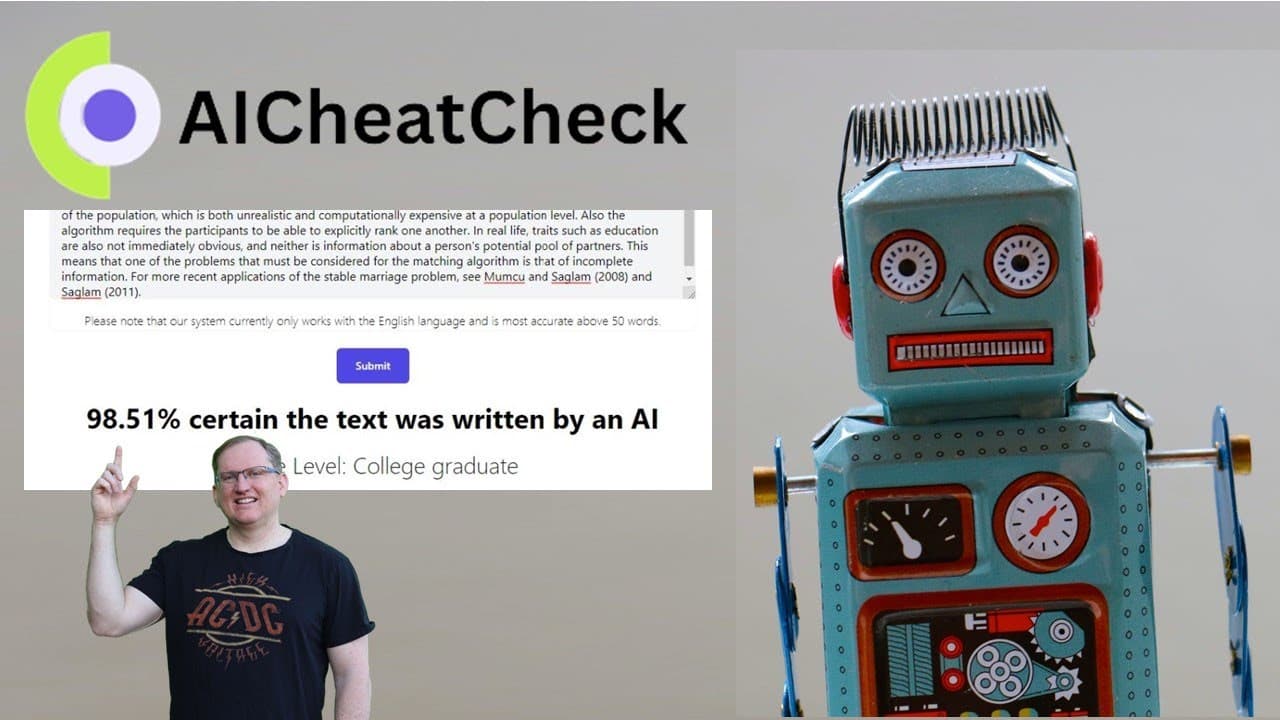
False positives from an AI detection tool - do I write like a robot?
TL;DR
The AI cheat check tool shows promise but has accuracy concerns.
Transcript
hey friends welcome back to the channel today I wanted to look at this tool AI cheat check so AIG check.com and what they claim is that they can detect whether a piece of text has been generated by an AI like chat GPT I've already played with this a reasonable amount and this is actually what triggered me creating this video is that I had a piece o... Read More
Key Insights
- ⚾ The AI cheat check tool analyzes text to identify AI authorship, but its accuracy can vary significantly based on text type.
- 👤 False positives and false negatives present challenges for users, impacting academic integrity and professional outcomes.
- 😥 The precision implied by decimal points in probability ratings can be misleading; users should interpret them critically.
- 😫 Testing with a diverse set of texts is essential to gauge the AI tool's reliability and to understand its limitations.
- ✍️ Different writing styles yield varying detection results, indicating that context is crucial in assessing AI-generated text.
- 🥺 Tools like AI cheat check can have consequences in educational settings if misused or misunderstood, leading to unjust outcomes.
- ⌛ Continuous updates and improvements to detection algorithms may cause fluctuations in results over time, emphasizing the need for ongoing scrutiny.
Install to Summarize YouTube Videos and Get Transcripts
Explore YouTube Video Summarizer or Get YouTube Transcript Extractor
Questions & Answers
Q: What is the primary function of the AI cheat check tool?
The AI cheat check tool is designed to detect whether a piece of text has been generated by an AI, such as ChatGPT. It analyzes submitted texts using algorithms and evidence to evaluate the likelihood of AI authorship. The effectiveness of this tool can vary across different types of writing, leading to both false positives and false negatives.
Q: What are type 1 and type 2 errors, and why are they important in this context?
Type 1 errors refer to false positives, where a human-written text is incorrectly identified as AI-generated. Type 2 errors denote false negatives, where AI-generated text is not recognized as such. Understanding these errors is crucial because the implications can affect students’ academic integrity and individuals’ professional reputations.
Q: How did the presenter assess the performance of the AI cheat check tool?
The presenter systematically tested various texts, including personal writings and excerpts from other authors. They recorded the tool's probability ratings for each text as either human or AI-generated. Over the course of testing, they observed occasional inaccuracies and fluctuations in the results, leading to a discussion of the tool’s reliability.
Q: What concerns did the presenter raise regarding the precision of the probability percentages given by the tool?
The presenter expressed concerns about the precision of the tool, highlighting that presenting results like "98.51%" could create a misleading sense of accuracy. They noted that such precision may not reflect the true capabilities of the algorithm, since factors affecting the analysis could fluctuate every time the same text is tested.
Q: What examples did the presenter use to demonstrate the tool's performance?
The presenter used a range of examples, including their own writing, excerpts from fiction and non-fiction, as well as song lyrics. For instance, they tested a Jack Reacher excerpt with a high confidence rating of being human-written, while an AI-generated story was accurately identified as such, showcasing the tool's mixed results.
Q: What implications could inaccurate AI text detection have in academic and business contexts?
In an academic context, faulty AI text detection could wrongly accuse students of cheating, leading to unjust penalties. In business, if a company’s marketing content is misidentified as AI-generated, it could adversely affect visibility in search engines and overall professional reputation. These inaccuracies can carry significant repercussions.
Q: How does the presenter recommend approaching the use of AI detection tools?
The presenter advises users to extensively test and understand such tools, acknowledging their potential for both accuracy and error. They emphasize the importance of not solely relying on the tool’s results, suggesting that users critically assess the context and writing style alongside the tool's claims to avoid misinterpretations.
Q: Did the presenter find the AI cheat check tool generally reliable?
Overall, the presenter regarded the AI cheat check tool as decent but not infallible. They noted that while it performed well in many instances and provided valuable insights, users should remain cautious and skeptical of results, as inaccuracies can occur. They encouraged a comprehensive approach to utilizing such detection tools.
Summary & Key Takeaways
-
The video explores the effectiveness of the AI cheat check tool, which claims to determine if a text is AI-generated. The presenter tested various texts and found mixed results, including several false positives.
-
The content emphasizes the significance of understanding type 1 and type 2 errors associated with AI detection tools. The consequences of misclassification can affect students and professionals alike.
-
The presenter provides multiple examples of texts they analyzed with the AI tool, highlighting instances of both accurate and inaccurate classifications, stressing the importance of caution when interpreting results.
Read in Other Languages (beta)
Share This Summary 📚
Summarize YouTube Videos and Get Video Transcripts with 1-Click
Try YouTube Summary with ChatGPT & Claude or YouTube Transcript Generator
Explore More Summaries from Dr Lyndon Walker 📚

Summarize YouTube Videos and Get Video Transcripts with 1-Click
Try YouTube Summary with ChatGPT & Claude or YouTube Transcript Generator