Serbian and Macedonian fronts | The 20th century | World history | Khan Academy
TL;DR
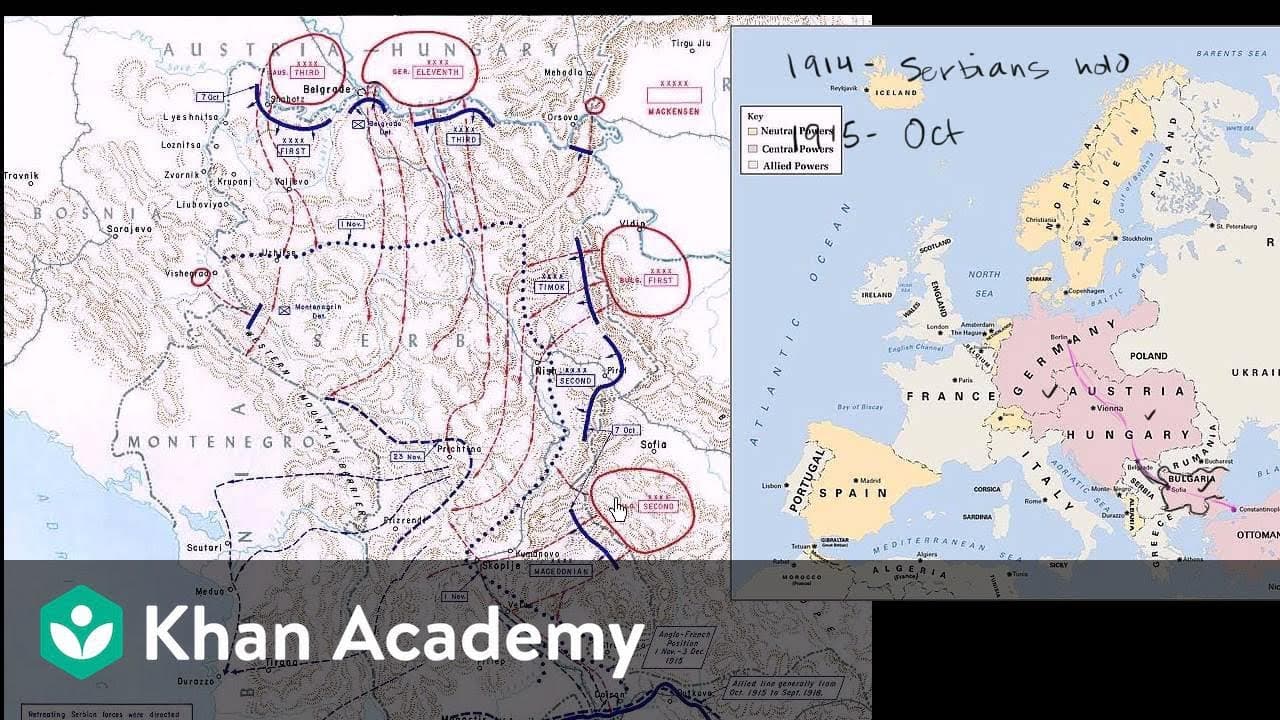
Austria-Hungary's initial attempt to quickly defeat Serbia in 1914 failed, leading to a joint offensive by the Central Powers in 1915 that occupied Serbia. Allied forces arrived in Salonica to support Serbia, leading to a coup and Greece joining the Allies. In 1918, the Allies launched a successful offensive, retaking Serbia and Constantinople.
Transcript
- [Voiceover] As we've already talked about multiple times, World War I broke out in 1914 and the beginning of it was all about Austria-Hungary declaring war on Serbia using the assassination of Archduke Franz Ferdinand as the pretext for declaring war on Serbia. This was in July, July 28, 1914, they declare war on Serbia and if you were a military... Read More
Key Insights
- 😮 Austria-Hungary's failure to quickly defeat Serbia in 1914 was a surprise and marked a victory for the Serbians.
- 🖐️ Bulgaria's decision to join the Central Powers in 1915 played a significant role in the occupation of Serbia.
- 🏛️ The Allies recognized the dire situation of Serbia and started building forces in Salonica to provide support.
- 🥺 A coup in Greece led to a divided country, with Macedonia and supporters of Venizelos coming under Allied control.
- 🤪 Greece officially joined the Allies in 1917 after Constantine I went into exile.
- 🇷🇸 The Allied offensive in 1918 was hugely successful, retaking Serbia and Constantinople.
- ❤️🩹 The success on the Macedonian front was part of the overall end to the Central Powers' ambitions in World War I.
Install to Summarize YouTube Videos and Get Transcripts
Explore YouTube Video Summarizer or Get YouTube Transcript Extractor
Questions & Answers
Q: Why did Austria-Hungary believe they could quickly defeat Serbia?
Austria-Hungary, a much larger and more powerful country than Serbia, had a strong army and significant military capabilities, leading them to underestimate Serbian resistance and believe in a swift victory.
Q: What role did Bulgaria play in the occupation of Serbia?
Bulgaria, eager to regain territory from Serbia, joined the Central Powers in 1915 and participated in a joint offensive that successfully occupied Serbia.
Q: How did the Allies support Serbia in Salonica?
French and British troops landed in Salonica to assist Serbia, but they arrived too late to prevent the joint offensive by the Central Powers. They built forces in Salonica to prepare for a future offensive.
Q: How did Greece's position change during World War I?
Greece initially stayed neutral, with the king leaning towards the Central Powers. However, a coup led by supporters of the Allies and Venizelos in 1916 resulted in Greece coming under Allied influence and officially joining the Allies in 1917.
Summary & Key Takeaways
-
In 1914, Austria-Hungary's attempt to swiftly defeat Serbia failed, surprising military analysts and marking a victory for the Serbians.
-
In 1915, other Central Powers, including Bulgaria, joined forces to conquer Serbia, successfully occupying the country.
-
The Allies recognized Serbia's dire situation and started building forces in Salonica, leading to a coup in Greece and their eventual support for the Allies. In 1918, the Allies launched a successful offensive, retaking Serbia and Constantinople.
Read in Other Languages (beta)
Share This Summary 📚
Summarize YouTube Videos and Get Video Transcripts with 1-Click
Try YouTube Summary with ChatGPT & Claude or YouTube Transcript Generator
Explore More Summaries from Khan Academy 📚






Summarize YouTube Videos and Get Video Transcripts with 1-Click
Try YouTube Summary with ChatGPT & Claude or YouTube Transcript Generator