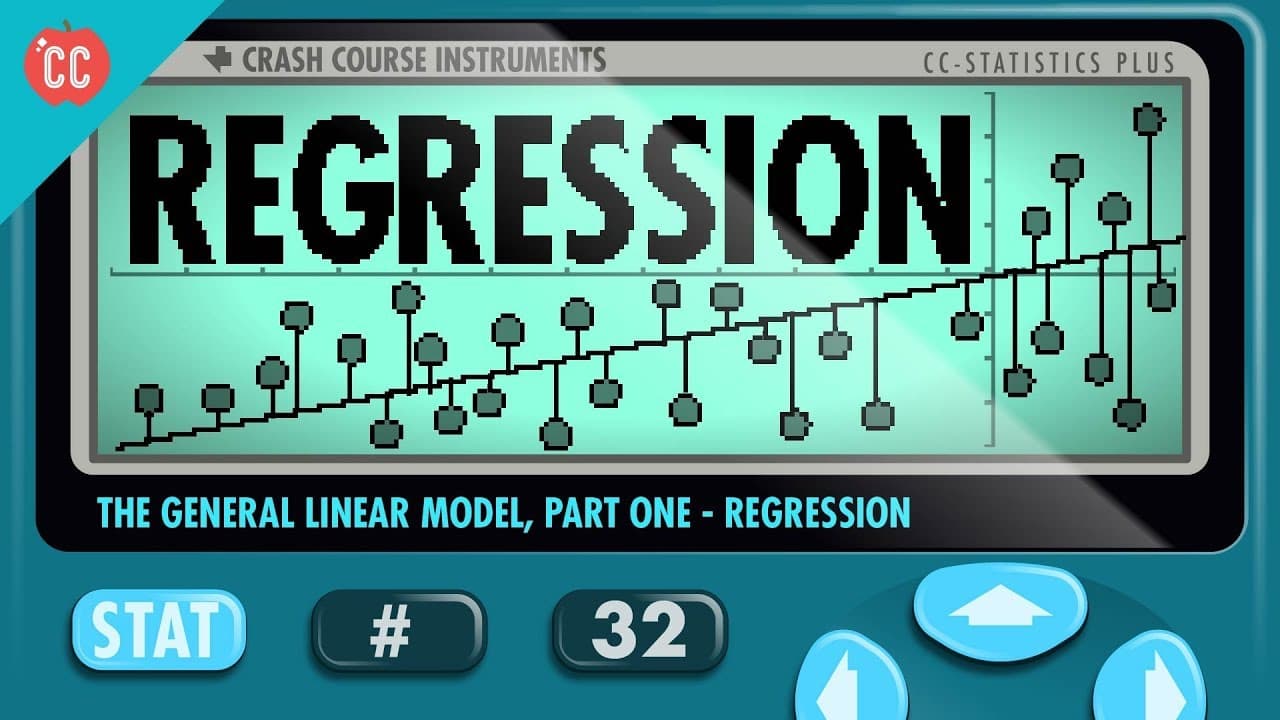
Regression: Crash Course Statistics #32
TL;DR
Introduction to the General Linear Model and its application in regression.
Transcript
Hi, I’m Adriene Hill and welcome back to Crash Course Statistics. There’s something to be said for flexibility. It allows you to adapt to new circumstances. Like a Transformer is a truck, but it can also be an awesome fighting robot. Today we’ll introduce you to one of the most flexible statistical tools--the General Linear Model, or GLM. The GLM w... Read More
Key Insights
- The General Linear Model (GLM) is a versatile statistical tool used to create various models for data analysis, including regression models.
- In a regression model, data is explained by a model and an error term, where the model often takes the form Y = b + mx.
- Errors in predictions are not necessarily wrong but represent deviations from the model, which can arise from unaccounted variables or random variation.
- Linear regression uses continuous variables to make predictions, such as predicting YouTube likes based on comments.
- Outliers in data can significantly affect the regression line, necessitating careful consideration of their impact.
- The F-test is used to test the null hypothesis in regression analysis, determining if there is a relationship between variables.
- The F-statistic compares the variation explained by the model to the unexplained variation, helping assess model significance.
- Regression models are widely used in various fields to understand relationships, though they do not imply causation.
Install to Summarize YouTube Videos and Get Transcripts
Explore YouTube Video Summarizer or Get YouTube Transcript Extractor
Questions & Answers
Q: What is the General Linear Model (GLM)?
The General Linear Model (GLM) is a flexible statistical tool used to create different models for data analysis. It explains data using a model and an error term. GLMs are used in various fields such as science and economics to describe relationships between variables.
Q: How does a regression model work?
A regression model works by explaining data through a model and an error term. The model often takes the form Y = b + mx, where Y is the predicted value, b is the intercept, m is the slope, and x is the input variable. The error term represents deviations from the model.
Q: What role do outliers play in regression analysis?
Outliers can significantly affect the regression line by exerting undue influence, potentially skewing results. It's essential to identify and decide how to handle outliers to ensure accurate regression analysis. Criteria for identifying outliers should be established and consistently applied.
Q: What is the F-test in regression analysis?
The F-test is a statistical test used in regression analysis to test the null hypothesis that there is no relationship between variables. It compares the variation explained by the model to the variation not explained, helping to determine the statistical significance of the model.
Q: How is the F-statistic calculated?
The F-statistic is calculated by dividing the sum of squares for regression (SSR) by its degrees of freedom, and dividing the sum of squares for error (SSE) by its degrees of freedom. It compares these two values to assess the proportion of variation explained by the model.
Q: What assumptions are made in linear regression?
Linear regression assumes a linear relationship between the input and output variables. It also assumes that residuals (errors) are normally distributed, homoscedastic, and independent. If data shows non-linear patterns, other models may be more appropriate.
Q: Why is regression a useful tool?
Regression is a useful tool because it helps understand relationships between variables, allowing predictions and insights into data patterns. It is widely used in fields like science, economics, and politics, though it does not imply causation, only correlation.
Q: What does the intercept in a regression model signify?
The intercept in a regression model signifies the expected value of the output variable when the input variable is zero. While it may not always make practical sense, it is a mathematical component of the regression equation, providing a baseline for predictions.
Summary & Key Takeaways
-
The General Linear Model (GLM) is introduced as a flexible tool for statistical analysis, allowing the creation of various models, including regression models. The episode focuses on using regression to model relationships between variables, such as YouTube likes and comments.
-
Regression models explain data through a model and an error term. Errors represent deviations from the model, not necessarily mistakes. The episode covers the importance of handling outliers and assumptions of linear relationships in regression.
-
The F-test is explained as a method to test the null hypothesis in regression, comparing the model-explained variation to unexplained variation. The episode emphasizes the significance of regression in fields like science and economics, though it doesn't imply causation.
Read in Other Languages (beta)
Share This Summary 📚
Summarize YouTube Videos and Get Video Transcripts with 1-Click
Try YouTube Summary with ChatGPT & Claude or YouTube Transcript Generator
Explore More Summaries from CrashCourse 📚




Summarize YouTube Videos and Get Video Transcripts with 1-Click
Try YouTube Summary with ChatGPT & Claude or YouTube Transcript Generator