Calculating rates from Respiratory Traces
TL;DR
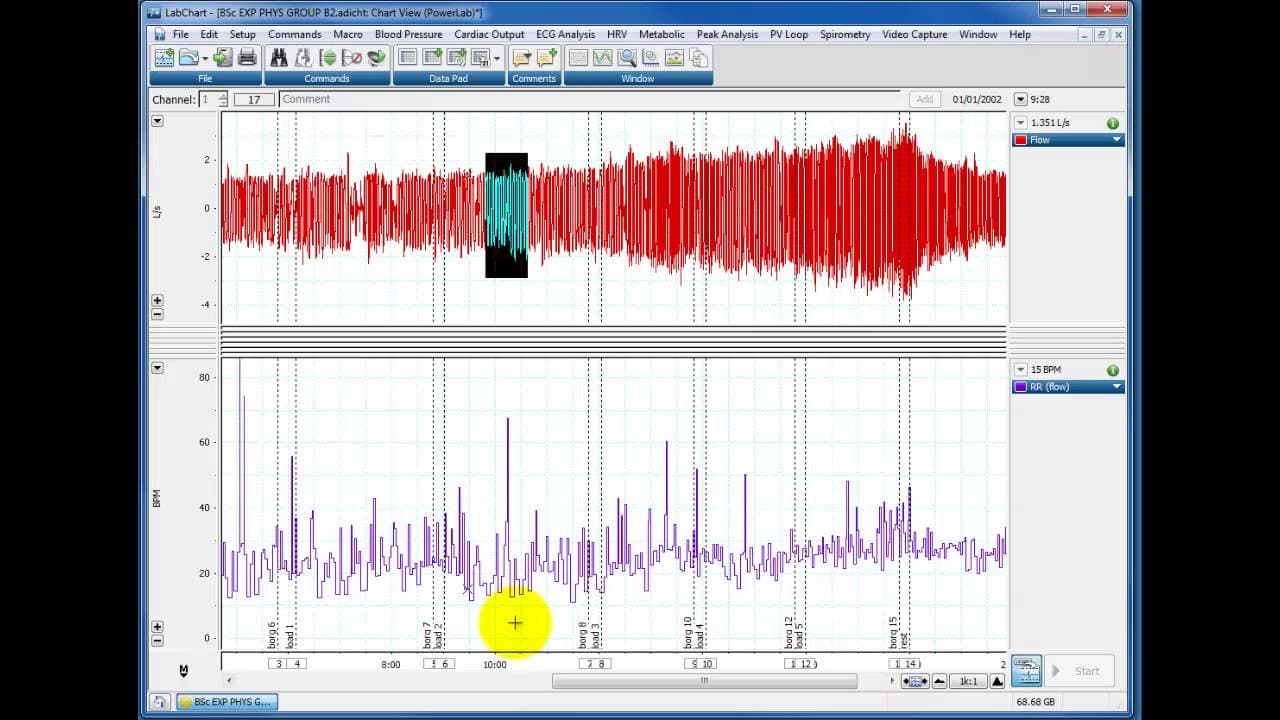
This tutorial demonstrates how to calculate respiratory rates using flow or gas traces, including the process of adding channels, choosing measurement sources, and applying smoothing algorithms.
Transcript
hello this is a very quick tutorial just to look at calculating rates respiratory rates from either a respiratory flow trace or from a CO2 or O2 Trace taken from a um a serx here we have uh the incremental exercise protocol and we've been using for other analyses we've got uh flow volume from the respiratory pod we've got CO2 and O2 from serx uh bl... Read More
Key Insights
- 🫢 Adding channels and selecting the appropriate measurement source allows for the calculation of respiratory rates from flow or gas traces.
- 🙊 Verifying the peak detection and confirming that peaks correspond to actual breaths is important to ensure accurate respiratory rate measurements.
- 📈 Smoothing algorithms and binning can be applied to the data for better visualization and analysis of trends.
- 🫢 Both flow trace and gas trace analyses should provide similar respiratory rate results when derived from the same data.
- ☠️ Using a quick visual examination of the data can help identify trends and expected respiratory rate patterns.
- ☠️ Binning the data into segments can help exclude anomalies and improve the quality of respiratory rate measurements.
- 🍓 The tutorial emphasizes the importance of relying on raw data for detailed analysis and excluding strange anomalies.
Install to Summarize YouTube Videos and Get Transcripts
Explore YouTube Video Summarizer or Get YouTube Transcript Extractor
Questions & Answers
Q: How can respiratory rates be calculated from flow or gas traces?
To calculate respiratory rates, you can add a channel and select the flow or gas trace as the source measurement. The software will then detect peaks and provide the respiratory rates accordingly.
Q: Can flow traces accurately determine respiratory rates?
Yes, flow traces can accurately determine respiratory rates by detecting breath peaks. However, it's important to confirm that the peaks correspond to actual breaths and not double or triple breaths caused by quick intakes of breath.
Q: What is the purpose of smoothing and binning the respiratory rate data?
Smoothing and binning the data are helpful for visualizing trends and identifying changes in respiratory rate over time. Smoothing algorithms, such as averaging, can remove noise and provide a clearer representation of the data. Binning the data into segments allows for better analysis and identification of anomalies.
Q: Do both flow trace and gas trace analyses yield similar respiratory rate results?
Yes, both flow trace and gas trace analyses should yield similar respiratory rate results when taken from the same person at the same time. Comparing the results from different analyses can help ensure accuracy and consistency in respiratory rate measurements.
Summary & Key Takeaways
-
The tutorial explains how to add a channel to measure respiratory rate using flow trace or gas trace data.
-
It demonstrates the process of selecting the appropriate calculation method and verifying if the peaks are accurately detected.
-
The tutorial also discusses the option of smoothing the data and binning it into segments for better visualization and analysis.
Read in Other Languages (beta)
Share This Summary 📚
Summarize YouTube Videos and Get Video Transcripts with 1-Click
Try YouTube Summary with ChatGPT & Claude or YouTube Transcript Generator
Explore More Summaries from Dory Video 📚


Summarize YouTube Videos and Get Video Transcripts with 1-Click
Try YouTube Summary with ChatGPT & Claude or YouTube Transcript Generator