Products
Features
YouTube Video Summarizer
Summarize YouTube videos
Web & PDF Highlighter
Highlight web pages & PDFs
Chat with PDF
Ask any PDF questions with AI
Ask AI Clone
Chat with your highlights & memories
Audio Transcriber
Transcribe audio files to text
Glasp Reader
Read and highlight articles
Kindle Highlight Export
Export your Kindle highlights
Idea Hatch
Hatch ideas from your highlights
Integrations
Obsidian Plugin
Notion Integration
Pocket Integration
Instapaper Integration
Medium Integration
Readwise Integration
Snipd Integration
Hypothesis Integration
Apps & Extensions
Chrome Extension
Safari Extension
Edge Add-ons
Firefox Add-ons
iOS App
Android App
Discover
Discover
Ideas
Discover new ideas and insights
Articles
Curated articles and insights
Books
Book recommendations by great minds
Posts
Essays and notes from readers
Quotes
Inspiring quotes collection
Videos
Curated videos and summaries
Explore Glasp
Glasp Newsletter
Weekly insights and updates
Glasp Talk
Interview series with great minds
Glasp Blog
Latest news and articles
Glasp Use Cases
Learn how others use Glasp
Build & Support
Glasp API
Access Glasp's API for developers
MCP Connector
Connect Glasp to Claude & ChatGPT
Community
Glasp Reddit Community
Students
Student discount and benefits
FAQs
Frequently Asked Questions
AboutPricing
DashboardLog inSign up

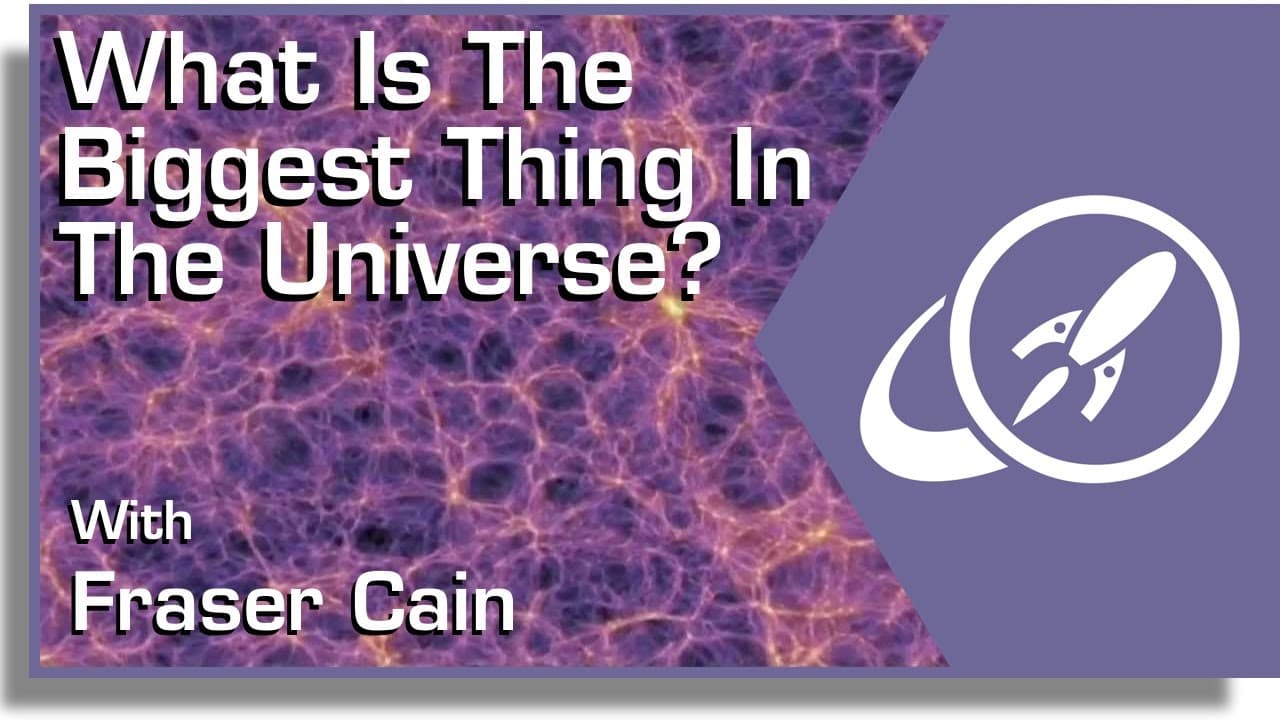
What Is The Biggest Thing In The Universe?
54.5K views
•
January 2, 2015
by
Fraser Cain
YouTube video player
What Is The Biggest Thing In The Universe?

TL;DR

The universe contains enormous objects, from giant stars to superclusters, challenging traditional notions of size.

Transcript

our observable universe is a sphere 96 billion light-years across and the entire universe might be infinite in size which is a hoarders dream walking closet space stuffed full of things it's loaded down with so much stuff that we've even given up naming things individually and now just spew out a list of letters and numbers to try and keep track of... Read More

Key Insights

  • 🤩 Red giant stars can be 2,100 times the size of the Sun, stretching beyond Saturn's orbit.
  • 🖤 Accretion disks around supermassive black holes can rival the size of entire solar systems.
  • 🛩️ The Milky Way galaxy is relatively small compared to larger galaxies in the universe.
  • 🙂 The Virgo Supercluster is part of the Laniakea structure, spanning 110 million light-years.
  • ❓ Dark energy's role in expanding the universe challenges traditional size definitions.
  • 🌥️ Laniakea, the larger structure encompassing the Virgo Supercluster, is named after Polynesian navigators.
  • 💁 Gravity and dark energy dynamics influence the formation of superstructures in the universe.

Install to Summarize YouTube Videos and Get Transcripts

Explore YouTube Video Summarizer or Get YouTube Transcript Extractor

Questions & Answers

Q: What is the biggest physical object in the universe?

The largest physical object is a red giant star, potentially 2,100 times the size of the Sun, expanding well beyond Saturn's orbit.

Q: How do supermassive black holes contribute to the size contest?

Supermassive black holes can host accretion disks larger than our solar system, challenging traditional size definitions with their immense scale.

Q: What is the significance of the Virgo Supercluster in the universe's size contest?

The Virgo Supercluster, part of the larger Laniakea structure, showcases how dwarfed our galaxy is in comparison, emphasizing the vast scale of the universe.

Q: Why is it challenging to define the biggest thing in the universe?

The expansion of the universe by dark energy prevents galaxies from forming into single objects, blurring the lines between individual entities and vast structures.

Summary & Key Takeaways

  • The observable universe is vast, possibly infinite, with objects like red giant stars up to 2,100 times the size of the Sun.

  • Supermassive black holes can host accretion disks larger than our solar system, redefining the concept of size.

  • Galaxies like the Milky Way are dwarfed by the Virgo Supercluster, part of the larger Laniakea structure in space.


Read in Other Languages (beta)

English

Share This Summary 📚

Summarize YouTube Videos and Get Video Transcripts with 1-Click

Download browser extensions on:

Try YouTube Summary with ChatGPT & Claude or YouTube Transcript Generator

Explore More Summaries from Fraser Cain 📚
Why Isn't the Asteroid Belt a Planet? thumbnail
Why Isn't the Asteroid Belt a Planet?
Fraser Cain
Why Did Mars Lose Its Atmosphere? And How Can We Get It Back? thumbnail
Why Did Mars Lose Its Atmosphere? And How Can We Get It Back?
Fraser Cain
What's On The Far Side Of The Moon? thumbnail
What's On The Far Side Of The Moon?
Fraser Cain
Are We Living in a Simulation? Understanding the Simulation Hypothesis thumbnail
Are We Living in a Simulation? Understanding the Simulation Hypothesis
Fraser Cain
Exploring Space Lava Tubes: How To Prepare For It thumbnail
Exploring Space Lava Tubes: How To Prepare For It
Fraser Cain / Universe Today Podcast

Summarize YouTube Videos and Get Video Transcripts with 1-Click

Download browser extensions on:

Try YouTube Summary with ChatGPT & Claude or YouTube Transcript Generator

Apps & Extensions

  • Chrome Extension
  • Safari Extension
  • Edge Add-ons
  • Firefox Add-ons
  • iOS App
  • Android App

Key Features

  • YouTube Video Summarizer
  • Web & PDF Summarizer
  • Web & PDF Highlighter
  • Chat with PDF
  • Ask AI Clone
  • Audio Transcriber
  • Glasp Reader
  • Kindle Highlight Export
  • Idea Hatch

Integrations

  • Obsidian Plugin
  • Notion Integration
  • Pocket Integration
  • Instapaper Integration
  • Medium Integration
  • Readwise Integration
  • Snipd Integration
  • Hypothesis Integration

More Features

  • APIs
  • MCP Connector
  • Blog & Post
  • Embed Links
  • Image Highlight
  • Personality Test
  • Quote Shots

Company

  • About us
  • Blog
  • Community
  • FAQs
  • Job Board
  • Newsletter
  • Pricing
Terms

•

Privacy

•

Guidelines

© 2026 Glasp Inc. All rights reserved.