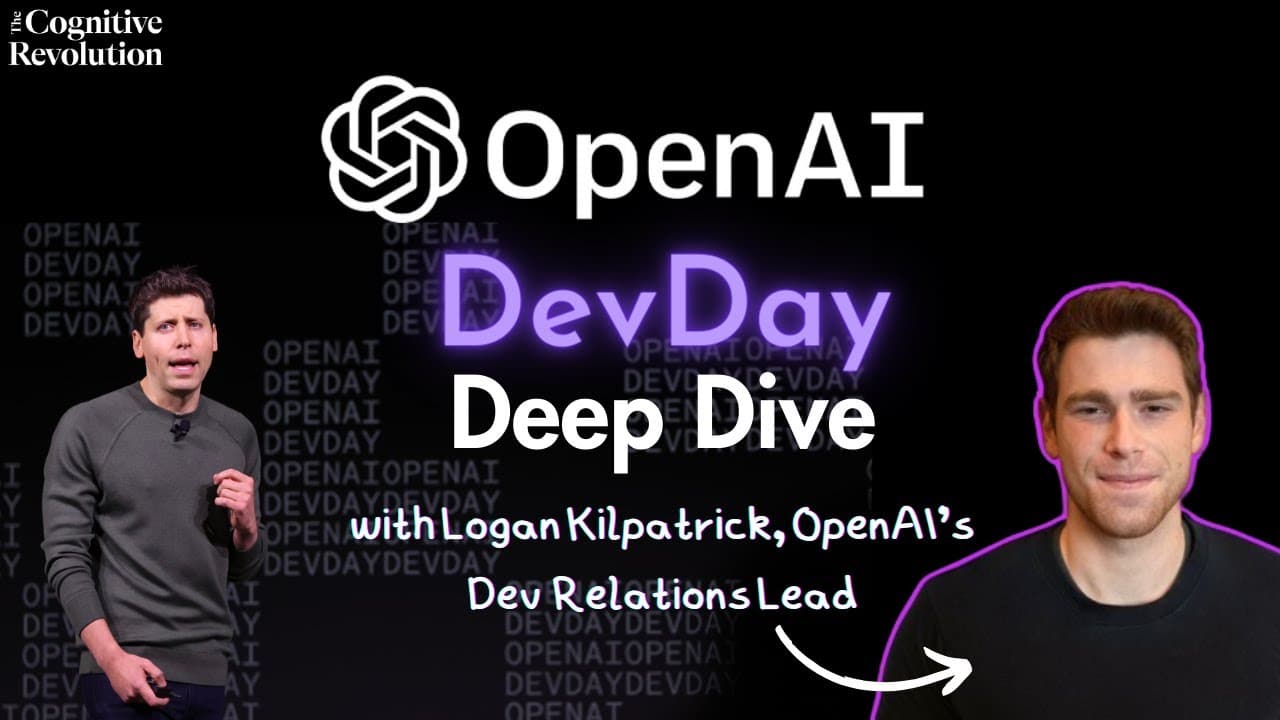
How OpenAI's DevDay is Shaping AI's Future
TL;DR
OpenAI's DevDay showcased the launch of new tools and features aimed at lowering barriers for startups and enhancing AI capabilities. The event emphasized the potential for startups to leverage OpenAI's technologies to build defensible businesses. Key highlights included the introduction of custom models, fine-tuning options, and the GPT Store, all designed to democratize access to advanced AI tools.
Transcript
how many startups do you think you guys uh killed yesterday there's so much opportunity for startups being created and I think like the reality is if your if your startup was like a super super thin wrap around something like you didn't really have a startup you just had some like project that you were working on that was building off of an API and... Read More
Key Insights
- OpenAI's DevDay introduced new tools to lower barriers for startups.
- Custom models priced at $2-3 million aim to help businesses build defensible AI-driven products.
- The GPT Store and expanded GPT capabilities are designed to democratize AI access.
- OpenAI emphasizes iterative releases to help society adapt to AI advancements.
- OpenAI's API does not train on user data, prioritizing user privacy.
- WhisperLarge v3 focuses on improving non-English language transcription.
- Text-to-speech API offers competitive pricing and prioritizes AI safety.
- OpenAI plans to enhance integration of modalities for a seamless user experience.
Install to Summarize YouTube Videos and Get Transcripts
Explore YouTube Video Summarizer or Get YouTube Transcript Extractor
Questions & Answers
Q: How can startups benefit from OpenAI's new tools?
Startups can leverage OpenAI's new tools, such as custom models and the GPT Store, to build innovative and defensible products. These tools lower the barrier to entry for AI development, enabling startups to access advanced AI capabilities and create competitive products in various industries.
Q: What are custom models and how do they help businesses?
Custom models, priced at $2-3 million, allow businesses to build AI-driven products tailored to their specific needs. These models provide a defensible edge by training on proprietary data, enabling businesses to develop unique solutions that competitors cannot easily replicate, thus enhancing their market position.
Q: How does OpenAI ensure user privacy?
OpenAI ensures user privacy by not training its models on data sent through its API. This approach prioritizes user data security and privacy, allowing businesses and developers to use OpenAI's tools without concerns about their proprietary data being used to train AI models.
Q: What improvements does WhisperLarge v3 offer?
WhisperLarge v3 focuses on improving transcription accuracy for non-English languages, making AI tools more accessible globally. This update reflects OpenAI's commitment to enhancing language support and providing high-quality transcription services across diverse linguistic contexts.
Q: What is the significance of the GPT Store?
The GPT Store democratizes access to AI by allowing developers to create and distribute their own GPTs. This platform expansion enables a broader range of applications and encourages innovation by providing developers with the tools to customize and share their AI solutions with a wider audience.
Q: How does OpenAI handle AI safety and red teaming?
OpenAI conducts extensive safety assessments and red teaming to ensure its AI models are safe and reliable. This process involves testing models for vulnerabilities and potential misuse, with a focus on creating systems that are both powerful and secure for users and society at large.
Q: What are the pricing details for OpenAI's text-to-speech API?
OpenAI's text-to-speech API offers competitive pricing at 1.5 to 3 cents per thousand characters, significantly lower than many other providers. This aggressive pricing strategy aims to make high-quality text-to-speech capabilities more accessible to developers and businesses, fostering wider adoption.
Q: What future developments can we expect from OpenAI?
OpenAI plans to continue enhancing its platform with new features and capabilities, focusing on integrating different modalities for a seamless user experience. Future developments will likely build on the current foundation, incorporating user feedback and advancing AI technology to meet evolving needs.
Summary & Key Takeaways
-
OpenAI's DevDay emphasized the potential for startups to leverage new AI tools to build innovative and defensible products. With the introduction of custom models and the GPT Store, OpenAI aims to make advanced AI capabilities more accessible. The event highlighted OpenAI's commitment to user privacy and safe AI development, with iterative releases to help society adapt.
-
The launch of WhisperLarge v3 and text-to-speech API indicates OpenAI's focus on expanding language support and enhancing AI audio capabilities. The event also introduced expanded knowledge and actions for GPTs, allowing for more seamless integration of AI into various applications.
-
OpenAI's DevDay showcased a strategic focus on enabling startups and businesses to build on its platform. By offering custom models and fine-tuning options, OpenAI is pushing the boundaries of AI development while ensuring user privacy and safety remain top priorities.
Read in Other Languages (beta)
Share This Summary 📚
Summarize YouTube Videos and Get Video Transcripts with 1-Click
Try YouTube Summary with ChatGPT & Claude or YouTube Transcript Generator
Explore More Summaries from Cognitive Revolution "How AI Changes Everything" 📚





Summarize YouTube Videos and Get Video Transcripts with 1-Click
Try YouTube Summary with ChatGPT & Claude or YouTube Transcript Generator